
A supermoon happens when the Moon is at its closest point in its orbit to the Earth at the same time as a full Moon, making it appear bigger and brighter than usual.
The distance between the Moon and the Earth varies, because the Earth is not exactly at the centre of the Moon’s orbit and the Moon’s orbit is not a perfect circle (it’s an ellipse).
The moment when the Moon is closest to the Earth is called a lunar perigee. When the Moon is farthest away it is known as a lunar apogee.
If the lunar perigee occurs very close to a full Moon, then we see a supermoon. If a lunar apogee occurs very close to a full Moon, we see the opposite: a micromoon.
The term 'supermoon' originates from a concept in astrology, but now has been popularly adopted.
So, how do we define a supermoon? One strict definition says that if the Moon is within 10% of its closest distance to Earth at the moment of full Moon, it is considered a supermoon.
During a supermoon, the Moon appears up to 14% bigger and 30% brighter compared with when the Moon is farthest away.
When is the next supermoon?
See upcoming supermoon dates below.
| Year | Supermoon date |
| 2026 | Tuesday 24 November |
| 2026 | Thursday 24 December |
| 2027 | Friday 22 January |
| 2027 | Saturday 20 February |

How can I see the supermoon?
As long as there aren't too many clouds, the full Moon will be clearly visible in the sky. This is a good opportunity to use a small telescope or a pair of binoculars to see the Moon's detailed surface, or even try taking a few interesting moon photos.
However, you can see the Moon perfectly well with just your eyes.
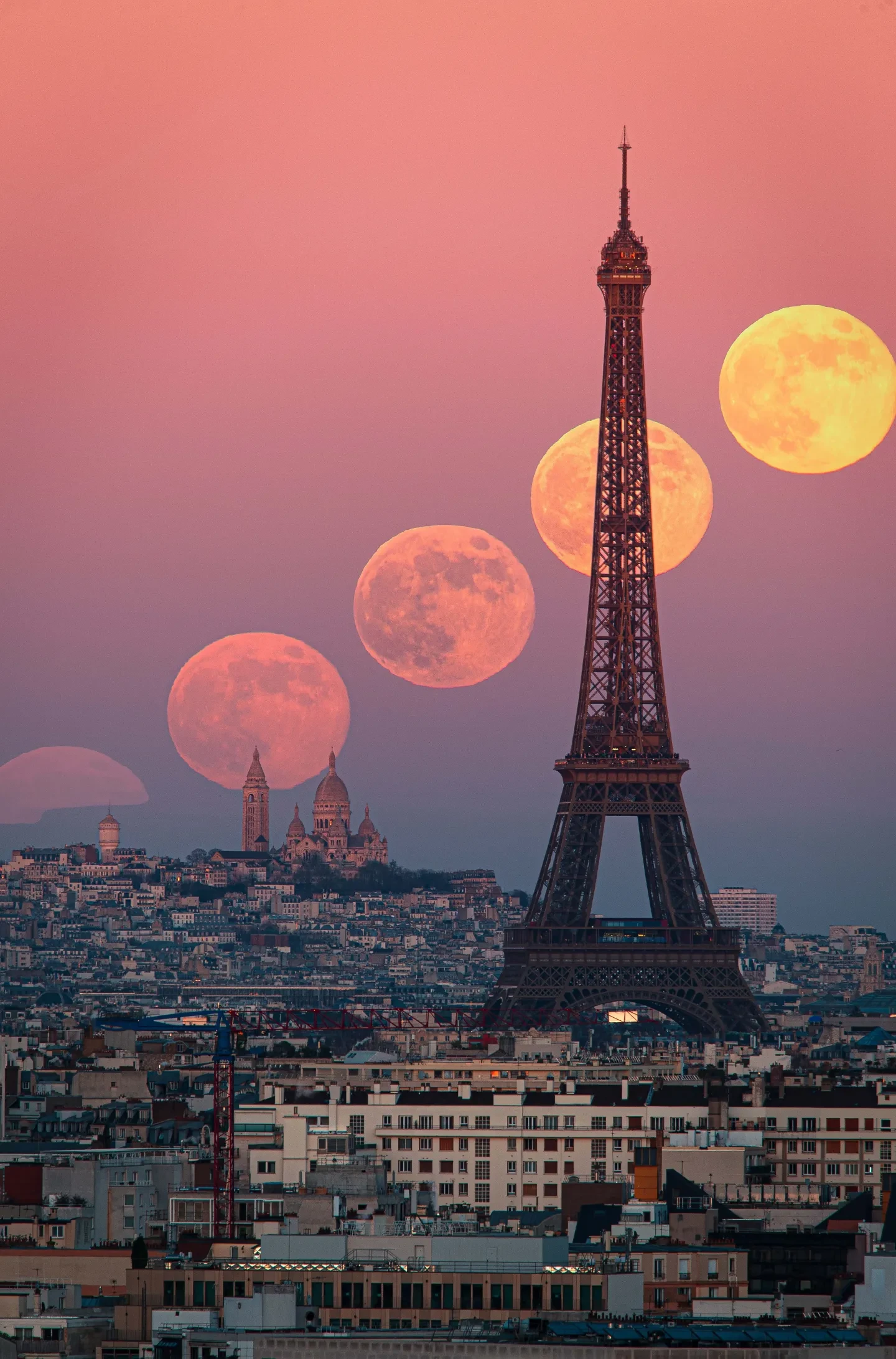
Seeing a supermoon rise just after sunset, or the Moon setting just before sunrise will be an impressive sight, as the Moon will appear enormous compared to the surrounding landscape.
This is due to an optical illusion called the 'Moon illusion'. During moonrise, the Moon looks bigger than it is because our brain doesn’t understand that the sky is a dome. It falsely projects things near the horizon to appear larger than they actually are.
What is a supermoon lunar eclipse?
An eclipse of the Moon occurs when the Earth lies directly between the Sun and the Moon and the Moon lies in the shadow of the Earth. During a total eclipse, the Moon does not disappear entirely but turns a deep, dark red. The Moon is illuminated by light that has passed through the Earth's atmosphere and has been bent back towards the Moon by refraction.
The last time a total lunar eclipse coincided with a supermoon was on 21 January 2019.
Learn more about lunar eclipses
How do supermoons affect tides?
The tides are caused by the gravitational forces of the Sun and the Moon on the Earth’s oceans. When the Moon is closer to the Earth during a supermoon, the gravitational pull is slightly stronger, and so the tides are bigger. However this effect is almost negligible, with only a couple of inches difference between a normal full moon and supermoon tide.
However, full moon and new moon tides can be much bigger than tides at other times in the lunar month, as the Sun adds its own gravitational pull into the mix, producing the so-called spring tides.
Photos of supermoons


Photos of supermoons
1 / 2
Supermoon Rising © Chris Grimmer, shortlisted in Astronomy Photographer of the Year 2018
2 / 2
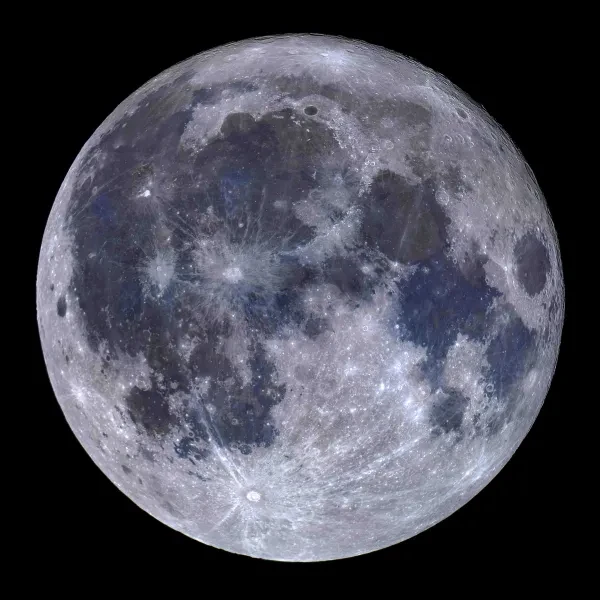
The Last Mineral Supermoon of 2024 © Karthik Easvur, shortlisted in ZWO Astronomy Photographer of the Year 2025
Read more about the Moon


Accessible astronomy guides

Header image: The Moon And the Shard © Mathew Browne