This month we explore Shipyard Spotlight, a short-lived wartime government publication recently discovered in the collections of the Caird Library and Archive. It offers researchers a fascinating glimpse into the changing social attitudes of the time.
Once a year, the Caird Library, like other specialist archives and libraries, close the reading rooms for a 'work week', allowing staff to take on a variety of projects. These tasks can vary: enhancing catalogue records, item maintenance such as re-housing items or physically moving collection items to re-organise their locations.
It can also be a journey of discovery.
Such was the case while I was working in the periodicals collection where I found a slim volume, hiding in plain sight, bound in the same colour as another title, the Glasgow Herald Trade Review. It must have come to our library as a part of the acquisition of the Glasgow Herald Trade Review.
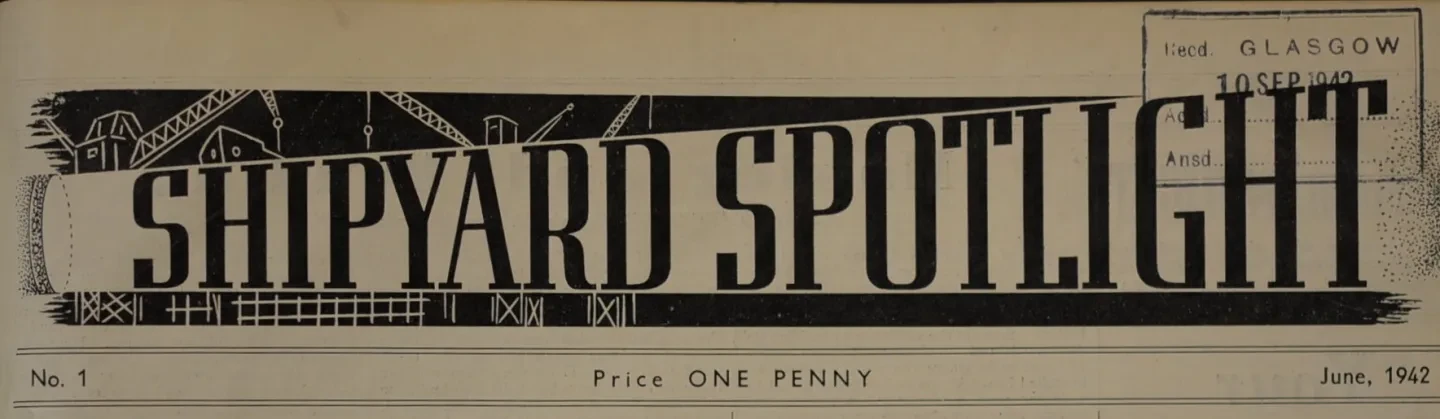
About Shipyard Spotlight
Shipyard Spotlight, published by the Admiralty, was circulated for sale in all shipyards in the UK, during the Second World War. Around 10,000 copies were printed every month in 1942. Interestingly, in the first few issues, it took several swipes at the trade unions before suddenly halting its attacks. It also published rather unsubtle and patronising government propaganda.
A short excerpt from the First Lord of the Admiralty, A.V. Alexander, was published on the front page of the first edition:
Those who build and repair our ships are playing a very big part in our war effort. Every day saved in the construction or repair of naval and merchant ships is of immense value.
The purpose of the publication
The second page of the first edition of Shipyard Spotlight contains the heading ‘Your paper’ with an introduction to the purpose of the publication: ‘there will be nothing more important than getting new ships to sea and repairing the damaged ones … After the war we shall be told what a tremendously important role you have played’.
The early editions encourage letters to the editor: ‘All communications should be sent to…’ Interestingly, after six months of circulation the address and invitation to correspond was removed. One wonders if they were receiving inappropriate types of communication which was deemed unsuitable for the purposes of worker morale.
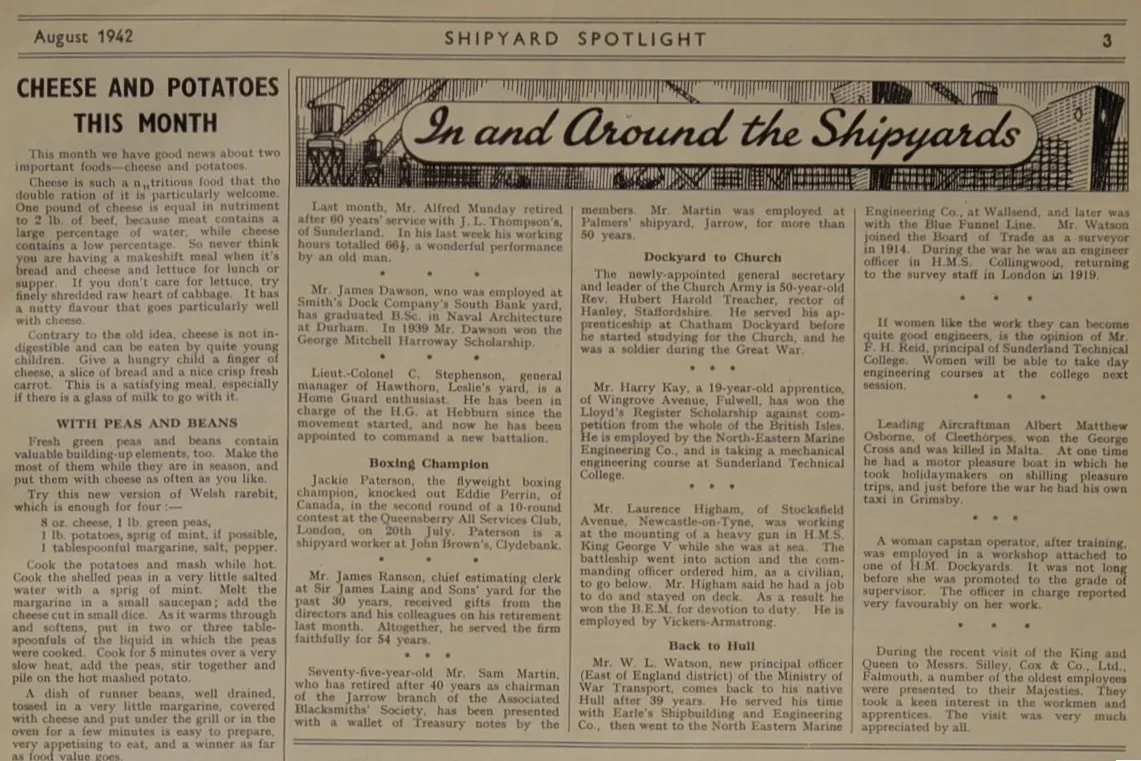
Talk of the yards: women rising through the ranks
The ‘In and around the Yards’ (later renamed ‘Talk of the Yards’) section of the newspaper was an attempt to highlight workers from shipyards around the country. It included those who had reached a notable number of years of employment; new appointments and promotions (a small paragraph noted a woman rising to a supervisor position) and, in the August 1942 issue, this note about women entering the engineering profession:
If women like the work, they can become quite good engineers, is the opinion of Mr F.H. Reid, principal of Sunderland Technical College. Women will be able to take day engineering courses at the college next session.
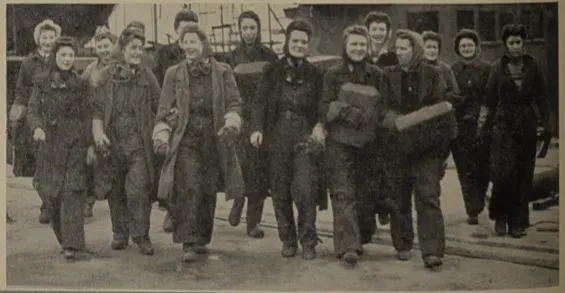
Competition Corner and a changing workforce
Competition Corner was a popular submission which was published monthly. In the April 1943 issue, one was titled ‘Ideas wanted for a competition!’ The competition ideas and the winning entries that were published are a great insight into the thinking of the working men and women of the time.
The winner announced in the May 1943 edition was Miss W. Fitzgerald, with her winning entry: ‘Write down six reasons why you welcome women in the yards.’ To the winning entry was added this response: ‘While, naturally, this is something that mainly concerns the men, there is no reason why women shipbuilders should not compete too.’
The winner’s suggestions included: ‘Women add beauty to an ugly environment’ and ‘Eve is doing a magnificent job along with Adam.’
Speaking of women working in shipbuilding, there is an article in the Australian newspaper, The Daily News, with a photograph of Miss Betty Warren, the British actress, showing her at work in her yard. Miss Warren and her partner purchased the Stebbings shipbuilding firm, and they produced 12 lifeboats, five whalers, 1500 rafts and 2000 masts. After the war, Miss Warren was keen to build her own yacht.
When you don’t work, you work for the enemy
An article in August 1942 titled: ‘Worthless. A factory in Detroit has adopted an unusual method of dealing with absentee employees’ gives another example of wartime propaganda.
The management of the American factory obtained a quantity of worthless German milliard-mark notes and put one of them in the pay envelope of each of the offending workmen with this explanation:
The extra pay enclosed is your reward for failing to report for work one day last week. This money comes from a country that is glad to pay you not to make supplies for our soldiers. When you don’t work, you work for the enemy.
T.N.T. and wartime photography
A persuasive slogan appears in the October 1942 issue: 'T.N.T.’ The Minister of Production, Oliver Lyttelton, coined the phrase to represent the urgency of the work – ‘Today, Not Tomorrow’. It does not have the explosive meaning that it might be interpreted as today.
Overall, Shipyard Spotlight has many photographs of workers, ships (launching and building), notable visitors (some with various employees ‘photobombing’ the photos) and one entire two-page spread in the July 1943 Supplement dedicated to the women workers of the shipyard, titled: 'Women in shipbuilding; some jobs they can do.'
(There are also numerous photographs of women in shipyards throughout issues of this paper).
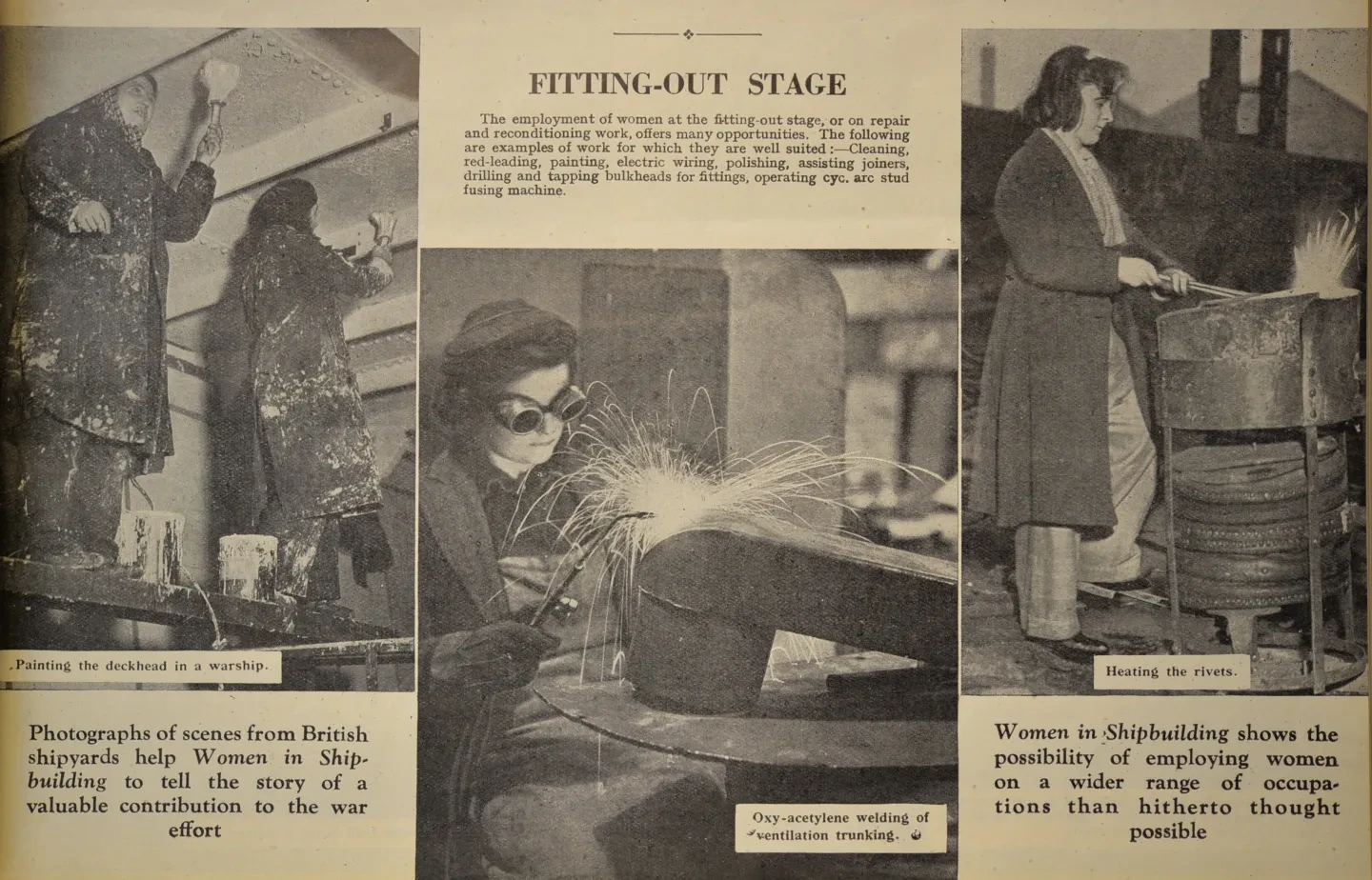
The captions across all Shipyard Spotlight's photos are very general and few actually state where the photo was taken – for example, ‘A conference in the yard’. Was this due to feelings that if they identified the photo’s location, it may be an incentive target for the enemy?
As well, it is noticeable that the articles rarely, almost never, credit an author. The general feeling by the contributors of this article is that the articles were most probably produced by a few junior civil servants.
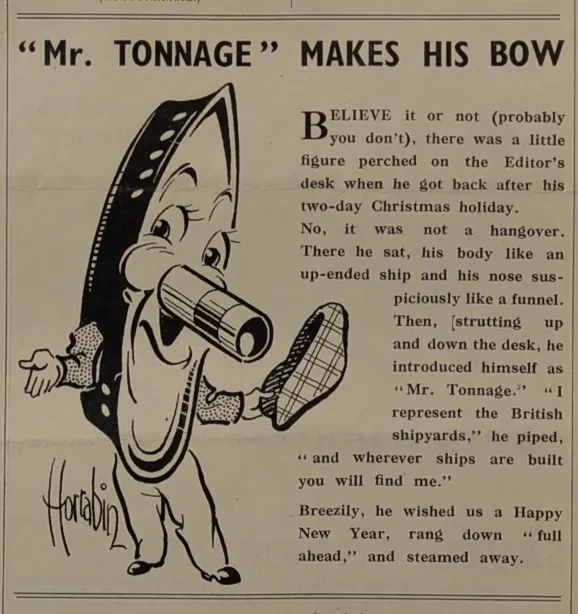
Mr Tonnage: a cartoon mascot
In the January 1943 issue, possibly intended as a mascot, a cartoon was introduced called ‘Mr. Tonnage’. This cheeky chap’s job was essentially to encourage workers to increase production with a jolly opinion and to also mock the enemy and perhaps instil bravado among the workers.
The end of the war and the end of the paper
The May 1945 issue headlined, ‘Supply lines are growing longer’.
The article seems to be encouraging the workers to continue to ‘soldier on', as supplies were needed for the allied troops in Germany and other ships they had built were being sent to the Far East to assist in the fight against the Japanese.
Throughout the newspaper, there were various articles found in the column ‘Mentioned in Despatches’, which made note of vessels and their various actions during the war. They were identified by name of ship and name of the companies that owned them; this shorthand was probably easily known by the men and women who built them.
Another article, ‘For Good Service’, lists names of dockyard workers who were awarded the Imperial Service Medal, along with their occupation and the name of the dockyard where they worked.
A small article – ‘Scrap that becomes souvenirs’ – gives credence to the fact that pieces of the scrapped warships will probably be re-used by ex-Royal Navy personnel to create mementoes such as model ships or furniture. I wonder if any of those creations made their way into museums?
Throughout the war, the ‘troops’ of the shipyards were kept informed, celebrated and encouraged to ‘do their bit’ through this unique publication. In the last issue, the First Lord of the Admiralty, A.V. Alexander repeated the sentiments of the Royal Navy, no doubt which many of the British people shared:
… [we] pay tribute to those who have played their part during the war years in producing the volume of shipping and ship repairs which alone enabled us to keep open the sea lanes to this country.
The effort to produce this newspaper by the Admiralty and the editor C Hope Johnston must have offered the men and women in the shipyards a glimpse of the positive impact that their work was doing for the war effort.
The issues of Shipyard Spotlight in our collection cover the entire run of the publication, from No. 1, June 1942 to No. 43, December 1945. Included are special editions, which are separate from each issue. Most issues consist of four pages and cost one penny per issue.
Resources
Hansard. Oral Answers to Questions, Royal Navy. HC Deb, 9 September 1942, c141.
WordPress. Shipyard Spotlight. Stebbings Archive, 18 June 2011.
Actress runs shipyard. The Daily News, 24 February 1945, page 23.
- Please contact the library team if you are interested in learning more about this unique publication.

National Maritime Museum
Venture to the Caird Library and Archive
Discover the largest maritime library and archive in the world
Delve into more blogs from the Caird Library