The submission deadline has now passed. Please note that we are unable to consider any late proposals.
Date: 11-12 November 2026
Conference venue: National Maritime Museum, Royal Museums Greenwich, London
Conference overview
Royal Museums Greenwich (National Maritime Museum) and the Centre for Port Cities and Maritime Cultures, University of Portsmouth invite proposals for papers, panels and posters for a two-day interdisciplinary conference exploring marginalised histories in maritime contexts from c.1500 to the present day.
Maritime history has long been shaped by narratives centred on political, military, and economic power. Yet the oceans have always been populated and impacted by maritime communities that were historically marginalised, or people whose maritime lives and labour remain overlooked or underrepresented in archives, collections, and scholarship. This interdisciplinary conference aims to bring those histories to the forefront: the workers, makers, families, travellers, navigators, communities, and knowledge-keepers who have lived and worked at the edges of visibility within maritime histories.
We particularly welcome contributions that engage critically with marginality, whether understood through gender, sexuality, race, class, labour (including domestic dimensions of maritime life), geography and environment, Indigenous knowledge systems, and representation within museum collections and practice.
Conference themes
Proposals may address, but are not limited to, the following themes:
1. Labour and working lives
- Dockyard, shipyard and maritime industrial labour, including marginalised or undocumented workers
- Crew diversity; racialised global crews
- Working conditions, pay, discipline, mutiny, and industrial disputes
- Maritime neighbourhoods
2. Gender and sexuality at sea
- Women's maritime labour: ship and shore; formal and informal
- Domestic work; caregiving roles e.g. ayahs and amahs or other domestic servants travelling by sea
- Queer histories and identities; queer methodologies; and LGBTQ+ maritime experiences
- Conceptions of masculinity and femininity among seafarers
3. Indigenous and non‑Western knowledges in maritime contexts
- Indigenous and non-Western cartography and navigation
- Cultural encounters in early modern and colonial settings
- Object histories which reveal cross‑cultural exchange
4. Everyday and domestic maritime worlds
- Craft, making, textile production, and material culture
- Food, victualling, hunger, alcohol, celebration, cultural food practices
- Hobbies, crafts, storytelling, and shipboard culture including music and maritime folklore
- The methodological challenge of representing the ‘mundane’ and domestic as critical historical practice
5. Health, sickness and the body
- Injury, disease, medical practice, remedies, and shipboard healthcare
- Living and environmental conditions, shaping bodily experience (including experience of war at sea)
6. Oceans and environments
- Relationships between marginalised or vulnerable communities and oceanic environments (from storms, flooding, shipwrecks to wildlife and environment)
- Environmental change, ecological knowledge, and ocean exploitation (e.g. whaling, fishing) and pollution
7. Museums and research: practice, methodologies and interpretation
- Curating in the margins: effective methodologies for recovering marginalised or hidden voices, including collecting and curating objects, manuscripts and oral histories
- Researching in the margins: methodologies such as reading against the grain or recording intangible heritage and lived environmental experience
- Decolonial and inclusive approaches to maritime collections and histories, including decolonial cartographic approaches
- Working effectively with communities including both contemporary marginalised maritime communities, or descent communities of underrepresented groups within maritime histories.
- Use of practice‑based research to foreground inclusive maritime histories.
- NB. We encourage illustrative case studies from museums.
Image
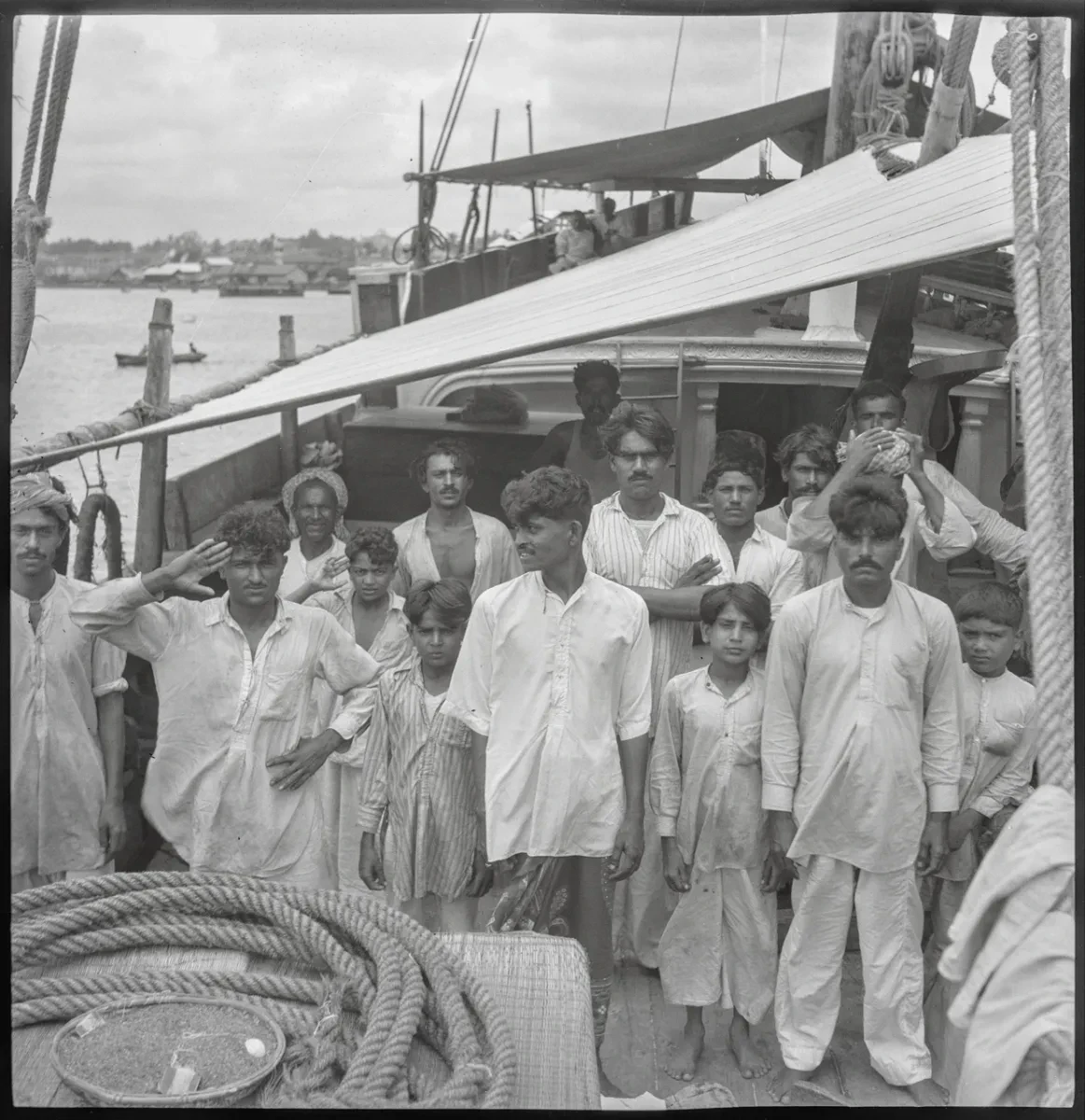
The captain and crew on board the Indian kotia type dhow Karimi (fl.1938) anchored at Colombo, Ceylon (by David Watkin Waters) P34317
How to submit a proposal
We invite submissions in the following categories:
1. Individual Papers
20‑minute presentations followed by questions.
2. Panel Proposals
Panels of 3-4 speakers (each 15-20 minutes) with a unifying theme. Panels that combine academic, museum and community voices are especially encouraged.
3. Posters
Open to all researchers, including MA students, PhD candidates, ECRs, community-based researchers and practice‑based creatives. A prize will be awarded for the best poster.
Practice-based or creative presentations
Please note that individual papers/presentations can also take practice-based, artistic and/or creative forms, rather than only speaking about practice as methodology.
Format
Please note that this is an in-person (not hybrid) conference.
Eligibility
This conference is open to all, regardless of institutional affiliation, discipline, or career stage. We particularly encourage submissions from researchers from the communities represented in the themes.
Limited financial support for speakers may be available; details will be provided upon acceptance.
Submission Guidelines
Please submit your proposal to research@rmg.co.uk marked 'Maritime Margins Conference proposal' including:
1. For individual papers:
- Title
- 250‑word abstract
- 100‑word bio
2. For panel proposals:
- Panel title and 200‑word summary
- Paper titles and 150‑word abstracts for each contributor and 100-word bio
- Name and contact details for the panel organiser
3. For poster contributions:
- 200‑word description of the project
- 100‑word bio
Deadline for submissions: 09.00 (GMT/UTC+1) on Monday 15 June
Our Partner