PRESS RELEASE
Manuscripts relating to the brothers of Jane Austen on display for the first time to commemorate the 250th anniversary of her birth
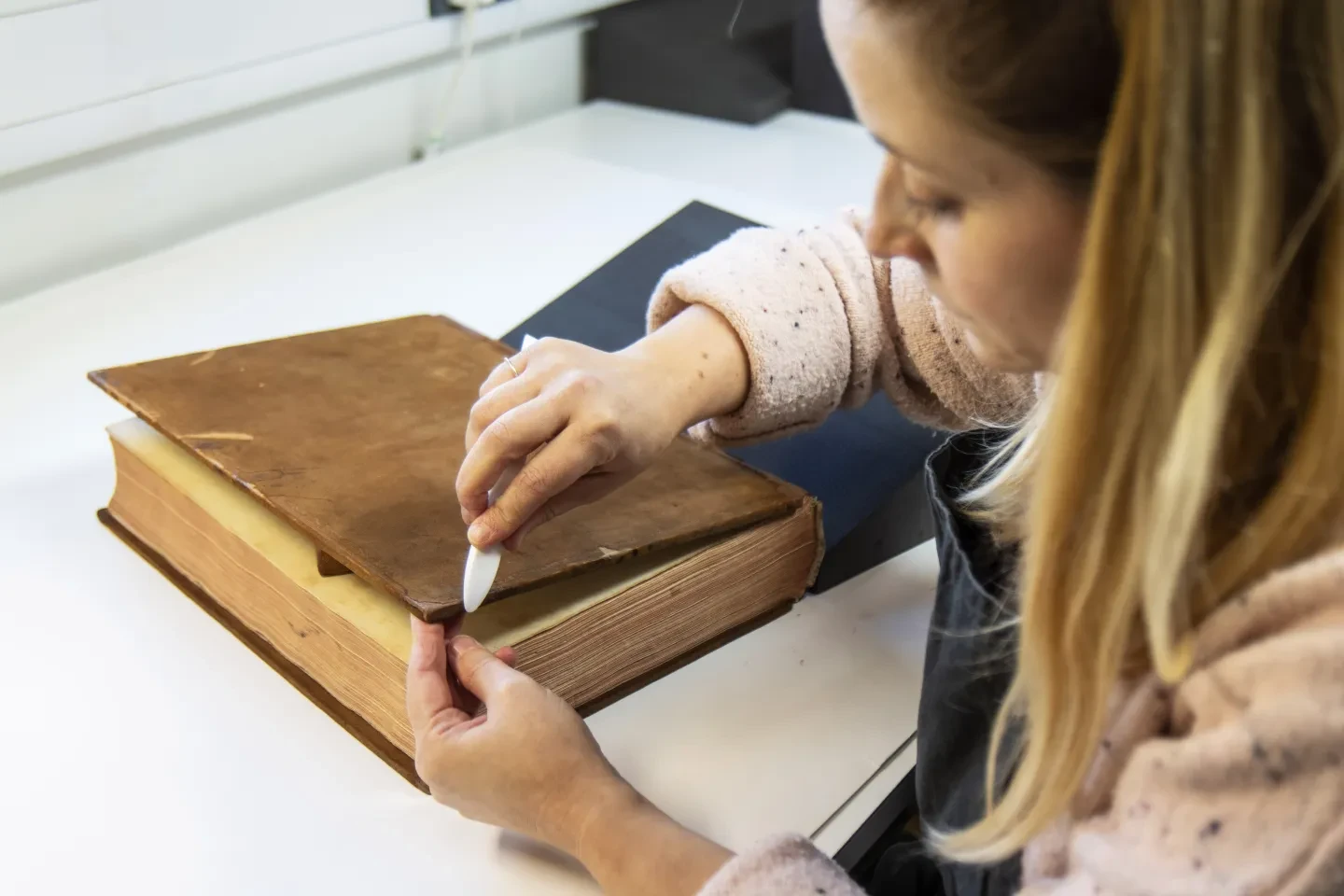
Conservation work on Francis Austen’s Royal Naval Academy mathematics coursebook.
© National Maritime Museum, Greenwich, London. | Download images and caption sheet here : https://we.tl/t-UxyxvuACmX
The National Maritime Museum (NMM) has opened a display to mark the 250th anniversary of Jane Austen’s birth on 16th December. Including manuscripts relating to her youngest brothers Francis and Charles Austen, the display examines Jane’s connections to the Royal Navy and the influence her brothers had in her works.
The influence of her naval brothers’ careers and connections enriches Jane Austen’s writing, most evidently in Mansfield Park and Persuasion. Jane Austen died first of her siblings and none of her notebooks or diaries have survived while most of her letters were destroyed. However, in the NMM’s Caird Library there are manuscripts relating to Francis and Charles, who both served in the Royal Navy before and after Jane’s death in 1817.
By studying these documents, Curator of Manuscripts, Martin Salmon, has drawn links between the real lives of these men and the plots of their sister’s novels. He said, ‘The two youngest Austen brothers both knew success, promotion and prize money but they both also endured long periods ashore struggling on half-pay to support their families in a profession with an uncertain future as the Navy wound down in peacetime. In doing so, both brothers served as constant reminders to their literary-minded sister of the precarious economic state that a naval career could be for any family it supported. What is certain is the naval characters that fill the pages of Jane Austen’s writing would not have emerged so clearly or captured the tone of the times with such subtlety without her sibling role models to call upon.’
Francis Austen, known to his family as Frank, was born in 1774, a year before Jane. He first entered the Royal Naval Academy at Portsmouth at the age of 12. Francis’s mathematic coursebook from this time is included in the display. After graduating he quickly rose through the ranks from lieutenant to commander and was captain of HMS Canopus during the Napoleonic Wars.
Another manuscript on display shows how Francis was favoured by Vice-Admiral Nelson, an order of battle instructing his ship to be the first in line at the Battle of Trafalgar. Ultimately, he was sent to Gibraltar for supplies and missed the battle and Nelson’s death.
The following year Francis played a leading role in the Battle of San Domingo, which Jane took inspiration from in Persuasion; Captain Wentworth achieved command ‘in consequence of the action off St Domingo’. Years after this, Jane, her sister Cassandra and their mother all went to live with Francis for a few years before their permanent move to Chawton. Francis’s naval career carried on beyond Jane’s death and he was ultimately made Admiral of the Fleet in 1863 before his death two years later.
Charles Austen was born in 1779 and followed his brother into the Naval Academy also at the age of 12. In 1800, Charles was a lieutenant on board the Endymion when it captured the French ship Le Scipio. He used the prize money from this to buy his sisters Jane and Cassandra each a gold cross pendant set with a topaz. Jane took inspiration from this for Mansfield Park as William, beloved brother of Fanny, gives her ’a very pretty amber cross’ when he returns to her after being away at sea. Featured in the new display is the lieutenant’s logbook from the Endymion recounting the capture of Le Scipio.
Charles was later captain of the Phoenix when it was wrecked at sea, leading to a long period in which he was unable to find another command, causing him to have to survive on half pay. This is the inciting incident in Mansfield Park as Fanny is sent to live with her cousins due to her family struggling to survive with the half-pay her naval father is on due to his disability.
Later in life Charles was made Commander-in-Chief of the East Indies and China Station, where he died on duty. Two of his sons followed him into the Royal Navy.
The Caird Library also holds other manuscripts belonging to both brothers, including Francis’s logbooks, letter books, general remarks and notes, one of which reveals his personal observations on slavery as ‘much to be regretted’, having witnessed it first-hand while in the Navy. Jane is thought to have had similar attitudes towards slavery, particularly evidenced in Mansfield Park, when Fanny’s question about the Bertram’s plantation is met with ‘such a dead silence’. It is widely believed that Jane named the Bertrams’ estate ‘Mansfield Park’ as a nod to Lord Mansfield, a judge who made several rulings against slave-traders. Francis’s remarks – and much more – can be accessed for free by the public by becoming a registered reader of the Caird Library.
Information for visitors:
Venue: Caird Library, National Maritime Museum, Greenwich
Date: Daily until March 2026 (Excluding 24 – 26 December)
Time: 10.00 – 17.00
Admission: Free
Visitor enquiries: 020 8858 4422
Twitter: @RMGreenwich
Instagram: @royalmuseumsgreenwich
Facebook: @royalmuseumsgreenwich
Notes to Editors
- The National Maritime Museum holds the world’s largest maritime collection telling stories of Britain’s relationship with the sea.
- The Caird Library is located in the Sammy Ofer Wing of the National Maritime Museum and is the world’s largest maritime library and archive collection. The contents of the library cover a range of subjects including maritime and global history, navigation, astronomy and more. The library is free to access. Readers need to register in advance at archiveandlibrary.rmg.co.uk/aeon
- The National Maritime Museum is part of Royal Museums Greenwich which also incorporates the 17th-century Queen’s House, Royal Observatory Greenwich and the famous clipper ship Cutty Sark. This unique collection of museums and heritage buildings form a key part of the Maritime Greenwich UNESCO World Heritage Site and is also a major centre of education and research. The mission of Royal Museums Greenwich is to enrich people’s understanding of the sea, the exploration of space, and Britain's role in world history. For more information, visit www.rmg.co.uk
-ends-
For further information or to request press images, please contact:
Royal Museums Greenwich Press Office
press@rmg.co.uk | 020 8312 6790