

With the arrival of No 1042, the Beagle pocket chronometer, into the Royal Museums Greenwich collection, we're taking a look at some of the other significant timekeepers in the Museum's care.
Chronometers were effectively portable pieces of Greenwich: they carried a reference to precise time across oceans, allowing sailors to turn time into longitude.
Our collection holds more than 200 marine chronometers: here’s a selection of eight that have followed explorers, surveyors, scientists and even royalty across two centuries of maritime exploration.
Image
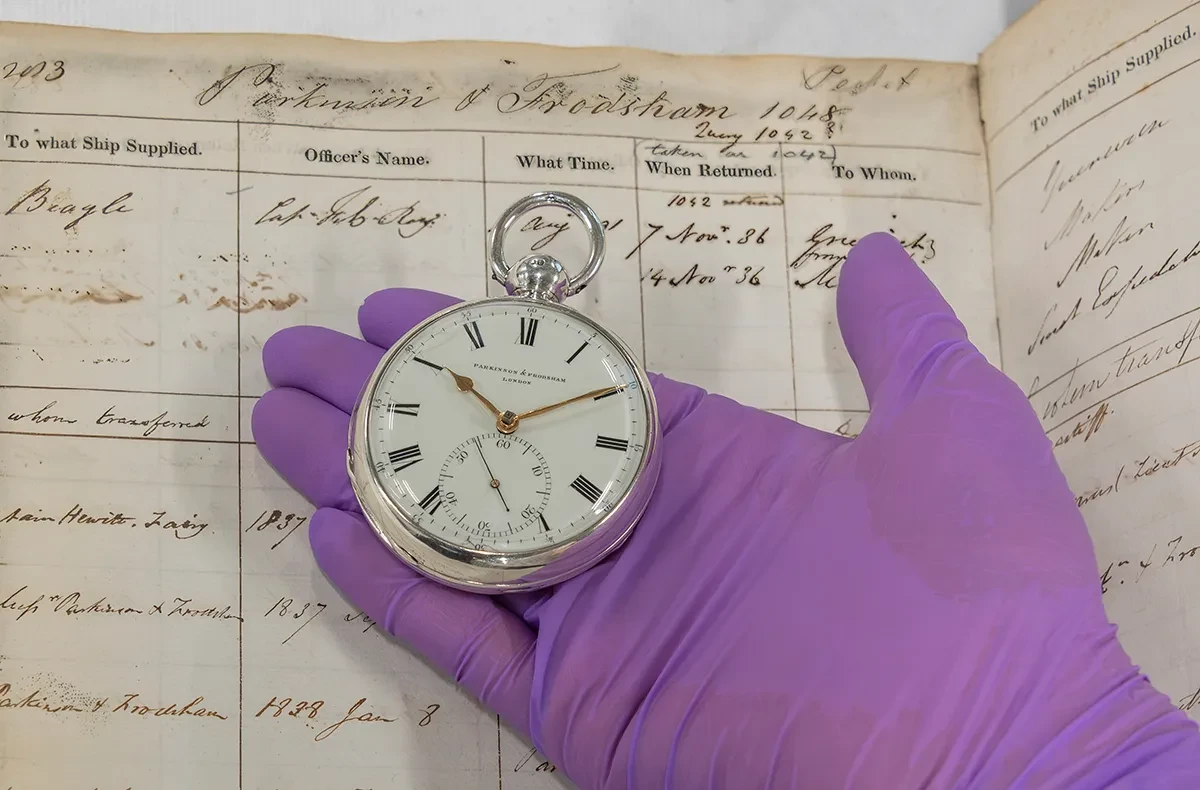
1. No 1042 – the surviving Beagle timekeeper
One of two surviving pocket chronometers from the second Beagle voyage (22 were carried on board), No 1042 was selected by Captain Robert FitzRoy as an observation chronometer. He referred to it affectionately as the 'journeyman watch'. While most of the chronometers remained in the captain's cabin, FitzRoy took this pocket watch on shore to measure the celestial observations essential to his timekeeping measurements.
FitzRoy described it as 'a very good pocket chronometer, carried by hand, in a box, [...] always used for taking time' on shore.
Image
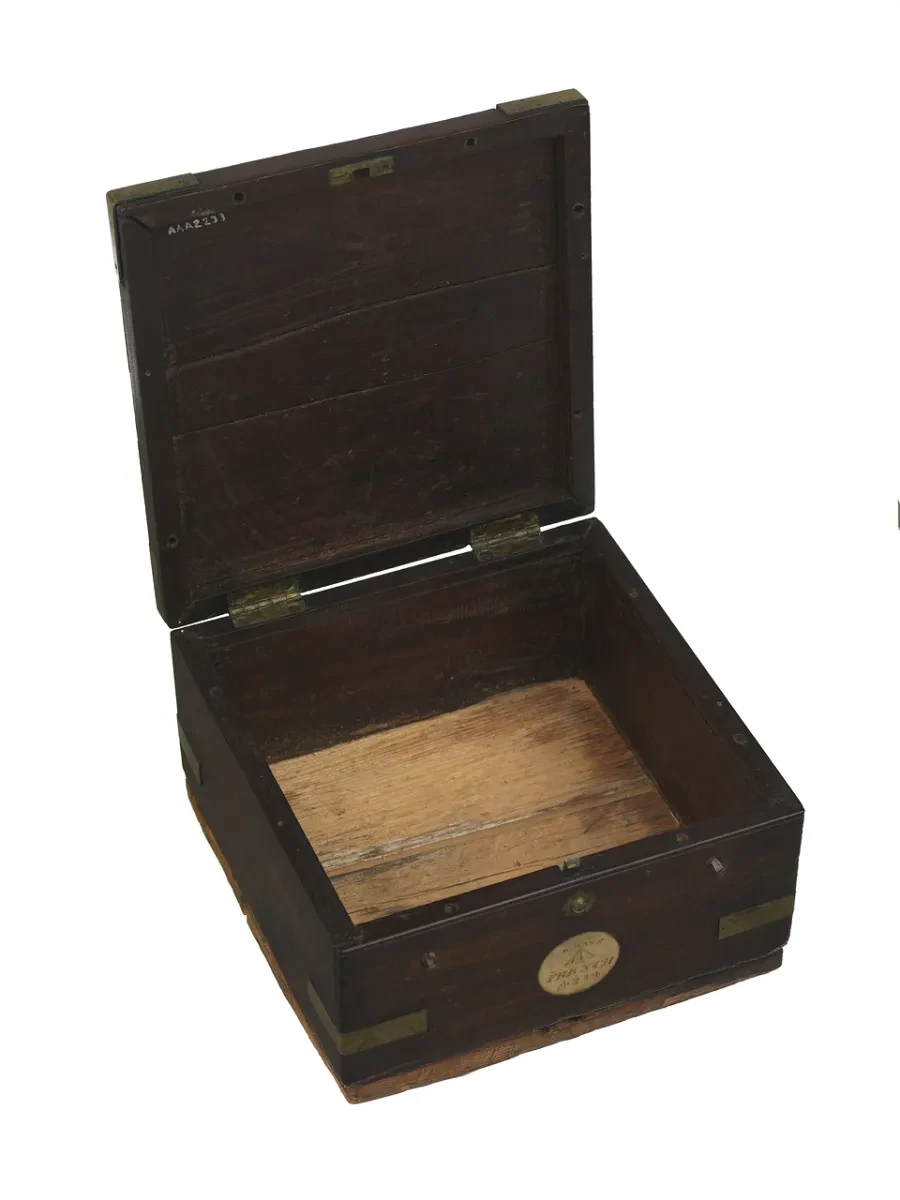
2. French 4214 – one instrument, two legendary expeditions
French 4214, one of curator Emily Akkerman's favourite chronometers, would be a fascinating companion to our new Beagle chronometer... had it not been lost to the Arctic.
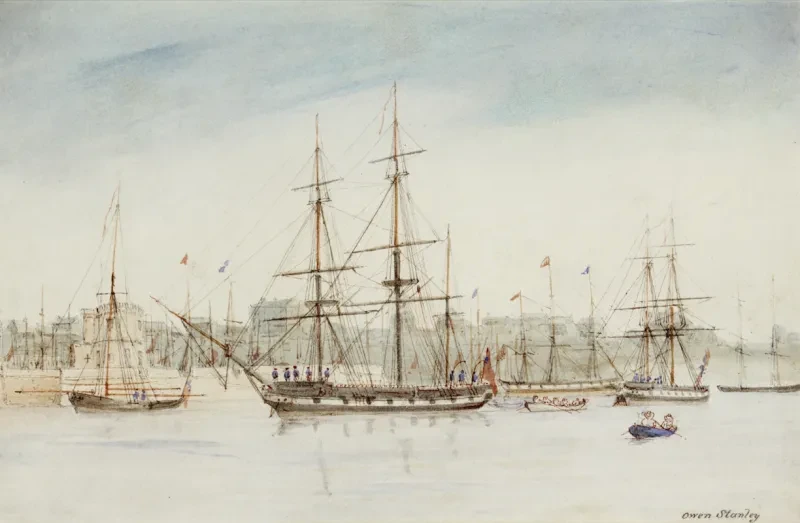
Made by James Moore French in 1828, French 4214 was bought by the Admiralty and first went on Henry Foster's scientific expedition on board HMS Chanticleer. In 1831 it was issued to HMS Beagle on FitzRoy's second voyage, travelling about 65,000km (40,000 miles) and helping establish meridian distances during the voyage that carried Charles Darwin around South America and the Galápagos Islands.
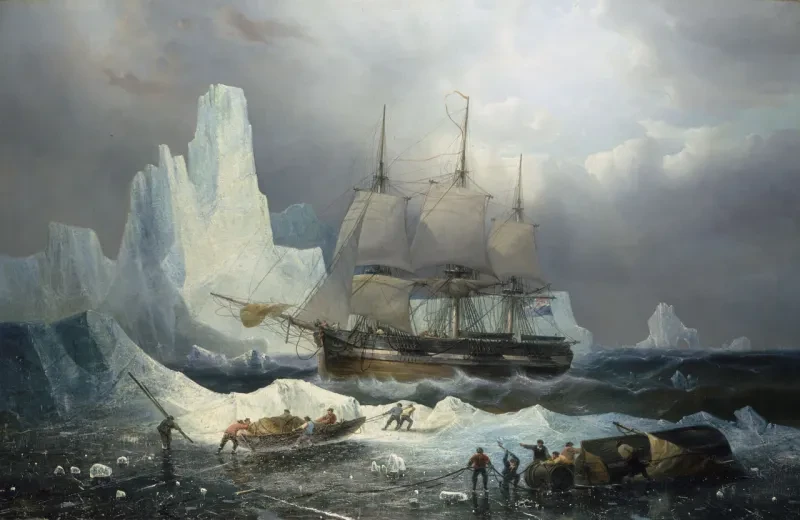
In 1845, it was issued to HMS Erebus for Franklin's doomed Arctic expedition. The chronometer itself was lost, but its box was later recovered from the Arctic. French 4214 shows how precarious the survival of these instruments can be; and reminds us how lucky we are that No 1042 has been acquired for the nation.
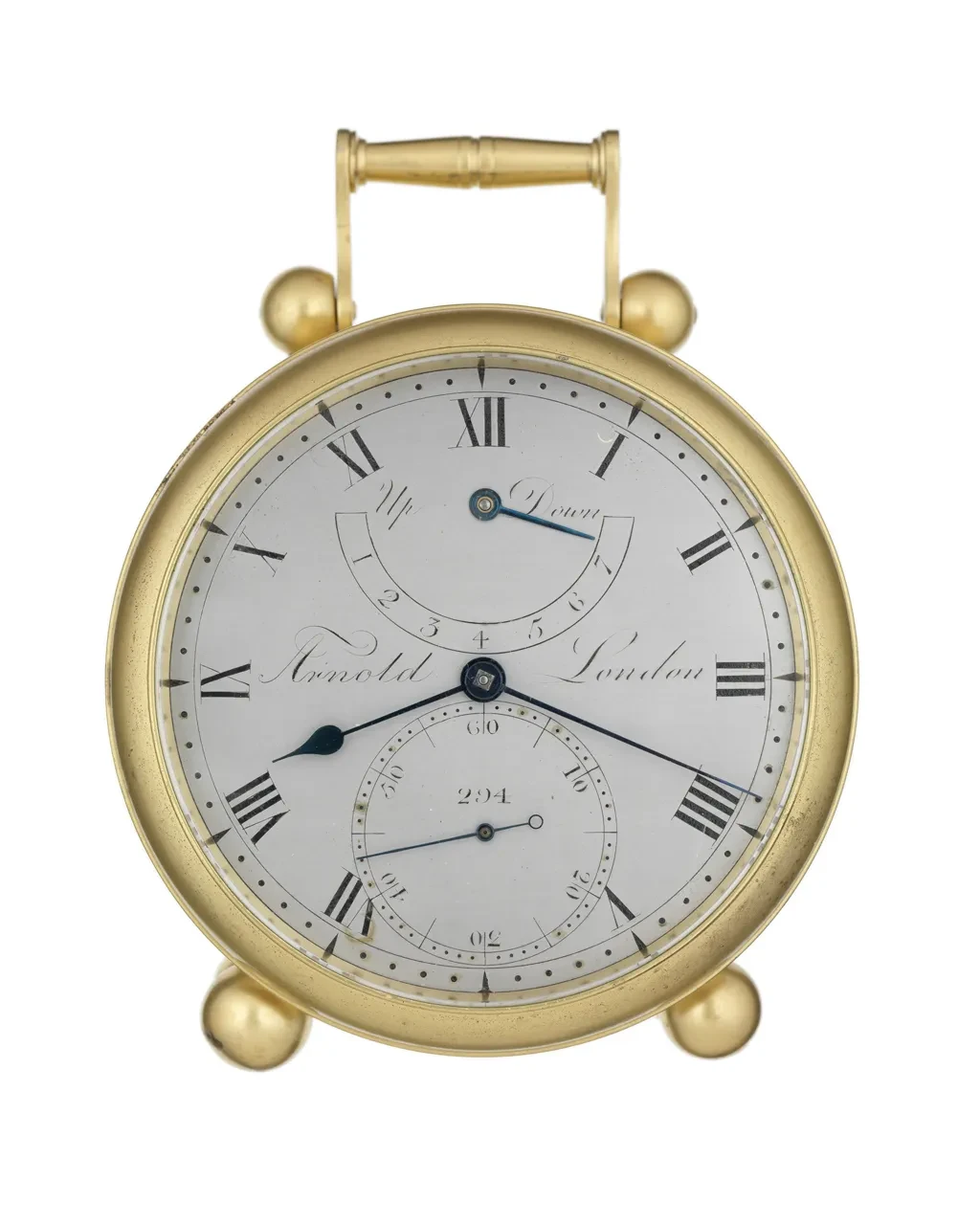
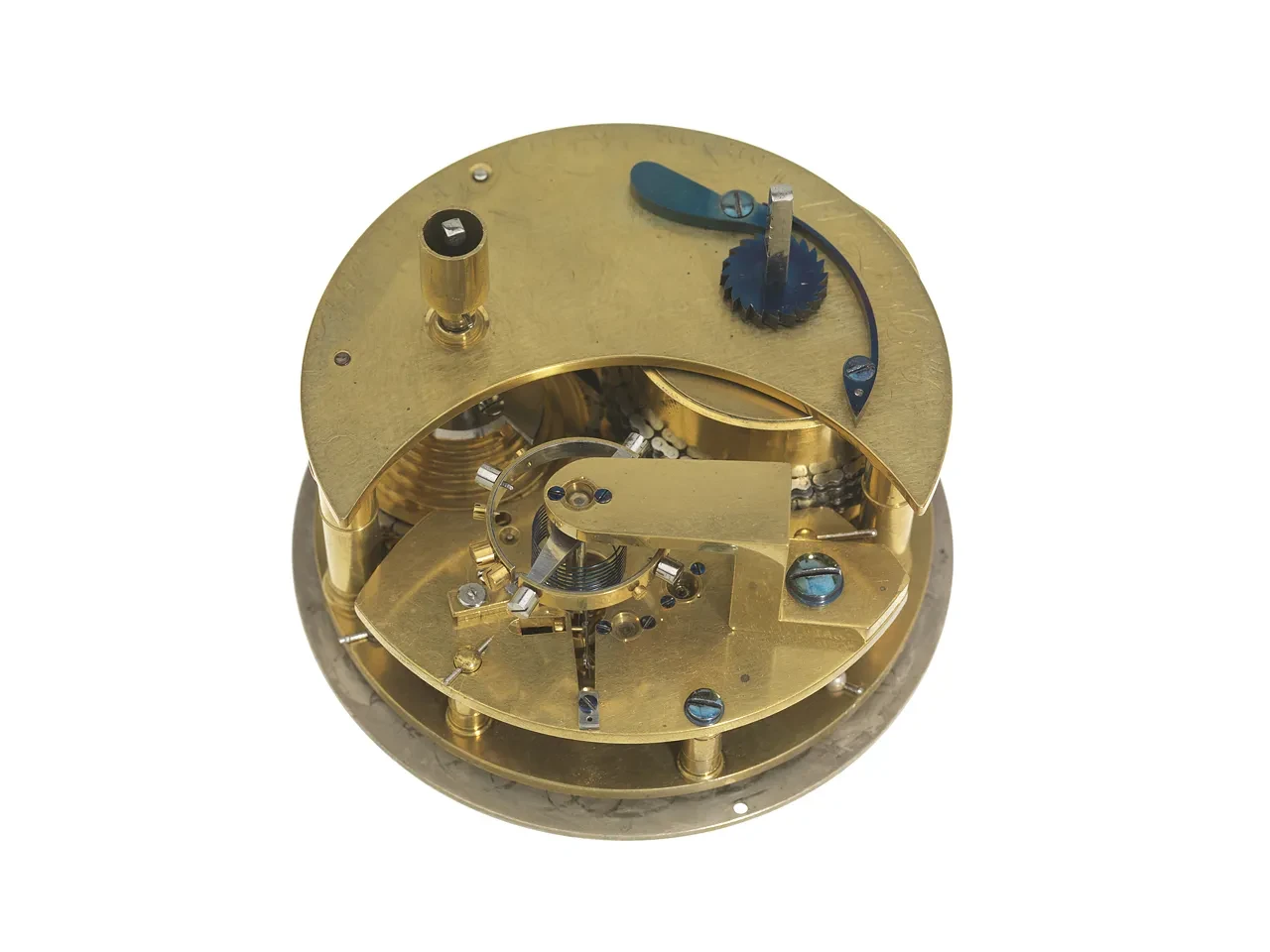
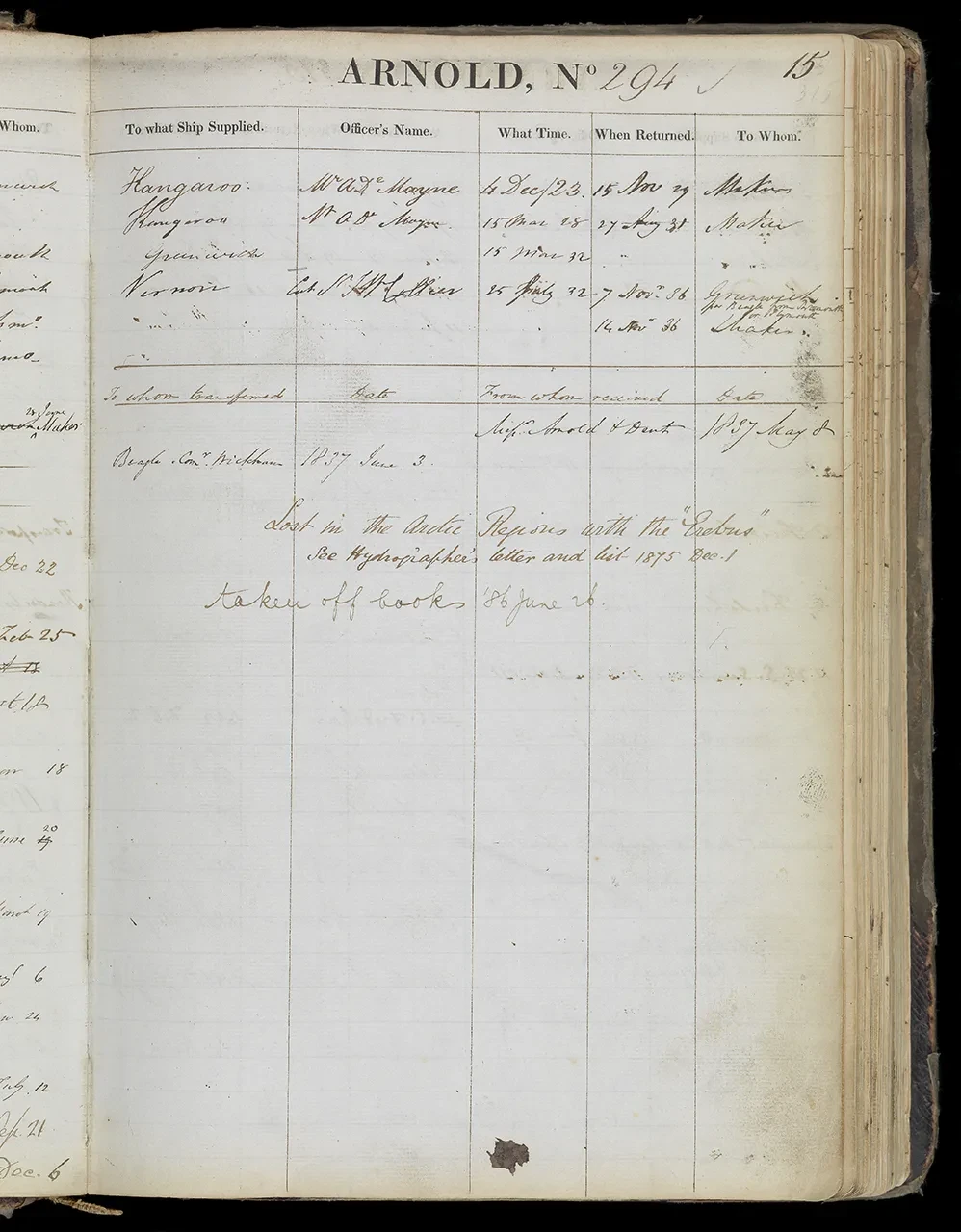
3. Arnold 294 – an Arctic survivor
Made around 1807 by John Roger Arnold, Arnold 294 is an eight-day chronometer with a spring-detent escapement.
It was carried on Franklin's last expedition to the Arctic, on which all 129 men perished. How the device made its way back remains a mystery. In 1999, Arnold 294 surfaced, inexplicably, at an English auction. It showed absolutely no signs of water or ice damage from its voyage. The chronometer had been doctored – the original 'Arnold' name on the dial was hammered flat, a fake clockmaker's name was substituted, and it was disguised as a Victorian carriage clock.
1 / 3
Chronometer 294
Marine Chronometer from Franklin's expedition, 8-day movement, Arnold spring-detent escapement and later balance. Mounted in original bowl, to which carrying handle and four ball feet have been added, converting it into a travelling timepiece.
2 / 3
The back of chronometer 294
Engraved silvered brass dial, showing signs of alterations to signature in 'Arnold' region.
3 / 3
The ledger for chronometer 294
Image
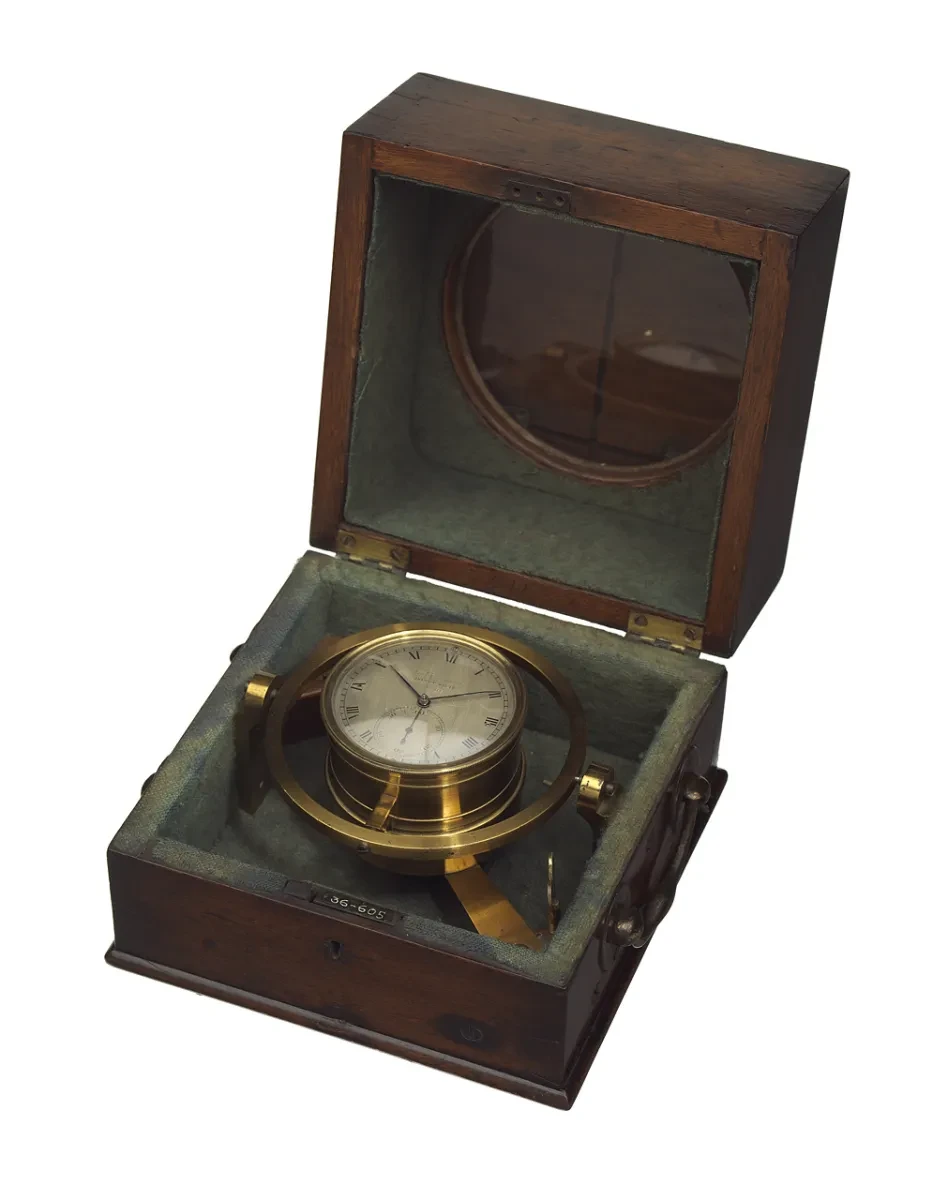
4. Earnshaw 512 – changing chronometer regulations
Earnshaw 512 is a typical example of Thomas Earnshaw's design, which transformed marine chronometers into a relatively simple, reproducible form. Remarkably, its basic design differs little from chronometers made in the mid-20th century.
It was owned by the East India Company and was recorded returning from India in 1821 before being issued to the Company ship Thomas Grenville under Captain Manning. This chronometer changed the rules because of its defects: it did not perform well and, on return to England, Manning was reprimanded for not informing the Committee of Shipping that it was unreliable.
Earnshaw inspected the device in 1823 and said it '…cannot be depended upon'.
The Committee declared that they '…are highly displeased at his having so long neglected to bring the subject of the chronometers to the notice of the Committee'.
The incident resulted in a new East India Company regulation concerning chronometers, in which a resolution was passed that '…the Commanders of the Company's own ships be desired immediately at the conclusion of each voyage to report particularly on the performance of their respective chronometers'.
Image
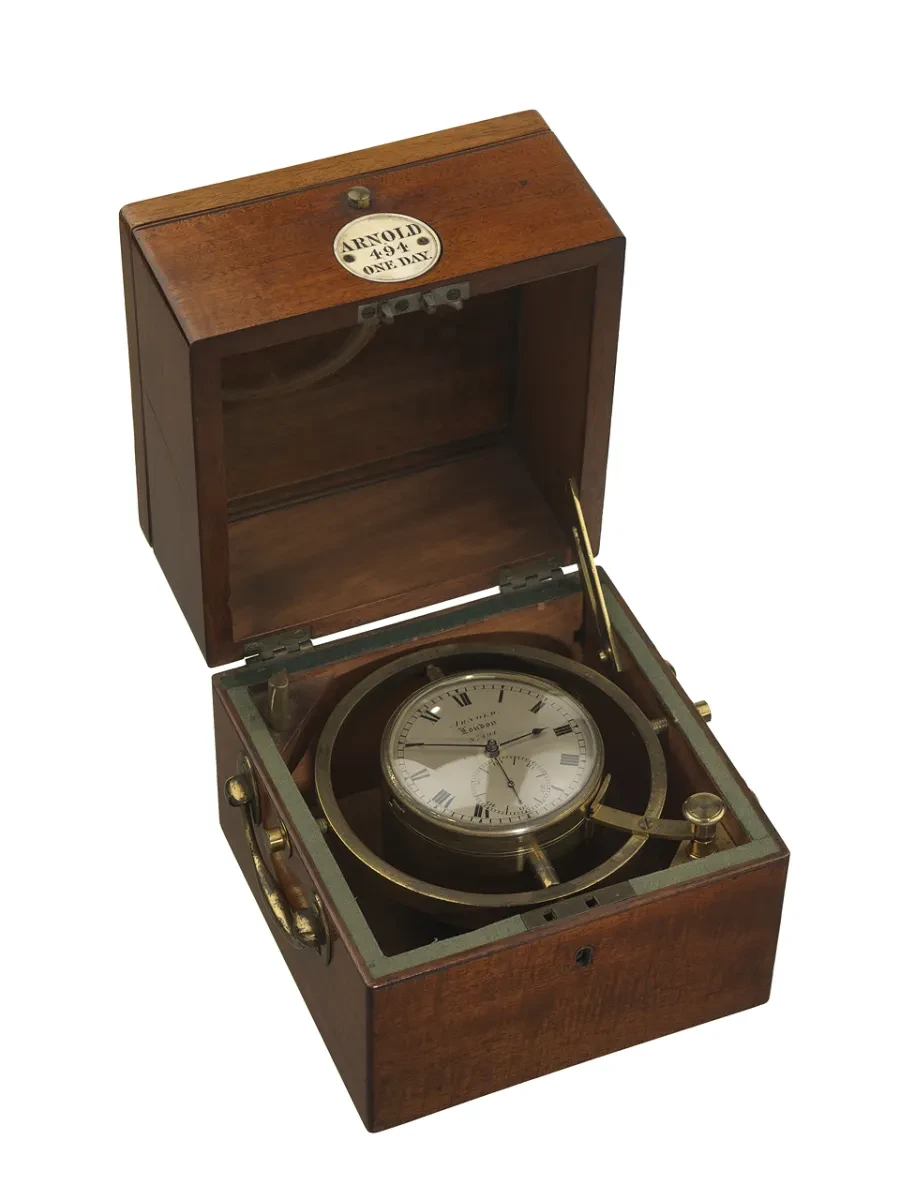
5. Arnold 494 – the chronometer that just kept going
Arnold 494 dates from around 1818 is one of the longest-serving chronometers in our collection, with a documented working life spanning 30 years in Admiralty service.
It was issued to HMS Forte in 1821 for a voyage to Jamaica, spending time in Halifax, Havana and Barbados; it then went on board HMS Columbine (see below), again working in the Atlantic between Havana and Bermuda.

HMS 'Columbine' coming to an anchor
PAD6419 • Prints & Drawings
HMS 'Columbine' (1826) coming to anchor against a background of grey skies and a low headland. The ship is still partially underway facing into a stiff breeze, indicated by the direction and spray off the waves and the blue ensign flying from the aft rigging.
Image
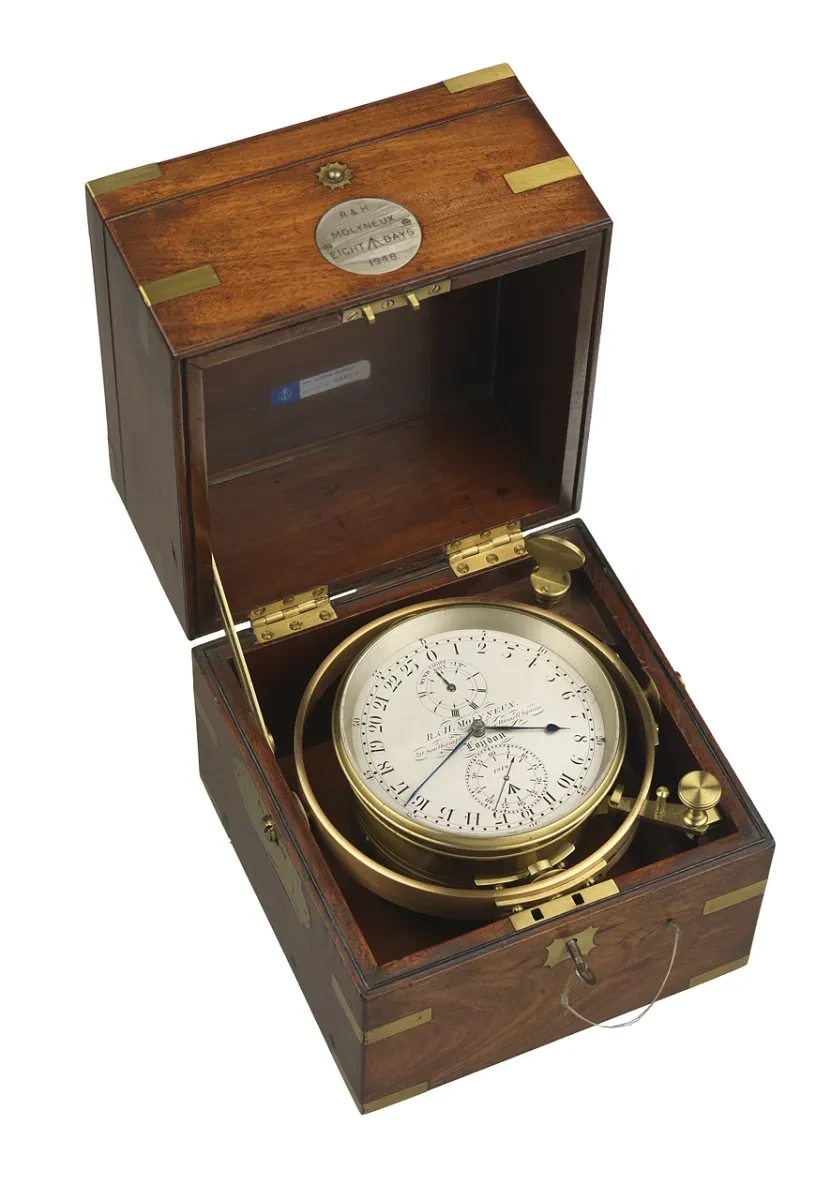
6. Molyneux 1948 – from Atlantic cable to solar eclipse
Made in 1840 by Robert and Henry Molyneux, No 1948 is an eight-day marine chronometer that was bought by the Admiralty in 1857 and went on to have a remarkable service history.
It was used on board the paddle-wheel steamer HMS Cyclops for soundings connected with the laying of the first Atlantic telegraph cable. It then served on board HMS Racer, HMS Flora and HMS Terror, was used by the Labrador Boundary Commission for the Newfoundland Survey, went on board HMS Mutine and in 1929 joined the Royal Society's solar eclipse expedition to Sumatra.
After it returned, No 1948 remained at the Royal Observatory for internal use.
Image
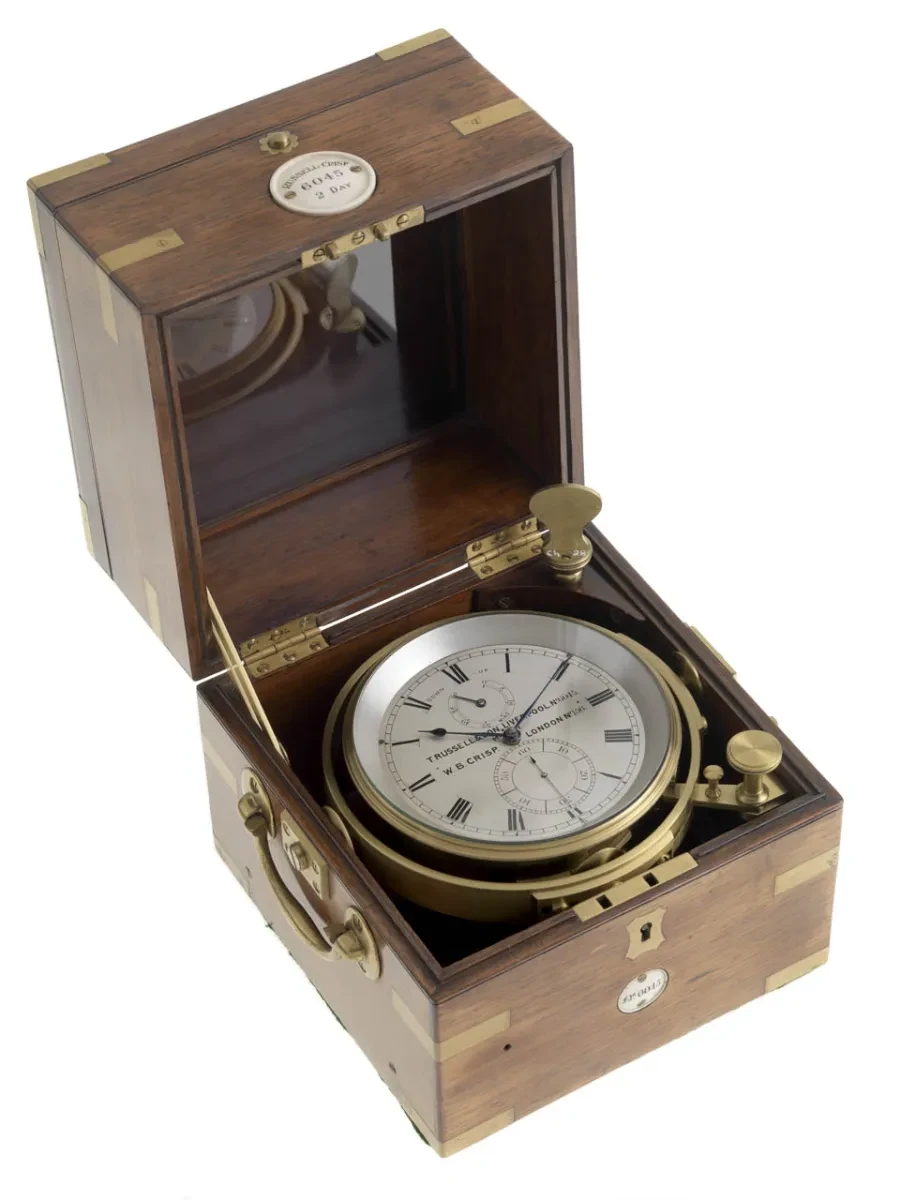
7. 6045/156 – the royal chronometer
A chronometer fit for a prince, 6045/156 is a two-day chronometer with an Earnshaw-type spring detent escapement. It was used on the Royal Yacht Victoria and Albert III and almost certainly on its predecessor, Victoria and Albert II (see below). It was given by Prince Albert to his son Prince Alfred, Duke of Edinburgh.
In 1930, when George V wanted the family chronometer on board the Royal Yacht, it was retrieved from the Observatory and put into royal service once again.
This chronometer was presented to the National Maritime Museum by HM Queen Elizabeth II on 25 October 1954, after the Royal Yacht Victoria and Albert III was broken up.

HMY Victoria and Albert II (1855); Royal/ceremonial vessel; Yacht
SLR0882 • Ship Models
This is a contemporary builder's style full-hull model of HMY 'Victoria and Albert' (1855). The model is decked and equipped with a full set of boats (including the Royal Barge) mounted on davits, anchors, capstan, an ornate double wheel and stump masts.
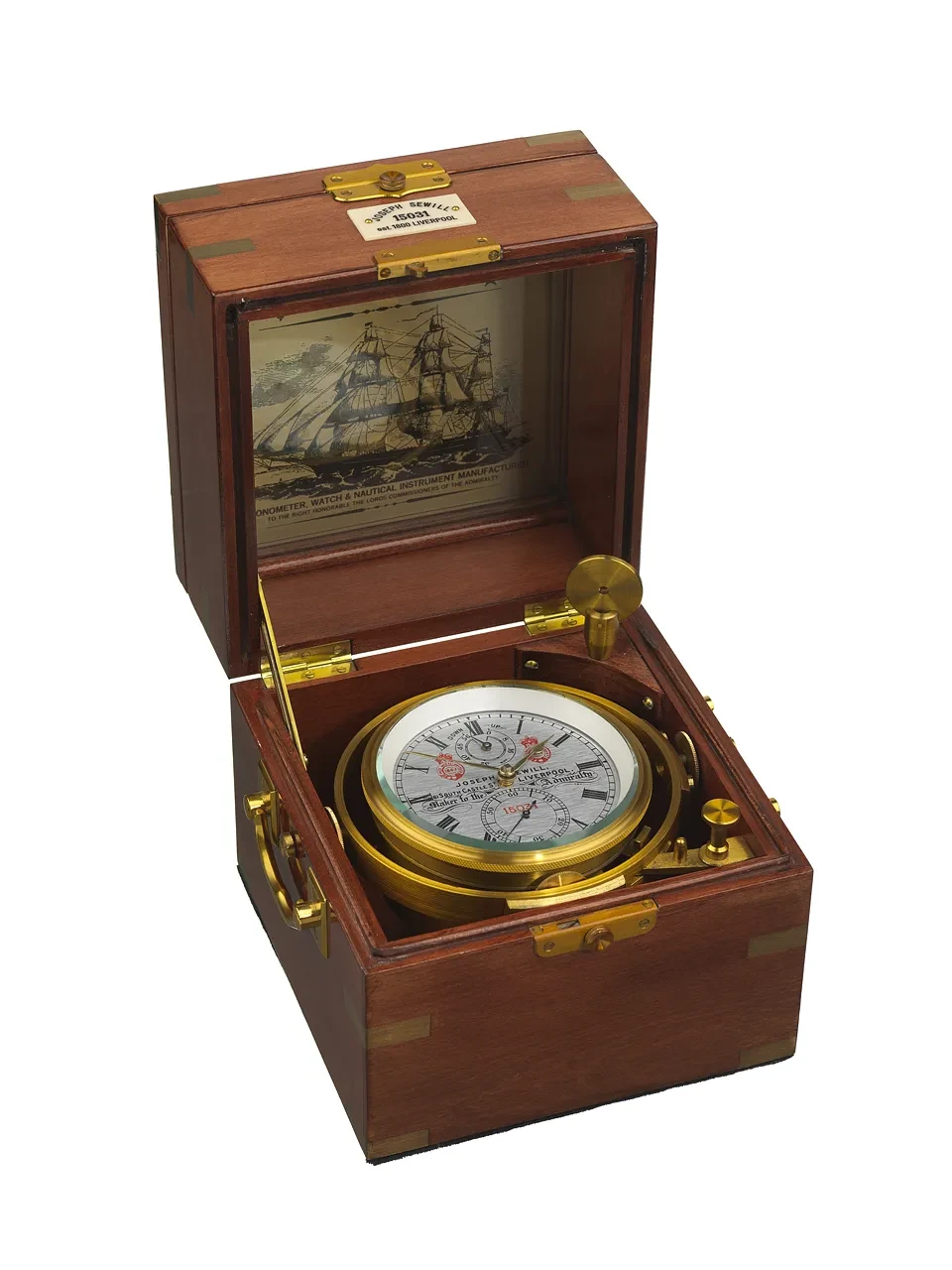
8. Kurova 15031 – the technology that refused to disappear
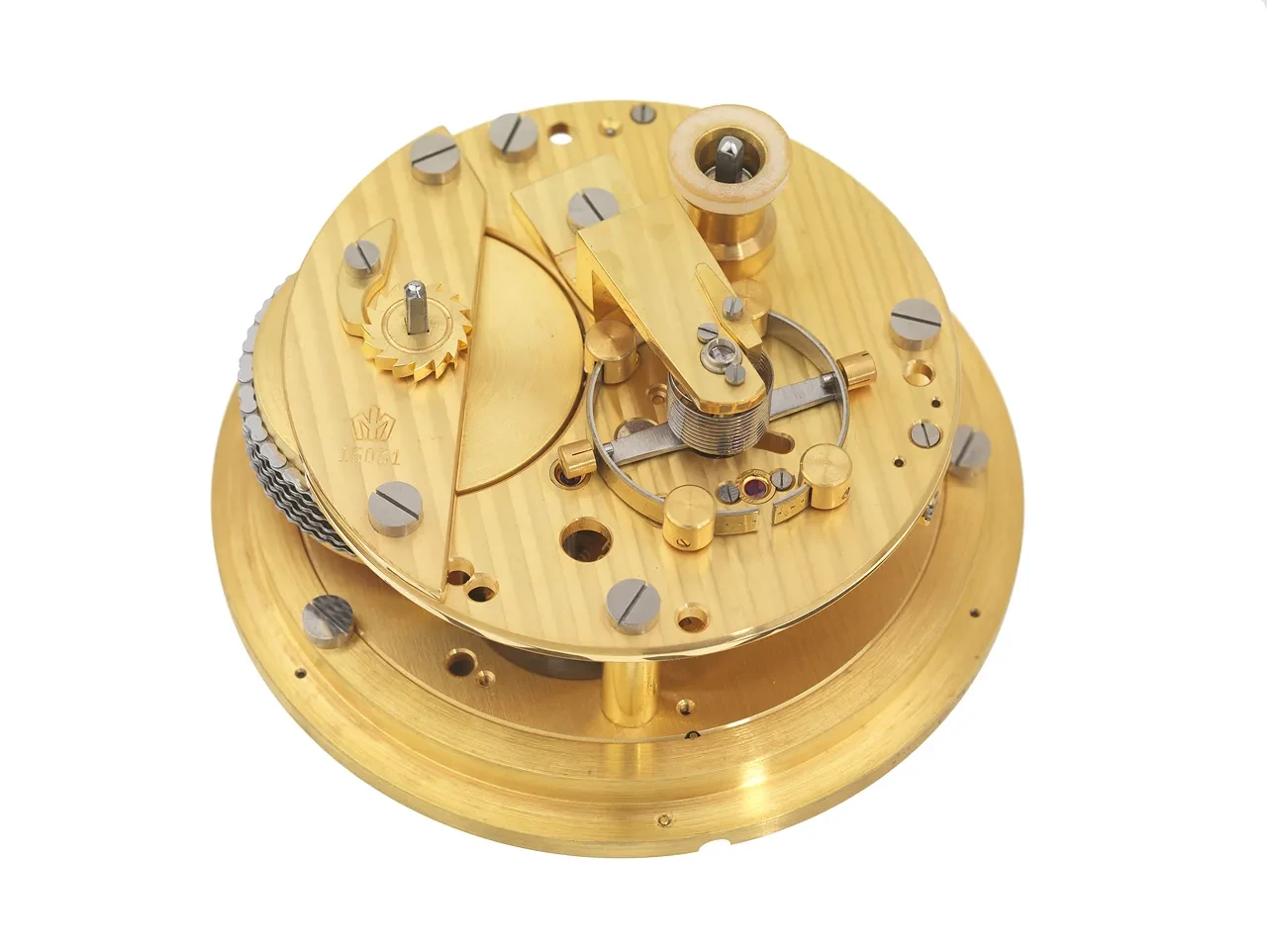
This chronometer from our collection explodes the notion that chronometers only belong in the age of Darwin and the Beagle. No 15031 was made around 1989, a Wempe-type, two-day marine chronometer with an aluminium dial and gilt-brass full-plate fusee movement.
No 15031 is among the later marine chronometers in our collection – a reminder that this technology survived remarkably late into the 20th century.
No 1042 was carried ashore in the 1830s because FitzRoy needed a chronometer where scientific observations were being made. More than 150 years later, No 15031 shows the underlying technology was still being made for much the same purpose – even though the world around it had changed almost beyond recognition.
1 / 3
Chronometer 15031 in its box
Marine chronometer, 2-day. Brass bowl in mahogany box. Wempe type, BC100 Einheits calibre, two-day, gilt-brass full plate fusee movement. Aluminium dial. (ZAA0551)
2 / 3
The back view of chronometer 15031
3 / 3
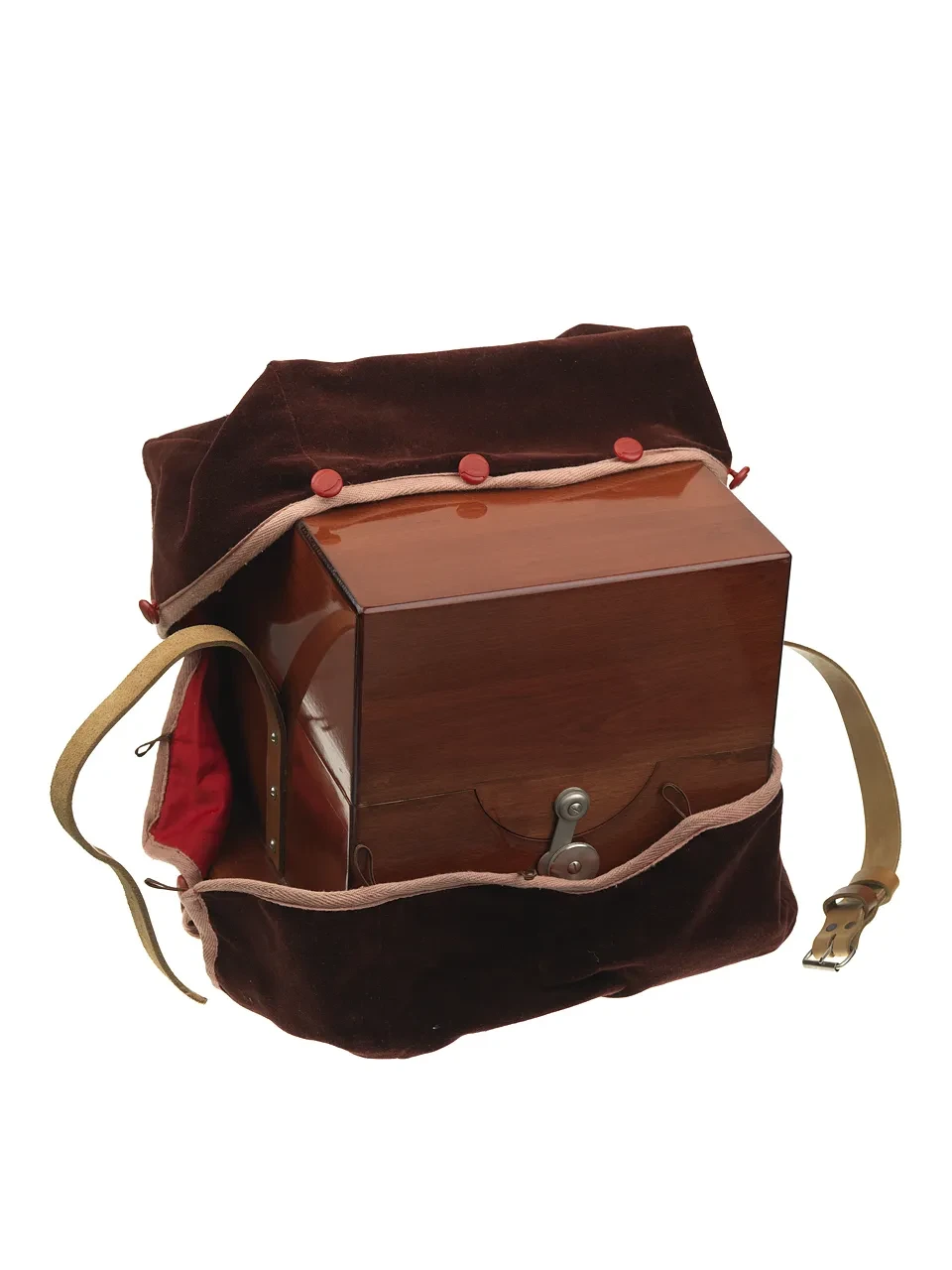
The closed box of chronometer 15031
Chronometer facts: 10 things to know
What is a marine chronometer?
A highly accurate mechanical timekeeper designed to keep precise time at sea, allowing navigators to calculate longitude.
What's the difference between a chronometer and a clock?
A chronometer is a highly accurate timekeeper designed to meet demanding standards of precision. Marine chronometers were specifically engineered to maintain accurate time at sea and had to pass rigorous independent testing for accuracy.
Why were chronometers important?
Because knowing the precise time at a known reference point, such as Greenwich, allowed sailors to calculate their longitude at sea.
Who invented the marine chronometer?
English clockmaker John Harrison developed the first successful marine chronometers in the 18th century, culminating in his famous H4 timekeeper.
When were marine chronometers first used?
Successful marine chronometers emerged in the 18th century. By the 19th century they were essential instruments on board naval and surveying vessels.
Where were chronometers used?
Primarily at sea, on board naval, merchant and surveying ships, but also on scientific expeditions and voyages of exploration.
Which chronometers can I see on display in the Maritime Museum?
Visit the National Maritime Museum and you can see:
How many chronometers are there in the Royal Museums Greenwich collection?
There are more than 200 chronometers in the Royal Museums Collection; it is the largest collection of chronometers in the world.
Why is Greenwich important to chronometers?
Greenwich became the reference point for the Prime Meridian and Greenwich Mean Time. Chronometers carried precise Greenwich time across the world's oceans, making longitude calculations possible.
Are marine chronometers still used today?
Mechanical marine chronometers continued to be made well into the 20th century. Our collection includes a chronometer made around 1989.
However, mechanical marine chronometers are no longer used as primary navigation tools on modern ships. They’ve been replaced by electronic systems like GPS and satellite navigation.
More to explore
Shop the collection


