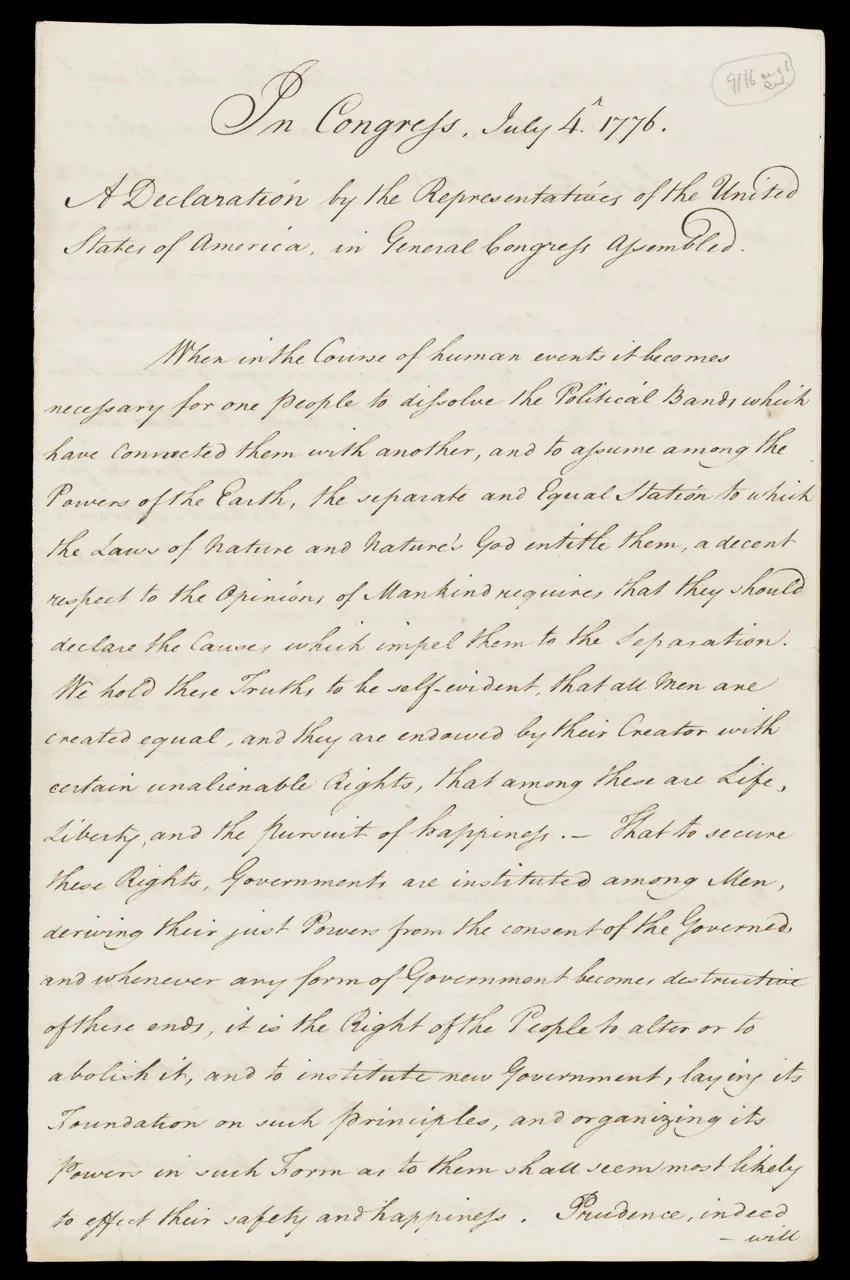
Credit: © National Maritime Museum, Greenwich, London
To mark the 250th anniversary of the adoption of the Declaration of Independence on 4 July 2026, the National Maritime Museum will unveil a special temporary display showcasing what may be one of the earliest British reports of American independence.
Opening on 15 June, this free temporary display will give visitors the opportunity to view this remarkable manuscript up close, shedding light on the speed, complexity, and impact of transatlantic communication during the American Revolution.
At the centre of the display are a letter dated 10 July 1776 and a handwritten copy of the Declaration made between 5 and 10 July 1776, sent to John Montagu, 4th Earl of Sandwich, First Lord of the Admiralty, by Vice‑Admiral Molyneux Shuldham, Commander‑in‑Chief of the North American Station. The documents are believed to be among the first written accounts of American independence to reach Britain, offering a remarkable insight into how news of the Declaration travelled across the Atlantic.
Sent to Britain only days after the Declaration was first printed in Philadelphia, the documents provide a rare British perspective on the revolutionary developments unfolding in America, news that would soon reshape global politics. Their survival offers an extraordinary opportunity to explore how information was transmitted, interpreted, and acted upon during a pivotal moment in world history.
The letter dated 10 July 1776 reveals that Vice-Admiral Molyneux Shuldham had transcribed a printed copy of the ‘late Declaration of the Continental Congress’, now known as the Dunlap Broadside, shortly after it reached him while commanding the British naval blockade of New York. In the letter, Shuldham describes the Declaration as ‘perhaps the first authentick [sic] confirmation of what has been so long suspected. The establishment of Independence in America’. The first Dunlap Broadside known to have reached Britain arrived in August 1776. Shuldham’s transcription, sent to the Earl of Sandwich in mid-July, may therefore be one of the earliest reports of American independence to reach British shores.
Martin Salmon, Curator of Manuscripts at the National Maritime Museum, said: ‘It is just possible this was the very first text of the Declaration of American Independence to reach British shores. Yet it’s the accompanying letter that’s in some ways even more interesting, because it gives insight into the timing and circumstances in which the document was created. Molyneux Shuldham was relieved of command, his replacement did not arrive until 12 July 1776. It is likely that among the very last acts of his command was to ensure the intelligence of American independence being fact, was communicated home.’
Information for visitors:
Venue: Caird Library, National Maritime Museum, Greenwich
Date: Daily from 15 June
Time: 10.00 – 17.00
Admission: Free
Visitor enquiries: 020 8858 4422
Twitter: @RMGreenwich
Instagram: @royalmuseumsgreenwich
Facebook: @royalmuseumsgreenwich
Notes to Editors
- The Caird Library is located in the Sammy Ofer Wing of the National Maritime Museum and is the world’s largest maritime library and archive collection. The contents of the library cover a range of subjects including maritime and global history, navigation, astronomy and more. The library is free to access. Readers need to register in advance at archiveandlibrary.rmg.co.uk/aeon
- The National Maritime Museum holds the world’s largest maritime collection telling stories of Britain’s relationship with the sea.
- The National Maritime Museum is part of Royal Museums Greenwich which also incorporates the 17th-century Queen’s House, Royal Observatory Greenwich and the famous clipper ship Cutty Sark. This unique collection of museums and heritage buildings form a key part of the Maritime Greenwich UNESCO World Heritage Site and is also a major centre of education and research. The mission of Royal Museums Greenwich is to enrich people’s understanding of the sea, the exploration of space, and Britain's role in world history. For more information, visit www.rmg.co.uk
-ends-
For further information or to request press images, please contact:
Royal Museums Greenwich Press Office
press@rmg.co.uk | 020 8312 6790