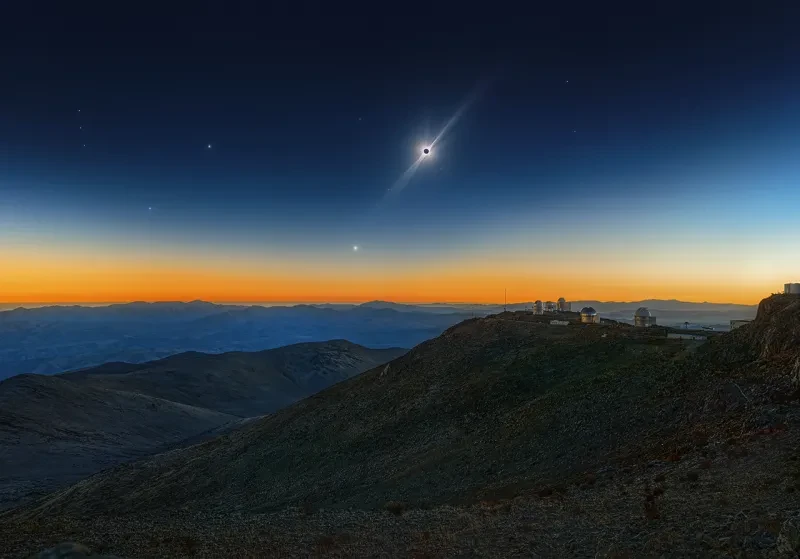
A solar eclipse is a spectacular event in and of itself, but the 1919 solar eclipse was particularly important for scientists.
Two groups of Royal Observatory Greenwich astronomers, one based on the northern coast of Brazil and the other just off the west coast of Africa, used photography to capture the bending of starlight by the gravitational field of the Sun during this total eclipse.
The deflection of starlight photographed was tiny, but the findings supported Einstein’s theory of general relativity, making the astronomers the first people to observe and measure the effect Einstein had hypothesised.
This event would later lead to the discovery of gravitational time dilation, gravitational lenses, black holes and gravitational waves.
Learn more about this historic eclipse below.
What is a solar eclipse?
Most of the major objects in our solar system orbit in the same plane. In other words, the solar system is very flat, with each of the orbits of many of the planets, moons and other bodies roughly lining up with one another. Every now and then these objects perfectly line up with one another.
There is no more spectacular example than that of a total solar eclipse. The Moon passes directly between the Earth and Sun, casting its shadow upon Earth. Observers in the darkest part of this shadow would see the Sun’s light being all but completely blocked out, like day very briefly turns to night.

By coincidence, the Moon is 400 times smaller than the Sun and 400 times closer to us than the Sun. This means its relatively small body can cover the entire Sun's surface.
Find out more about solar eclipses
Why are solar eclipses important to astronomers?
Solar eclipses also provide an opportunity to observe parts of the Sun not visible at other times.
While the Sun's 'surface' is covered by the Moon during a total solar eclipse, its much fainter atmosphere extends far further.
Ground-based observers could use these eclipses as a chance to see these faint and usually drowned-out parts of the Sun in detail.
However, these short-lived and geographically inconvenient events are no longer our only insight into this field.
The development of solar probes and solar coronagraph technology has given us new opportunities to explore the Sun whenever we want.
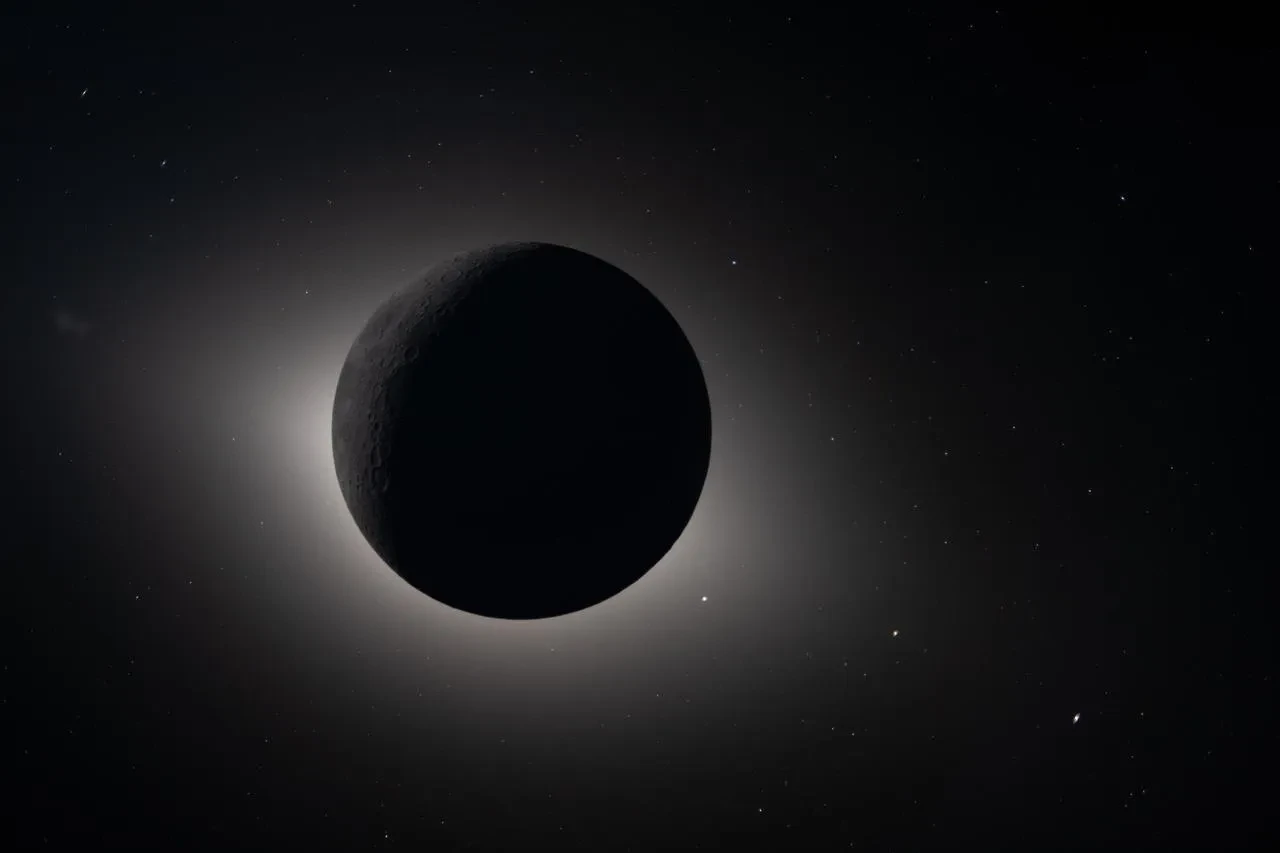
Solar coronagraph technology allows the Sun's atmosphere to be observed outside of an eclipse.
What made the 1919 solar eclipse different?
It is due to the scientists that the 1919 solar eclipse went down in the history books.
In 1915, Albert Einstein published what may well be his greatest, and certainly is one of his best-known, works: his Theory of General Relativity.
This was in part an attempt to understand the nature of gravity, the mysterious force responsible for much of the structure of our universe. It would eventually revolutionise the way scientists understood the Universe.
Scientists were reluctant to move away from Sir Isaac Newton's view of gravity, which had dominated for over 200 years.
The problem was that experimentally, their predictions were similar, despite being fundamentally different.
In other words, an experiment to test gravity would give extremely similar results. This made designing a test to separate them very difficult.
Using photography
However, in 1917, Sir Frank Watson Dyson, the Royal Observatory Greenwich's Astronomer Royal at the time, formulated an experiment that could do it.
In both Newton’s and Einstein’s views, the path of light can be bent by gravity. However, the difference in this bend in the two views is noticeable, with Einstein predicting twice the deflection of Newton’s view.
To see this deflection requires a big object with a lot of mass to bend the light around it. Dyson suggested that the Sun might be seen to do this to background stars during an eclipse.
Sir Arthur Eddington was Secretary of the Royal Astronomical Society and a great believer in Einstein’s theory. He organised two groups of astronomers, sending them on expeditions to parts of the world expected to see the eclipse on 29 May 1919.
These groups took photographs during totality. They measured the deflection of the stars from their “true” positions.
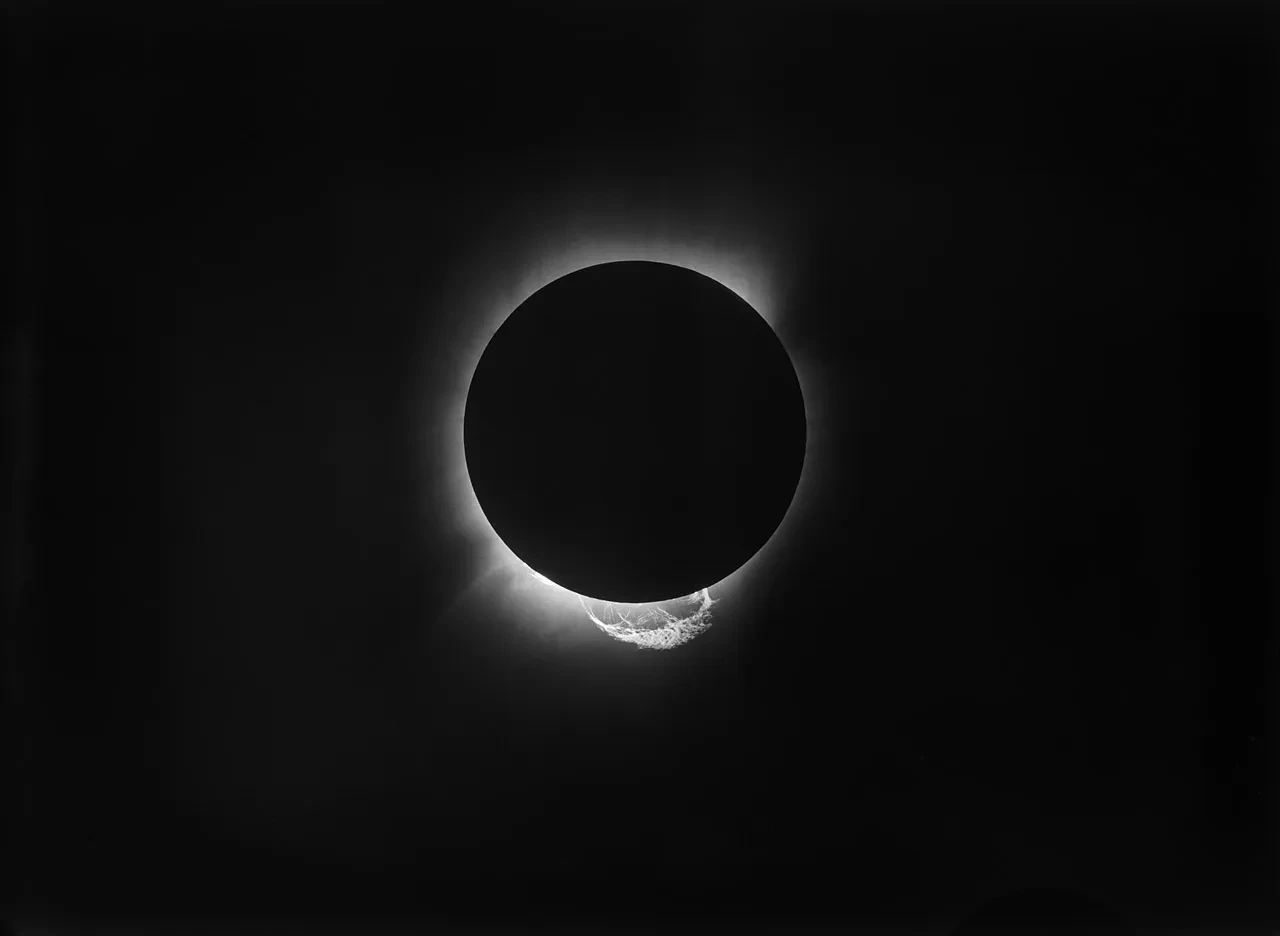
The angle they measured from where the stars should be to where they appeared to be during the eclipse was a little under 2 arcseconds. This is 1/1800th of a degree or 0.00015% of a full circle. This is a tiny deflection, but it was enough to show that Einstein was right.
This was one of the first key pieces of evidence to show Einstein’s view could trump Newton's, paving the way to it becoming the dominant theory.
This in turn led to the discovery of gravitational time dilation, gravitational lenses, black holes and, most recently, gravitational waves.
These results are all built upon a theory tested with the 1919 total solar eclipse.

Visit the Royal Observatory
Visit the Royal Observatory Greenwich to stand on the historic Prime Meridian of the World, and see the home of Greenwich Mean Time (GMT)