

A selection of the shortlist for the ZWO Astronomy Photographer of the Year 2026 competition has been revealed.
From a snow-dusted mountain crowned with a glowing moon to an eye-like nebula and a partial solar eclipse shrouded in clouds, entrants to the competition have captured the breathtaking variety of the cosmos.
Almost 4,000 images were submitted to 2026's competition from 769 different entrants.
Explore a few images from the shortlist below.
And the winners are...
The winning images in the ZWO Astronomy Photographer of the Year 2026 competition have been revealed during an online awards ceremony! See all the winning images here.
Ali Alobaidly is the overall winner of ZWO Astronomy Photographer of the Year 2026 with his photo of the Shark Nebula, titled The Quiet Predator.
The images are now on display in a special exhibition at the National Maritime Museum.
Image
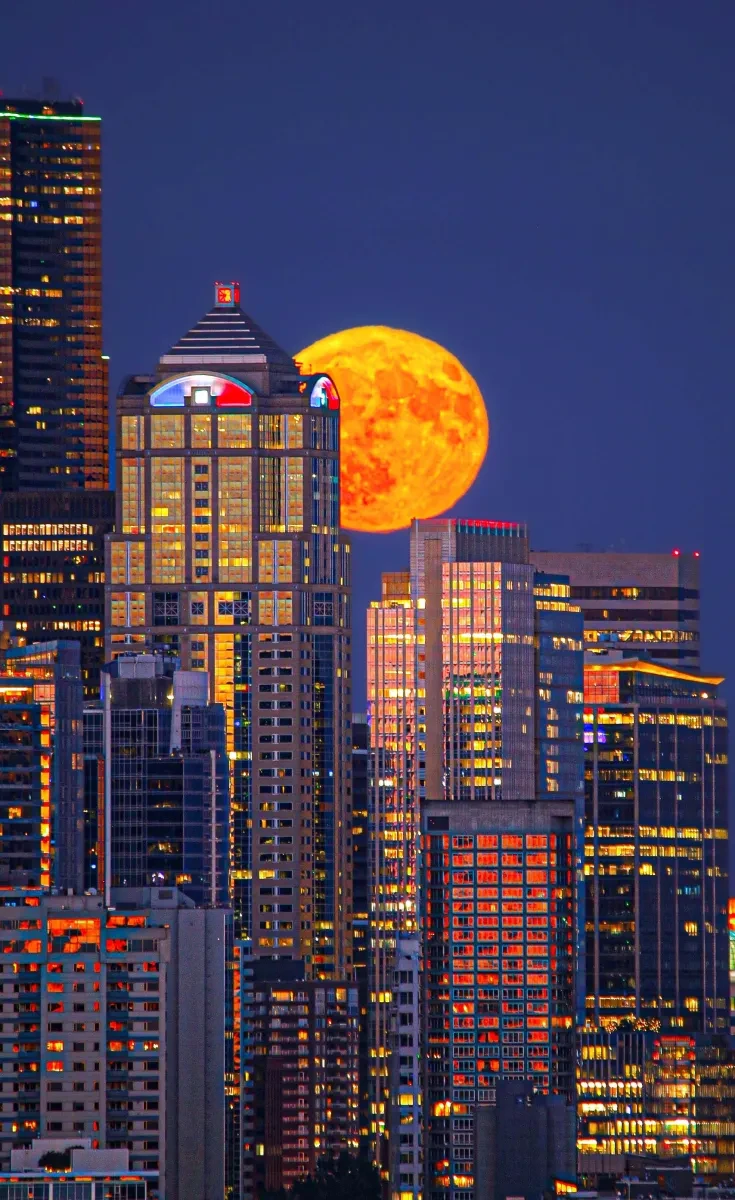
Golden Moonrise Over Seattle by AJ Smadi
Seattle, Washington, USA
‘This picture reveals the city of Seattle, illuminated at twilight during a summer sunset. Above it, the orange Buck Moon is rising. The colour of the Moon reflected in Seattle’s skyline casts a golden light over the entire city, its deep glow adding presence to the image and providing a contrast to the sleek lines of the intricate architecture with its raw and rugged terrain.’
Image
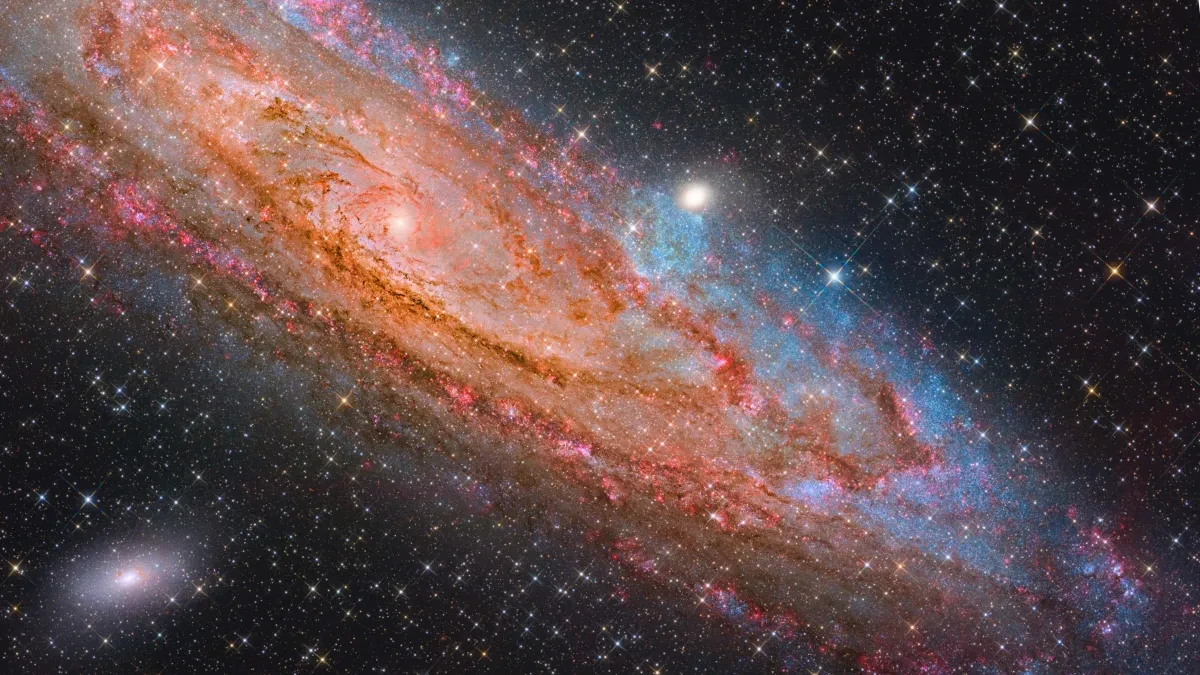
The Crimson Vortex and Sapphire Blossoms of Andromeda by Chuhong Yu and Zuoming Wang
Zhuanghe City, Liaoning Province, China
‘This deep-field image of the Andromeda Galaxy (M31) captures its dual nature: a crimson vortex of ionised gas and dust spiralling toward the supermassive black hole at its centre and sapphire "blossoms" – luminous blue stellar nurseries – blooming across its spiral arms.
'Captured in both optical and near-infrared wavelengths, the image reveals the galaxy’s dynamic equilibrium through the striking contrast between red and blue, with matter falling inwards toward the core, while new stars ignite in the arms. We were astonished that we were able to resolve the faint stars in the galaxy as well as the vortex near the core.’
Image
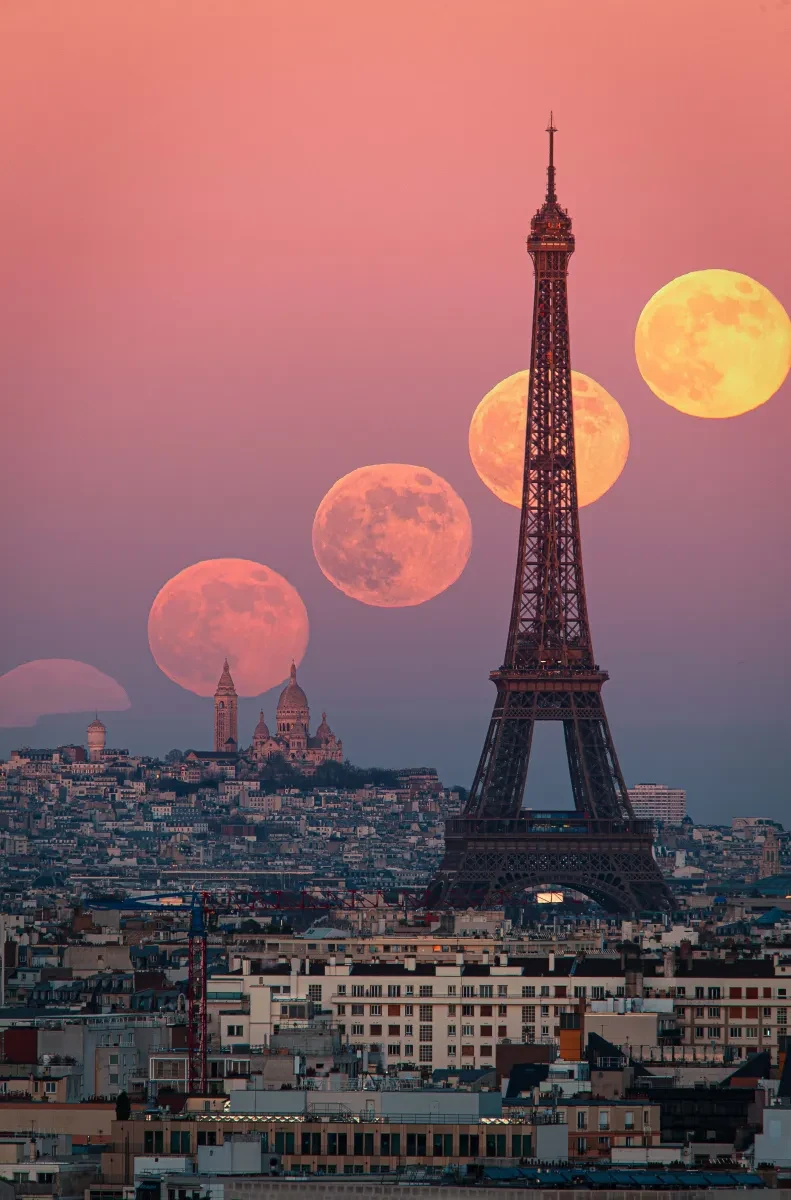
Supermoon Path Over Paris at Sunset by Martin Giraud
Meudon, Île-de-France, France
‘A few days before New Year, I noticed on my planning app that the first Full Moon of 2026 would rise perfectly aligned with a spot that I had scouted years ago.
'The Eiffel Tower was 6.3 km (3.9 miles) away from my position, and the Sacré-Cœur Basilica was 11.1 km (6.9 miles) away. This explains why the Moon appears so large in the frame. At this distance, it is quite rare for all the necessary conditions to come together to get the shot. The location had to offer a perfect alignment between me, the buildings and the rising Moon. Just a few metres difference and the composition would be ruined.’
Image
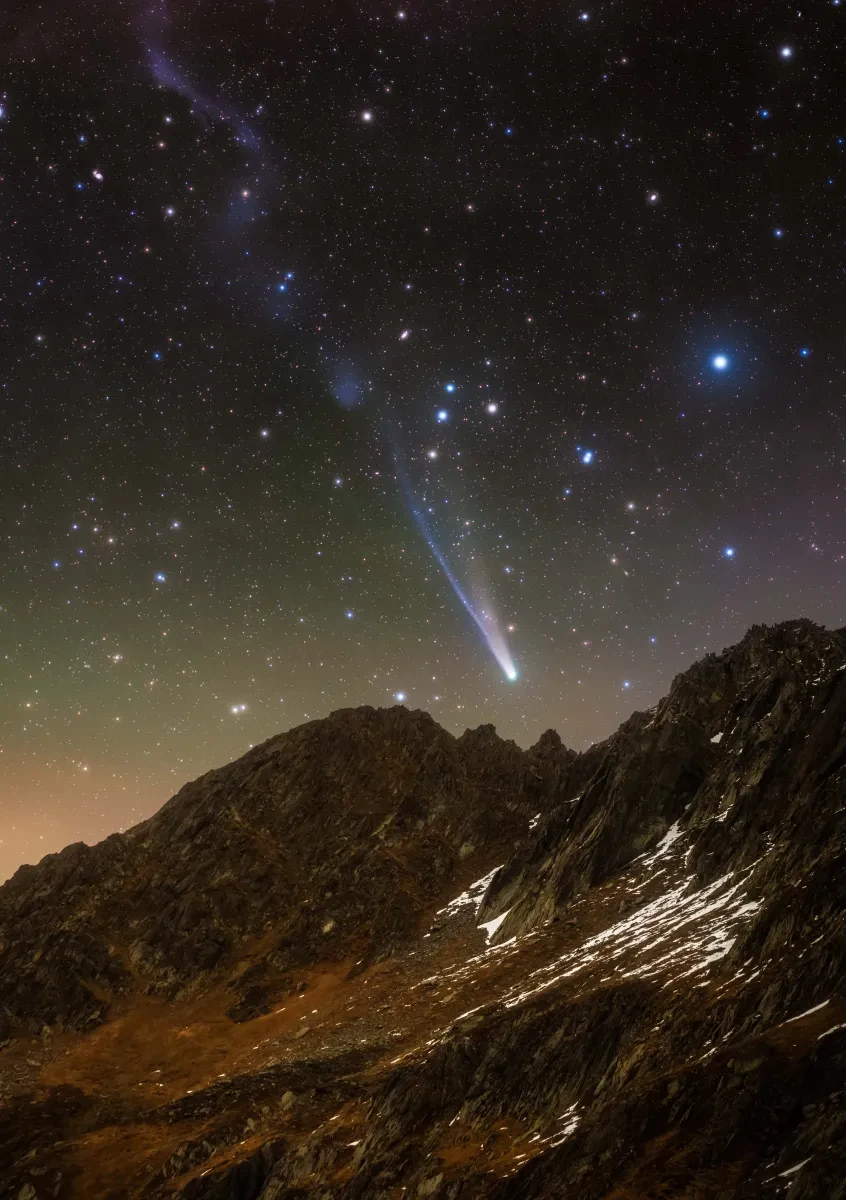
Comet C/2025 A6 (Lemmon) Over the Swiss Alps by Jakob Sahner
Tujetsch, Graubünden, Switzerland
‘This photograph shows Comet C/2025 A6 (Lemmon) in the early hours of the morning. The four-hour hike to this spot was worth it, even though I hadn’t done any planning beforehand on how to shoot this comet. I drove deep into the Swiss Alps to make the most of the last clear night before the new Moon cycle. The landscape was breathtaking and made a perfect foreground for the comet.’
Image
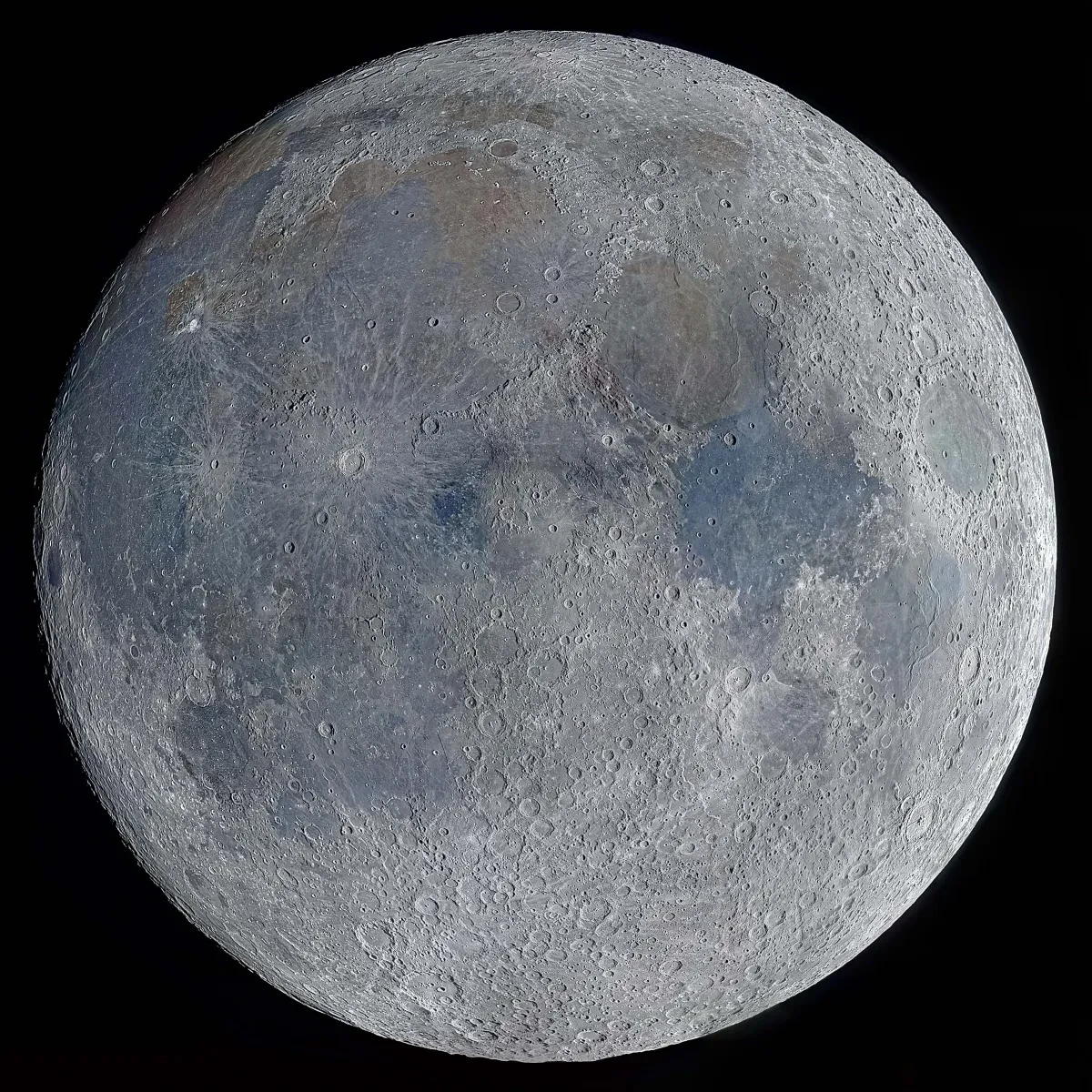
Shadow Moon by Richard Addis
Wallasey, Merseyside, England
‘I have always wanted to make a composite image using photographs of every lunar phase from the New Moon to the Full Moon. In April 2025 I finally had the opportunity. Two weeks of clear skies (a huge rarity in the UK) enabled me to collect enough data to put together this labour of love.
'The image shows shadow detail across the entire lunar surface, a sight which cannot be seen during a Full Moon, when the surface is lit directly. It really emphasises the landscape and makes for a beautiful study.’
Keep up to date
Sign up to our space newsletter for astronomy news, guides and events, and be among the first to see this year's ZWO Astronomy Photographer of the Year winners
Image
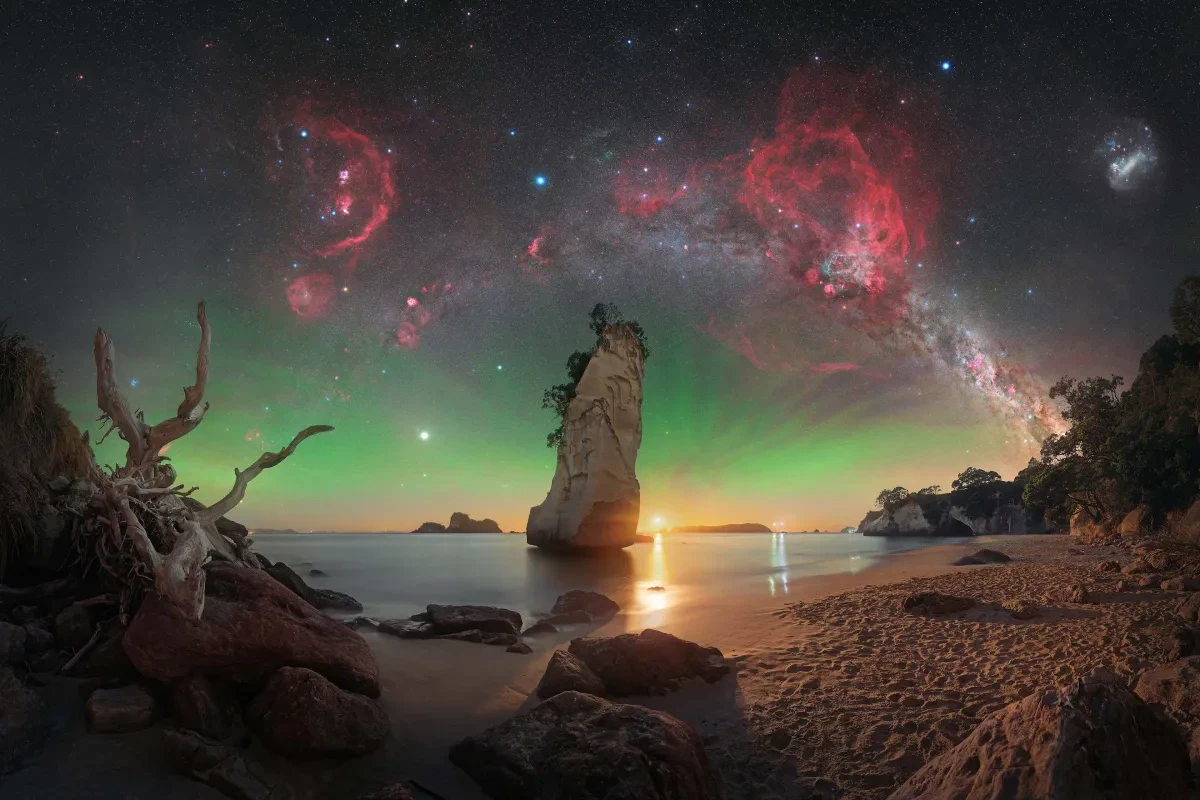
Te Hoho Rock Moonrise by Evan McKay
Cathedral Cove, Waikato, North Island, Aotearoa New Zealand
‘On this particular night I only had a small window to capture the sky before the Moon started to rise, so I decided to make the most of it. I got my mount polar-aligned during twilight and then started shooting the sky panorama from this location. The Moon began to rise soon after I finished the sky, so I then captured the foreground. The moonlight gave me the best of both worlds and did a fantastic job lighting up the foreground. To enhance the sky, I shot a separate panorama using a dual narrowband filter and blended it in to bring out the nebulae.’
Image
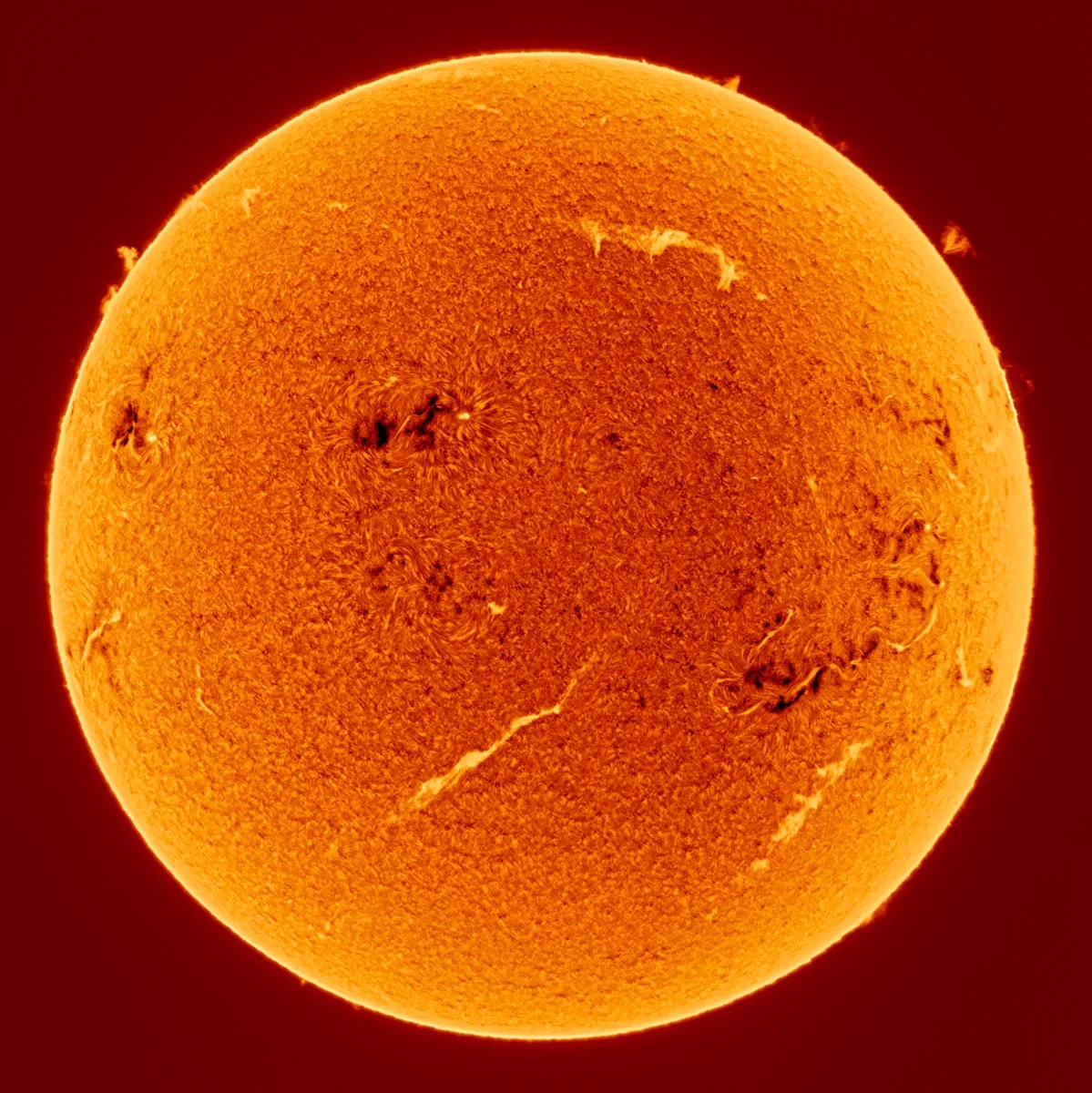
Dancing Flames © 与晨 林, aged 14
Xiamen, Fujian Province, China. Shortlisted in ZWO Astronomy Photographer of the Year Young competition
'This high-resolution H-alpha image of the Sun’s chromosphere was captured from home in decent seeing conditions. It reveals intricate surface details including sunspots, solar flares, filaments and prominences along the solar limb.'
Image
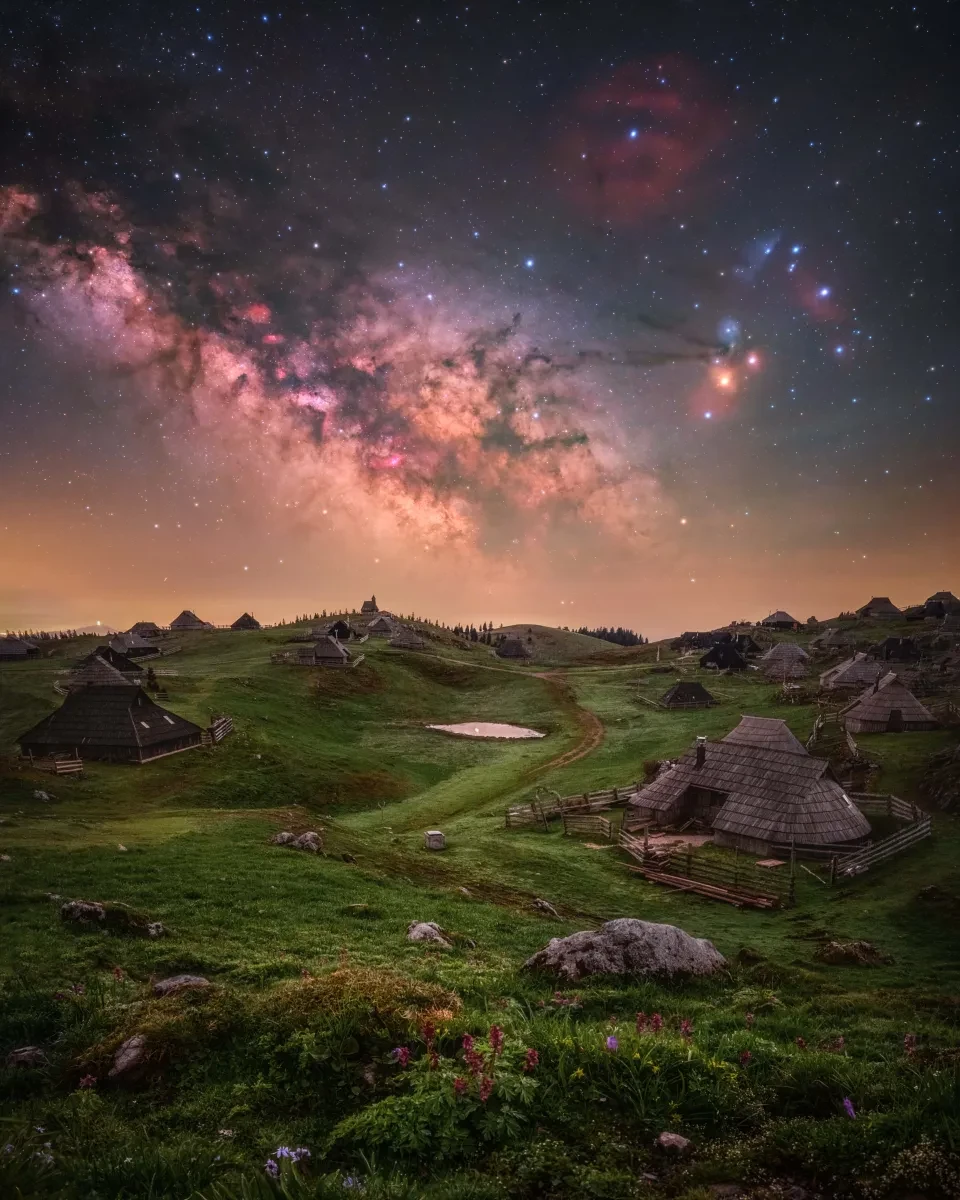
Fairyland by Uroš Fink
Velika Planina, Kamnik-Savinja Alps, Slovenia
‘Velika Planina is one of the most beautiful places in Slovenia, a paradise for photographers where they never run out of compositions. In the foreground of this image you can see a settlement with the wooden huts that are characteristic of the area, while in the background the core of the Milky Way rises in all its beauty.’
Image
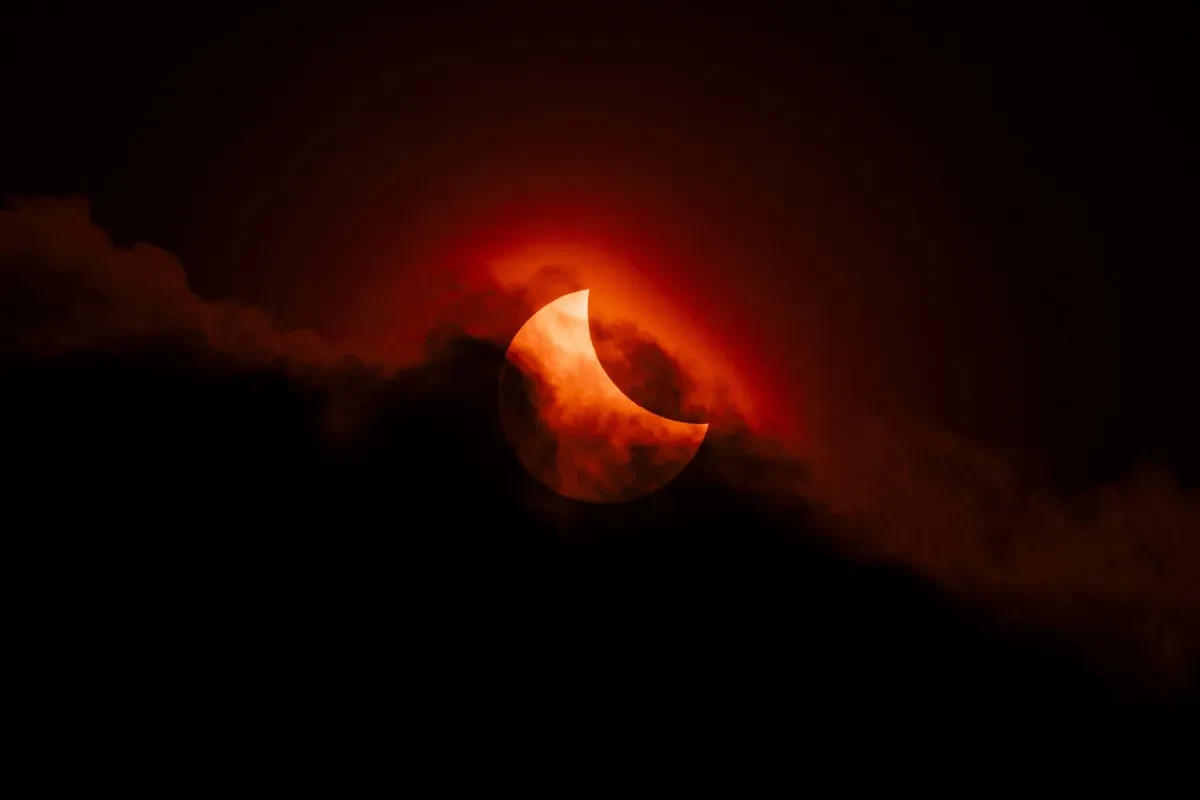
Moody Partial Solar Eclipse by James McBeath
‘Here, the partial solar eclipse of 2025 was shot through fast moving clouds on what was a beautiful spring morning. I spent several hours in a local park tracking the eclipse with my camera, showing many passers-by what I was doing and giving them a good view of the eclipse. I ended up with hundreds of shots, but this one, with the clouds framing the Sun perfectly, immediately caught my eye. I am very happy with most of the shots I took that day, but this one is easily the dreamiest.’
Image
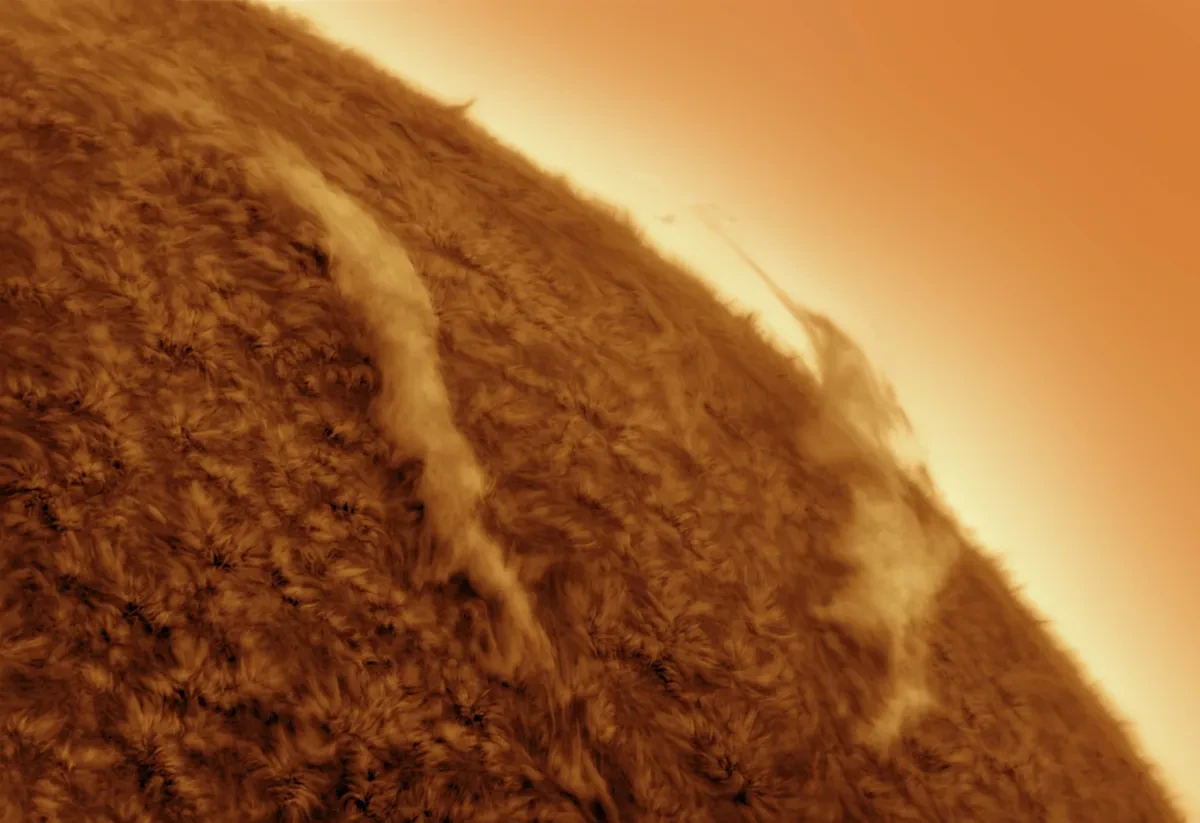
Suspended Plasma by Mario Cogo
Monticello Conte Otto, Vicenza, Italy
‘The solar limb, presented in inverted tones and enhanced colour, reveals a ‘filaprom’ (filament-prominence) that rises like an arc of fire shaped by invisible magnetic forces. Nearby, a filament winds across the luminous surface, cutting through the incandescent plasma. The tonal inversion heightens the contrast and creates a vivid sense of three-dimensionality, revealing the dynamic nature of our star.’
Image
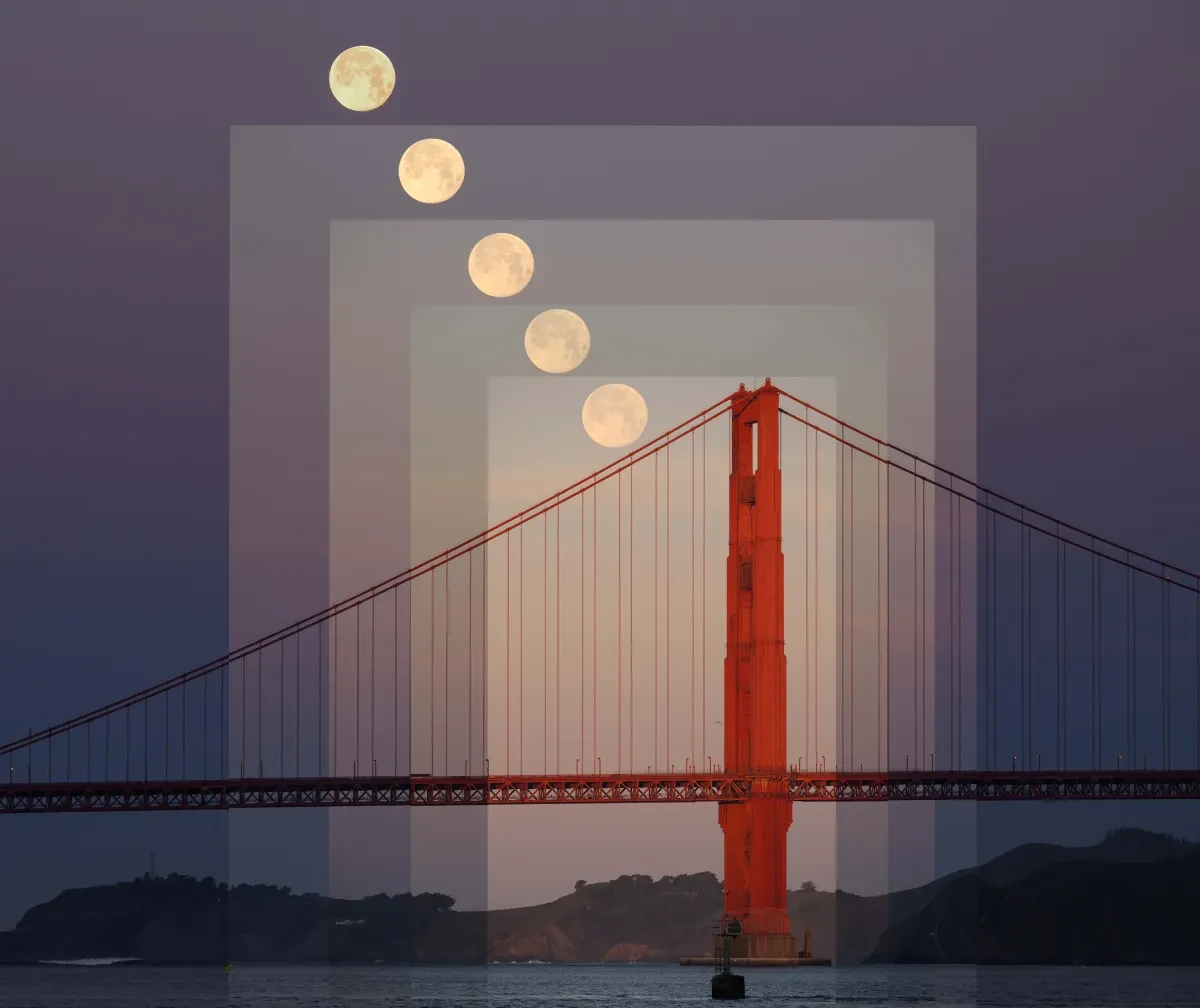
Fifteen Minutes of Moonset and Sunrise Over the Golden Gate by Fredric Walder
San Francisco, California, USA
‘This composite image shows five separate captures of the setting Full Moon, taken as the sky changed from a deep blue, in which the pinkish glow known as the Belt of Venus was visible, to full golden-hour illumination. I have attempted to show the evolution of both the colour and luminosity of the sky by keeping the lunar disc at approximately the same brightness in each section.’
Image
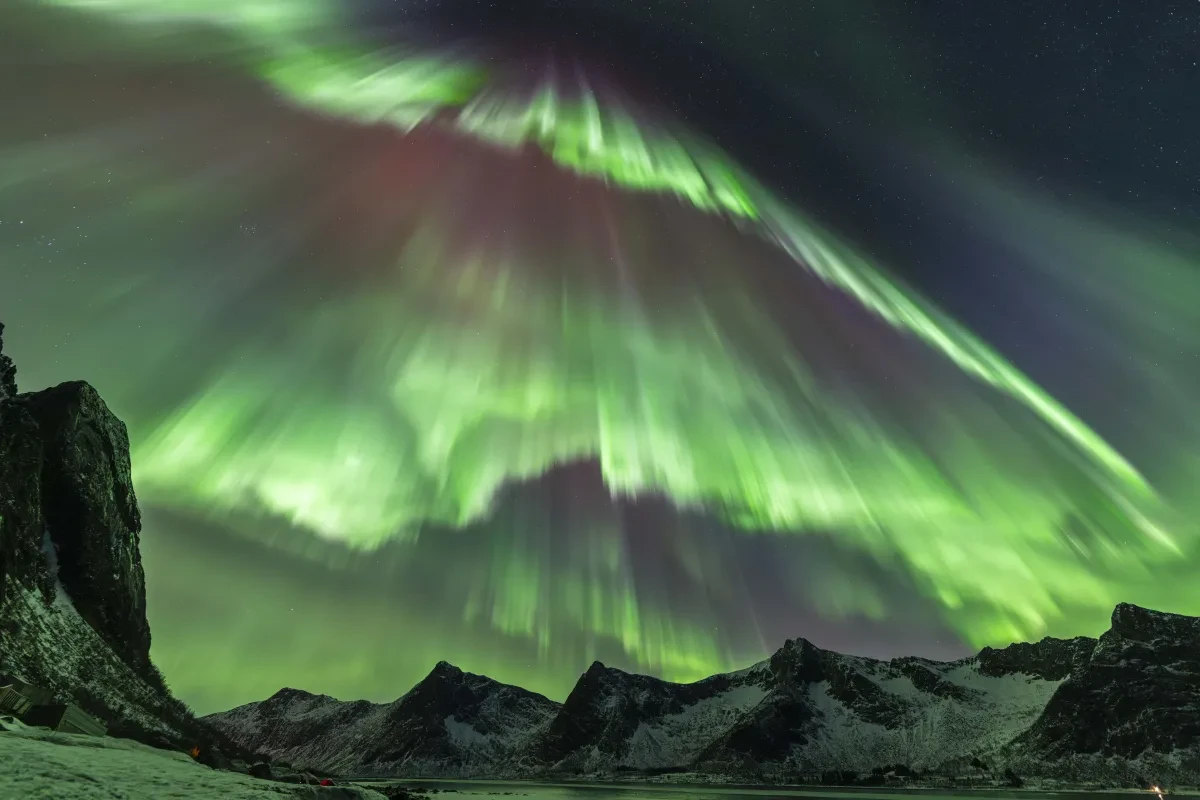
An Auroral Deluge by Julien Cadena
Lyngen, Troms, Norway
‘I had set up my camera facing the iconic ‘Devil’s Teeth’ peaks on the island of Senja in Norway. I was hoping the Northern Lights would rise directly above the jagged summits, but they flared up in the opposite direction instead. Their intensity and speed were breathtaking.
'The real challenge with this shot was avoiding overexposure from the exceptionally bright aurorae. As a result, the foreground was left underexposed, although that was easily balanced in post-processing.’
Image
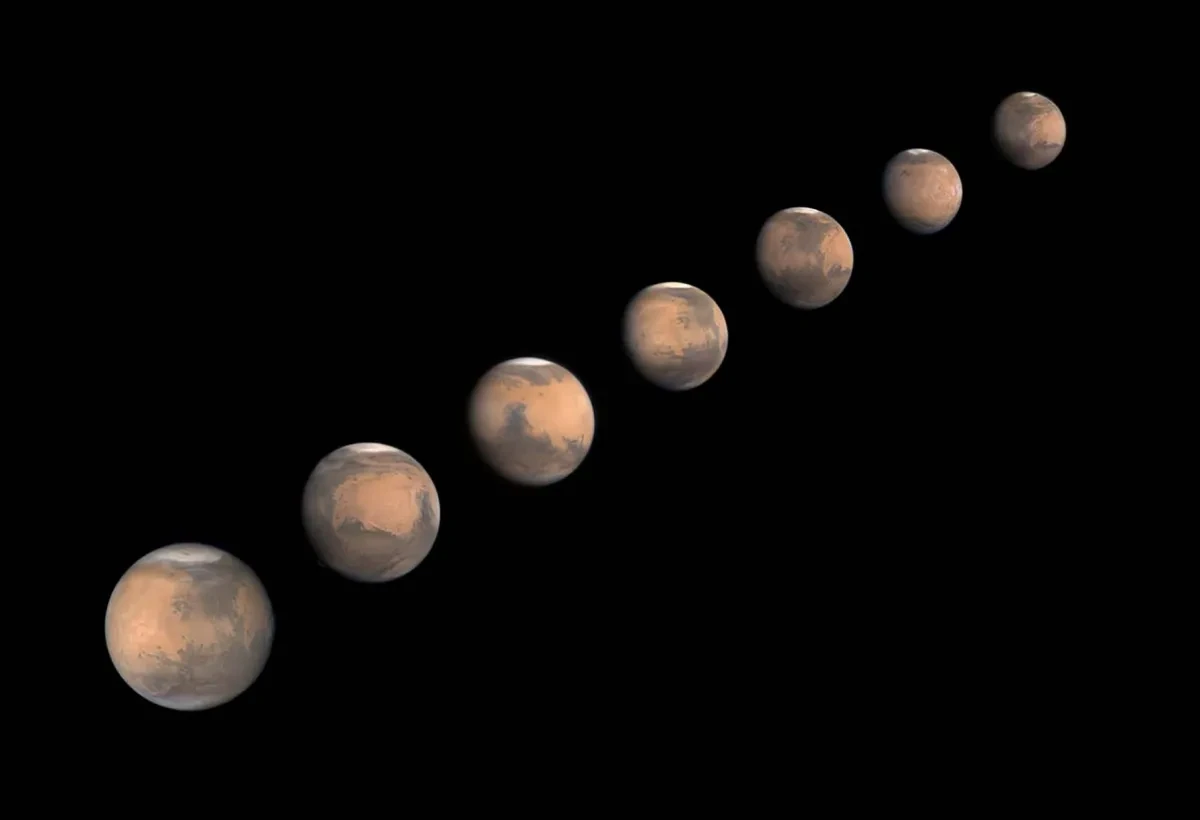
Mars in 2025 by Tom Williams
Trowbridge, Wiltshire, England
‘This composite image shows several views of Mars after it reached opposition, the point at which Earth was directly between Mars and the Sun. All the images were captured at the same scale, highlighting how quickly the planet decreases in apparent size as it recedes from Earth. Seasonal changes are also visible, with the polar ice cap shrinking as the planet’s northern hemisphere enters local spring/summer.
'Notably, Mars’s four largest volcanoes are clearly visible as dark ‘spots’ in the middle image, with Olympus Mons, the largest known volcano in the Solar System, positioned at the upper left.’
Image
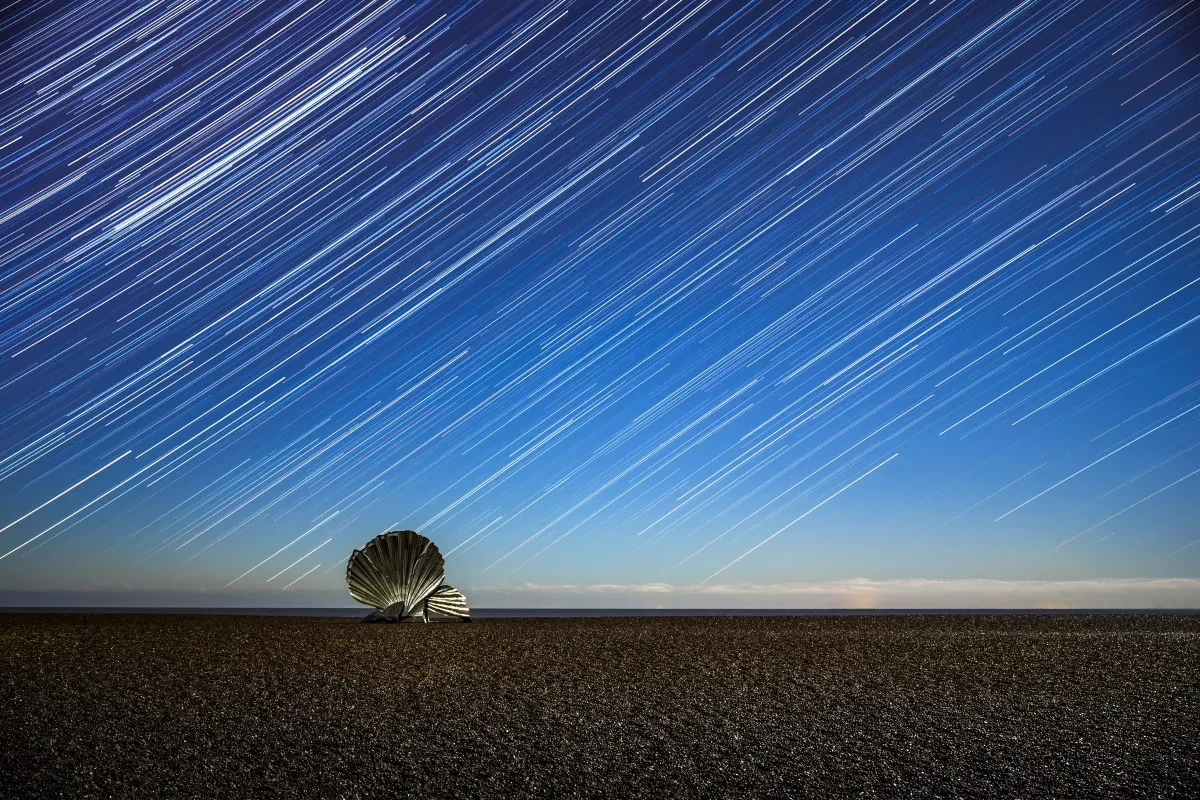
I Hear the Stars by João Yordanov Serralheiro
Aldeburgh Beach, Suffolk, England
‘This image of star trails above the Scallop sculpture on Aldeburgh Beach has been a long time coming while I waited for the right night and conditions. It represents the quiet and peaceful feeling of sitting down by the sea, listening to the waves come and go as time passes by – demonstrated here by the movement of the stars.’
Image
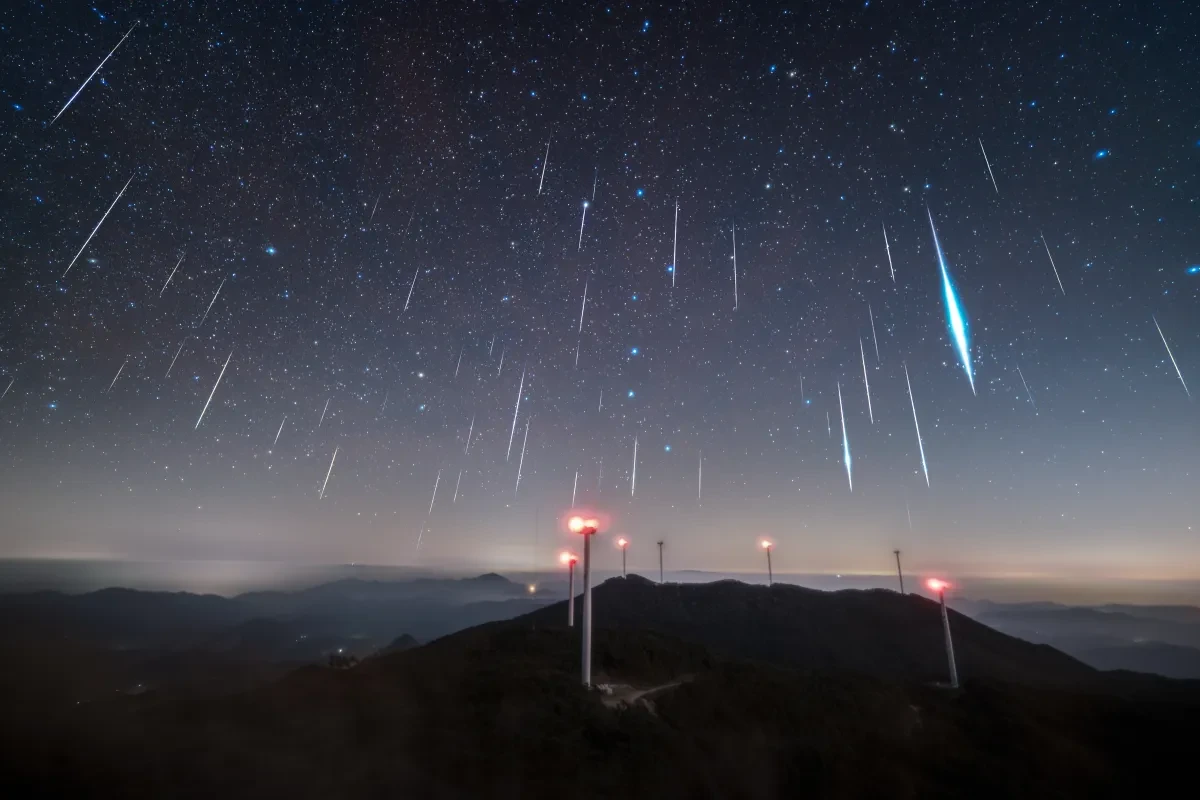
Meteor Shower Over the Big Dipper by ZhiPu Wang
Sanming, Fujian Province, China
‘The Geminid meteor shower was once again reliable in 2025, with numerous bright meteors. After its radiant [the point from which the meteors appear to emanate] rose on the night of 14 December, the sky was filled with falling stars.
'At midnight on the 15th, I pointed my camera towards the rising Plough asterism (also known as the Big Dipper) in the constellation Ursa Major. I originally planned to photograph only the Plough, using a soft-focus filter to enhance the star points, but during the shoot I noticed a great number of meteors in the field of view, so I adjusted my settings to capture them. Within three hours, I had captured dozens of meteors.’
Image
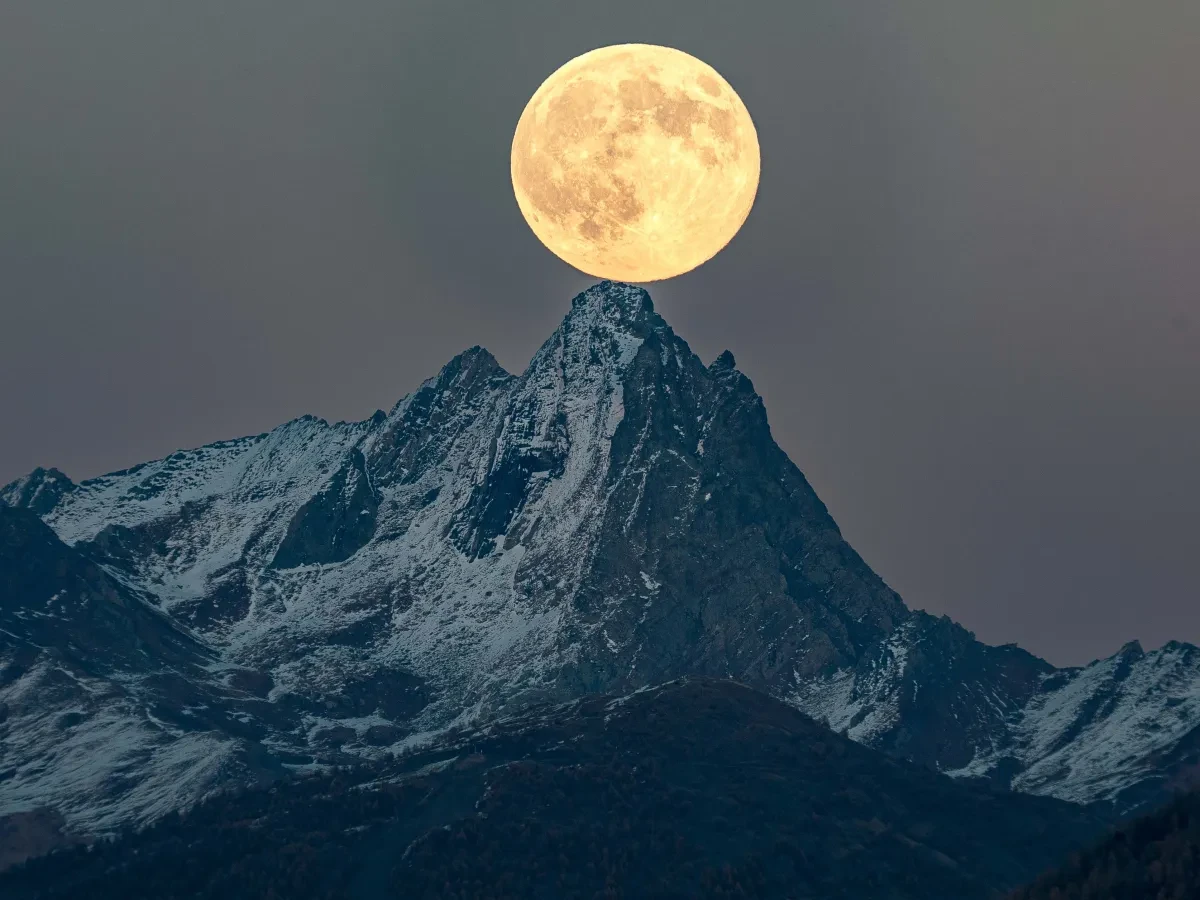
Watched by the Moon by Jean-François Gely
Arvieux, Provence-Alpes-Côte d’Azur, France
‘Once a month, the Moon rises just as the Sun sets. This creates fantastic natural scenes. I love finding the perfect spot from which to photograph it with an iconic peak like Bric Bouchet, as seen here.’
Image
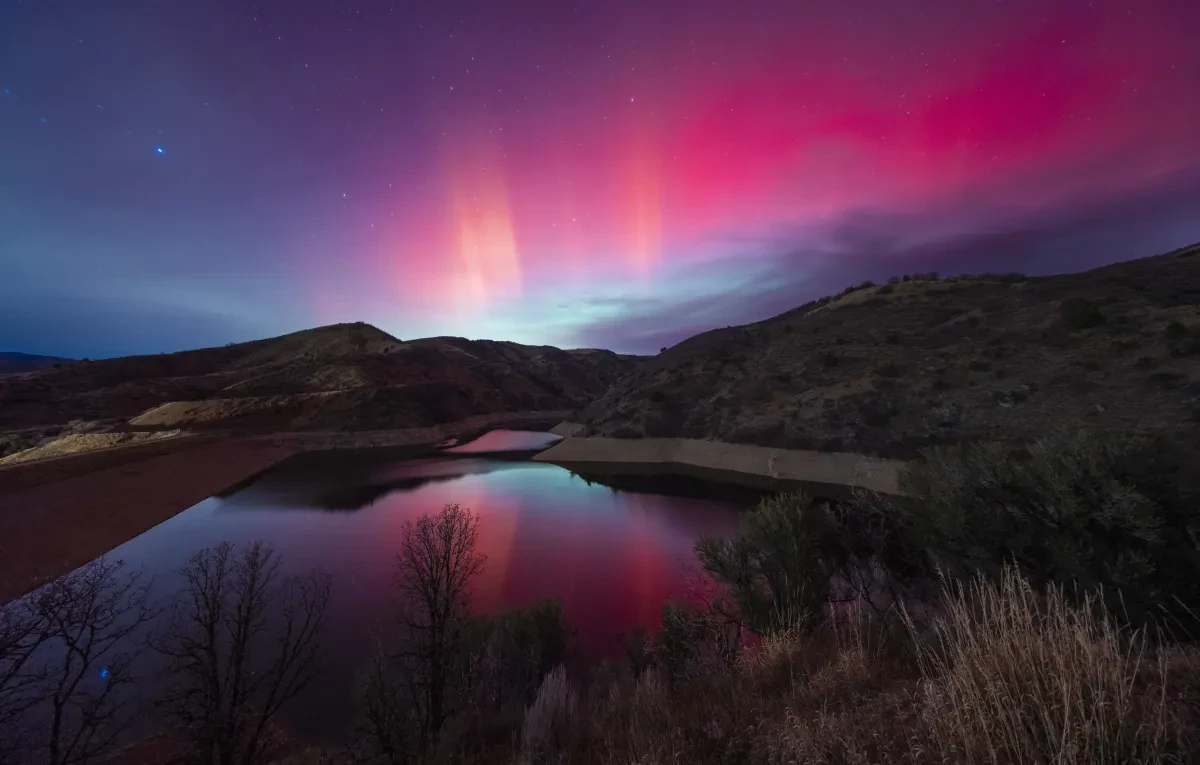
Aurora Over Causey Reservoir by Samuel Morse
Weber County, Utah, USA
‘I managed to catch this aurora near Causey Reservoir with a friend of mine. We were up against clouds and heavy traffic, with a lot of people trying to see the same auroral display as us, but we managed to find it. This is a straightforward single-frame image with no compositing or other alterations, although I did push the colour balance a bit towards blue to bring out the vibrancy and produce colours that were complementary to the red in the sky.’
Image
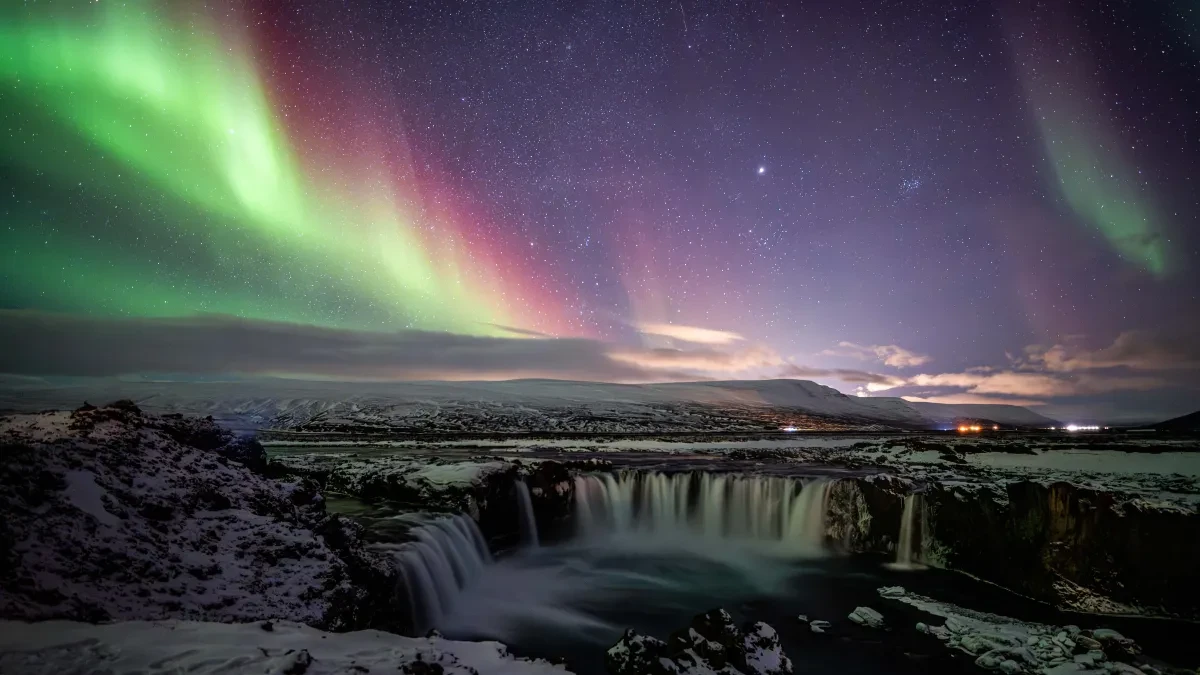
Colourful Aurora and Waterfall by Yifan Cao
Goðafoss Waterfall, Þingeyjarsveit, Iceland
‘I witnessed a major aurora outburst in Iceland, during which the whole sky shone green, red and purple. Goðafoss Waterfall is a famous scenic spot which is strongly linked to Norse mythology. I stayed there for two days, looking at the forecast every hour, to try to capture this unforgettable moment.’
Image
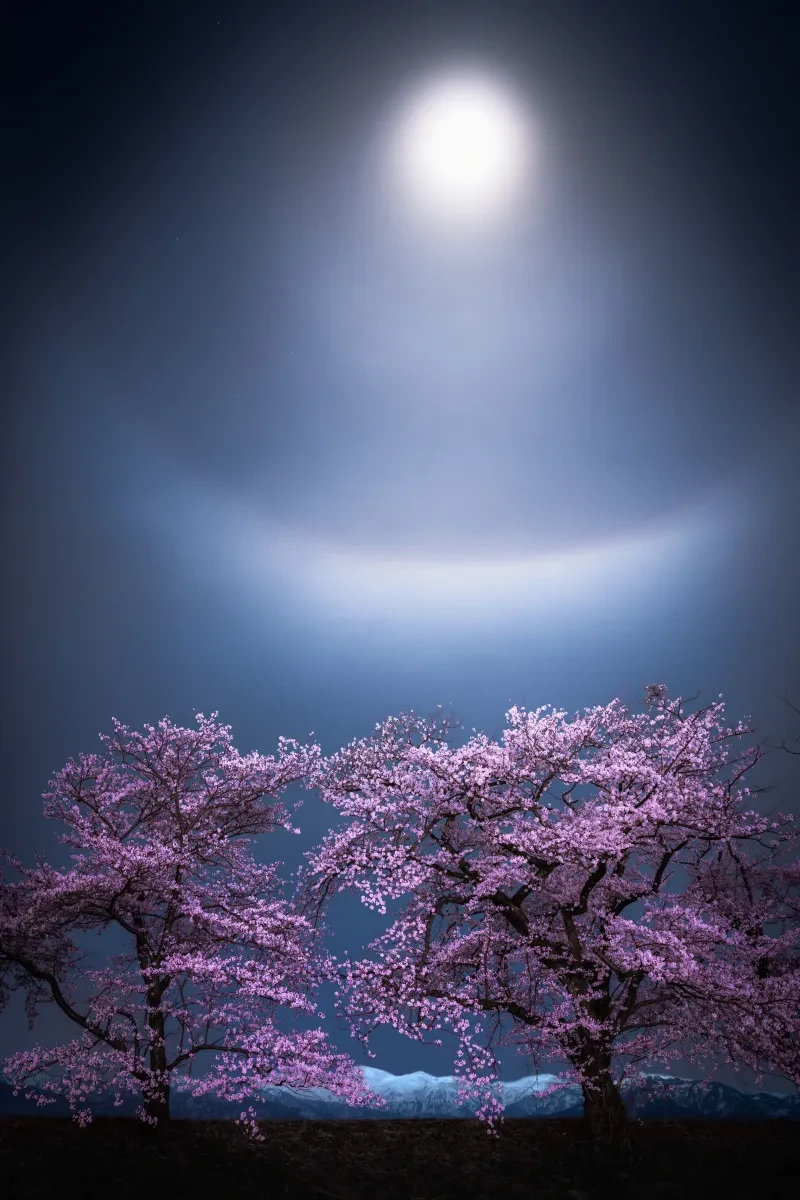
Setsu-getsu-ka by Takanobu Kurosaki
Asahi, Toyama Prefecture, Japan
‘“Setsu-getsu-ka” is a traditional Japanese expression that means “snow, moon and flowers”. This photograph captures that trio at the Funakawa River by framing Mount Asahi – Asahi’s symbolic peak – and cherry blossom trees under a lunar halo and a rare, faint tangent arc [optical phenomena caused by the refraction of moonlight through ice crystals in clouds]. The blossoms last for only about ten days, making their synchronisation with the snow-capped mountain and these atmospheric optics a once-in-a-season miracle. To emphasise the fragility of the scene, I captured this as a single exposure rather than as a composite.’
Image
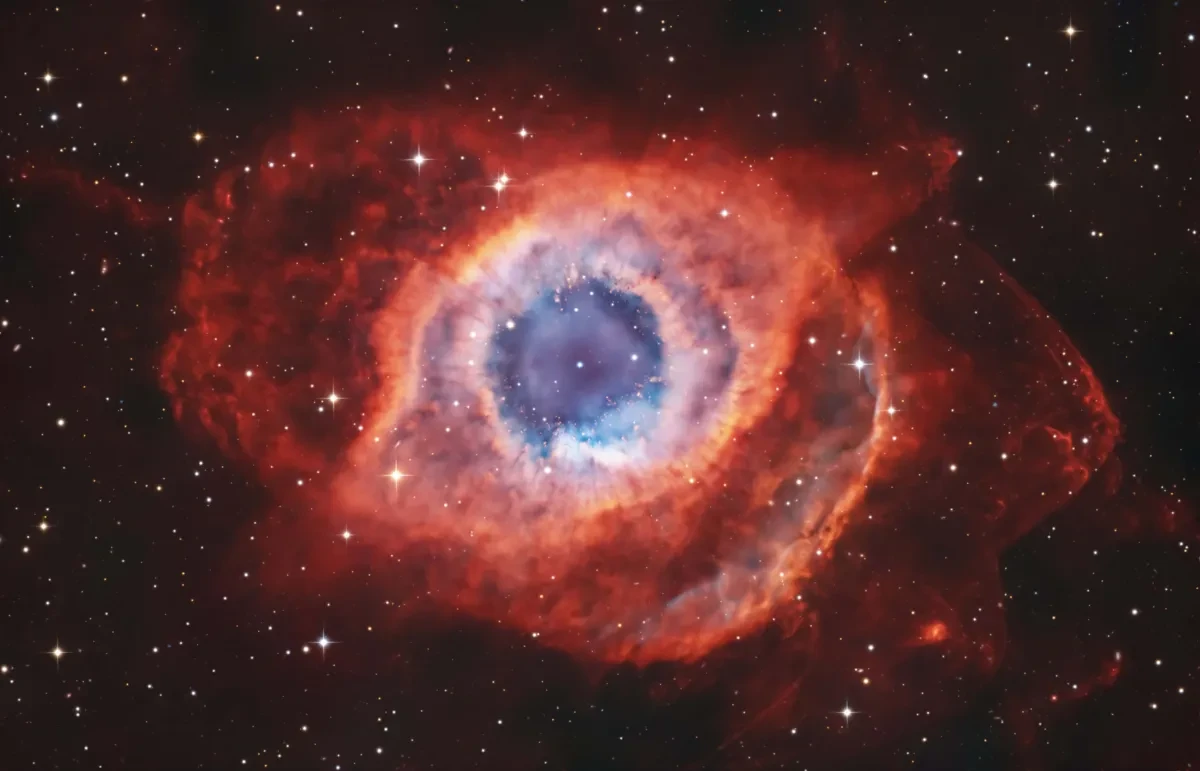
NGC 7293: The Helix Nebula by Humbert Cédric
Elqui Province, Coquimbo, Chile
‘NGC 7293, better known as the Helix Nebula, is one of the closest and most spectacular planetary nebulae observable from Earth. It is located about 650 light years away in the constellation Aquarius.
'Planetary nebulae are the remnants of dying stars. In the Helix Nebula’s case, about 10,000 to 12,000 years ago, a star similar to our Sun ejected its outer layers into space at the end of its red giant phase. The extremely hot remnant core emits intense ultraviolet radiation that ionises the surrounding gas, causing it to glow with spectacular colours.’
Image
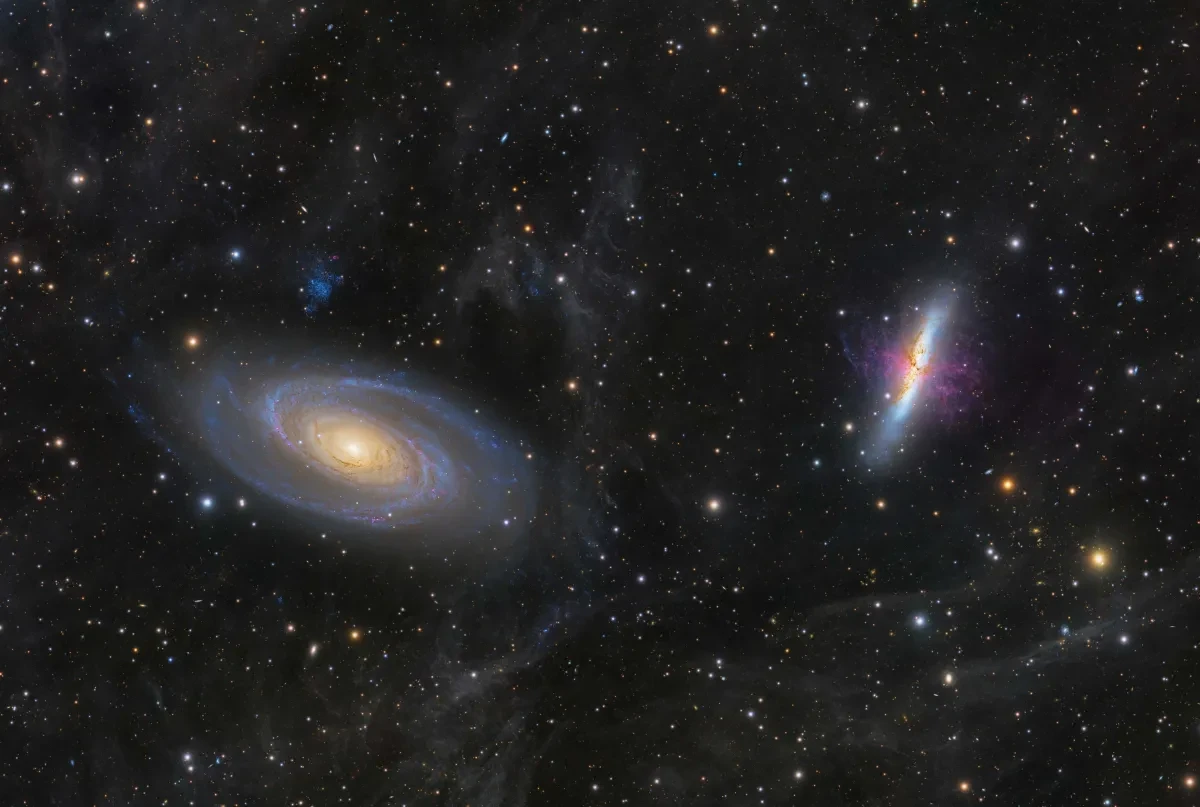
Cosmic Neighbours: Beauty and the Beast by Yijing Zhu and Xinghan Yang
Ürümqi, Xinjiang Uyghur Autonomous Region, China
‘This image captures a dramatic cosmic pairing: the serene elegance of Bode’s Galaxy (M81, left) alongside the chaotic violence of the Cigar Galaxy (M82, right). Located about 12 million light years from Earth, these two neighbours are locked in a gravitational dance that has shaped their destinies profoundly. M81 retains its perfect grand design spiral form, a picture of galactic grace.
'In stark contrast, M82 is a starburst galaxy, reeling from a close encounter with its larger companion. This gravitational disturbance has triggered a furious burst of star formation at its core, which blasts into space spectacular red filaments of superheated hydrogen gas that are clearly visible in this deep exposure.’
Image
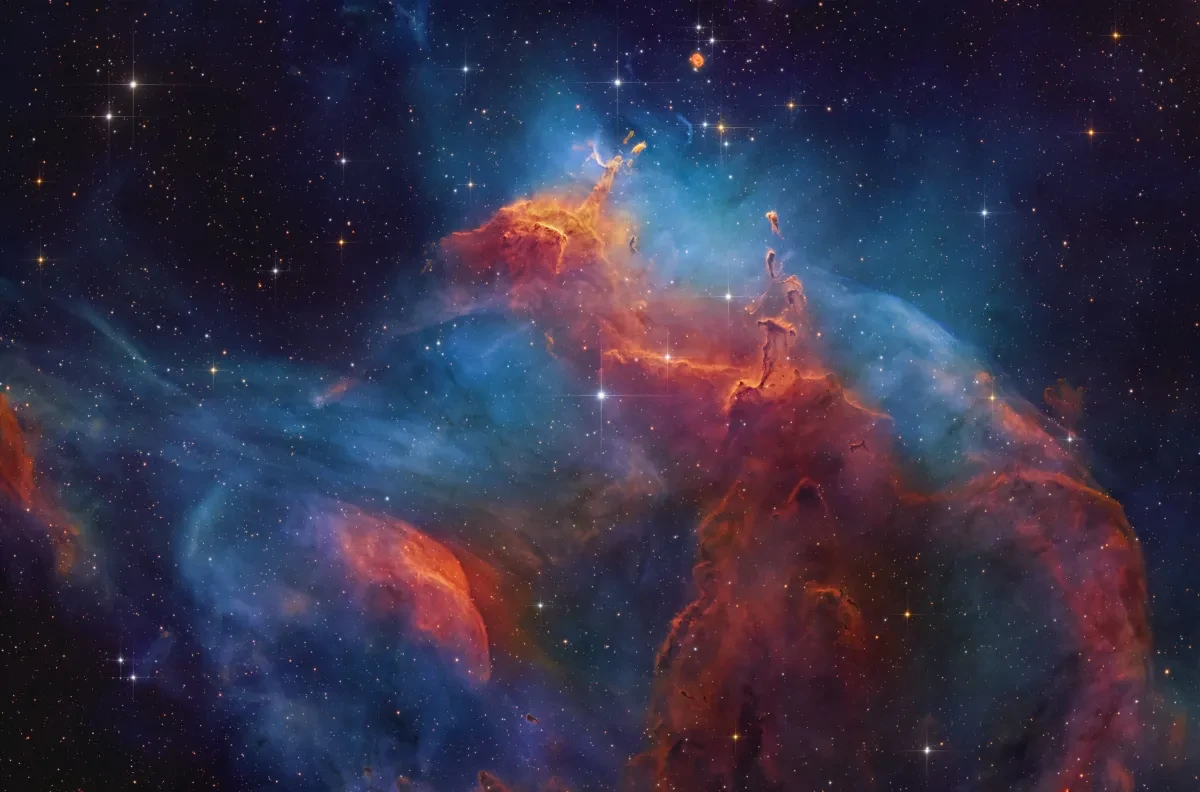
Gum 37: The Southern Tadpoles (or 'Teapot Nebula') by Ani Shastry
El Sauce Observatory, Río Hurtado, Chile
'Gum 37 is an HII-complex in the southern sky, where stellar radiation carves pillars, rims and curling shock fronts. It is commonly called the Southern Tadpoles Nebula, but the longer I look, the more I think it resembles a cosmic teapot pouring cobalt mist into the dark.
'Here, ember-red hydrogen ridgelines glow like heated ceramic alongside areas of denser gas, while cool blue oxygen floods the surrounding cavities, tracing winds and ionisation fronts that peel open the nebula layer by layer. Dark dust seams are visible within the brighter areas, giving the whole scene depth.’
Image
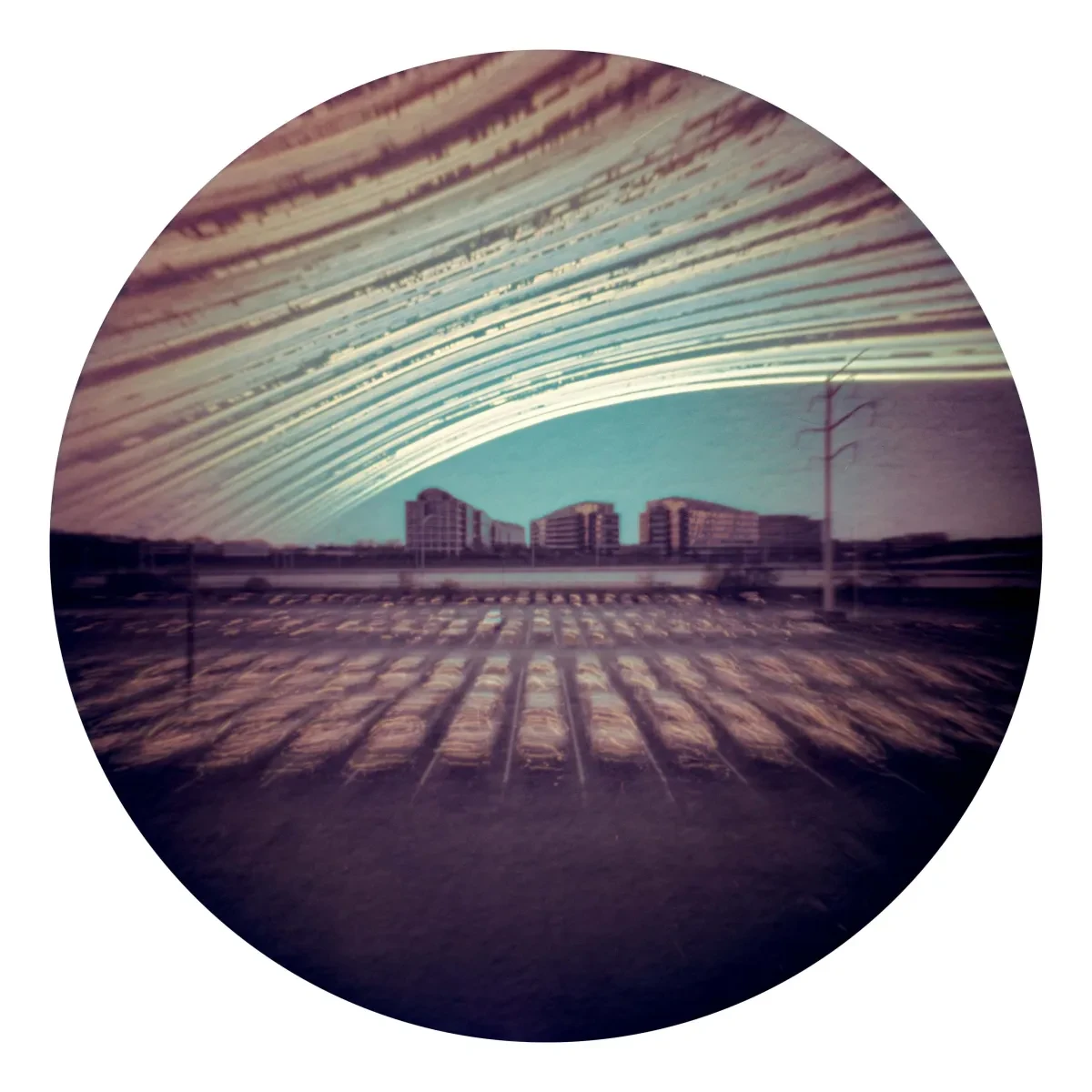
Solargraph 182 Days by Ksawery Wrobel
Shortlisted in the Annie Maunder Open Category
‘Solargraphy is a photographic technique that uses a homemade pinhole camera and photosensitive paper to create extremely long exposures. Depending on how long the camera remains in place, the final image records the Sun’s path across the sky from dawn to dusk, as well as its gradual shift from north to south (or vice versa) between the solstices. Each bright streak represents a day of sunlight. If a streak is missing, it means the Sun was hidden by clouds. To create my solargraph photos, I use small round aluminium jars, as they are easy to install in urban spaces.’
Image
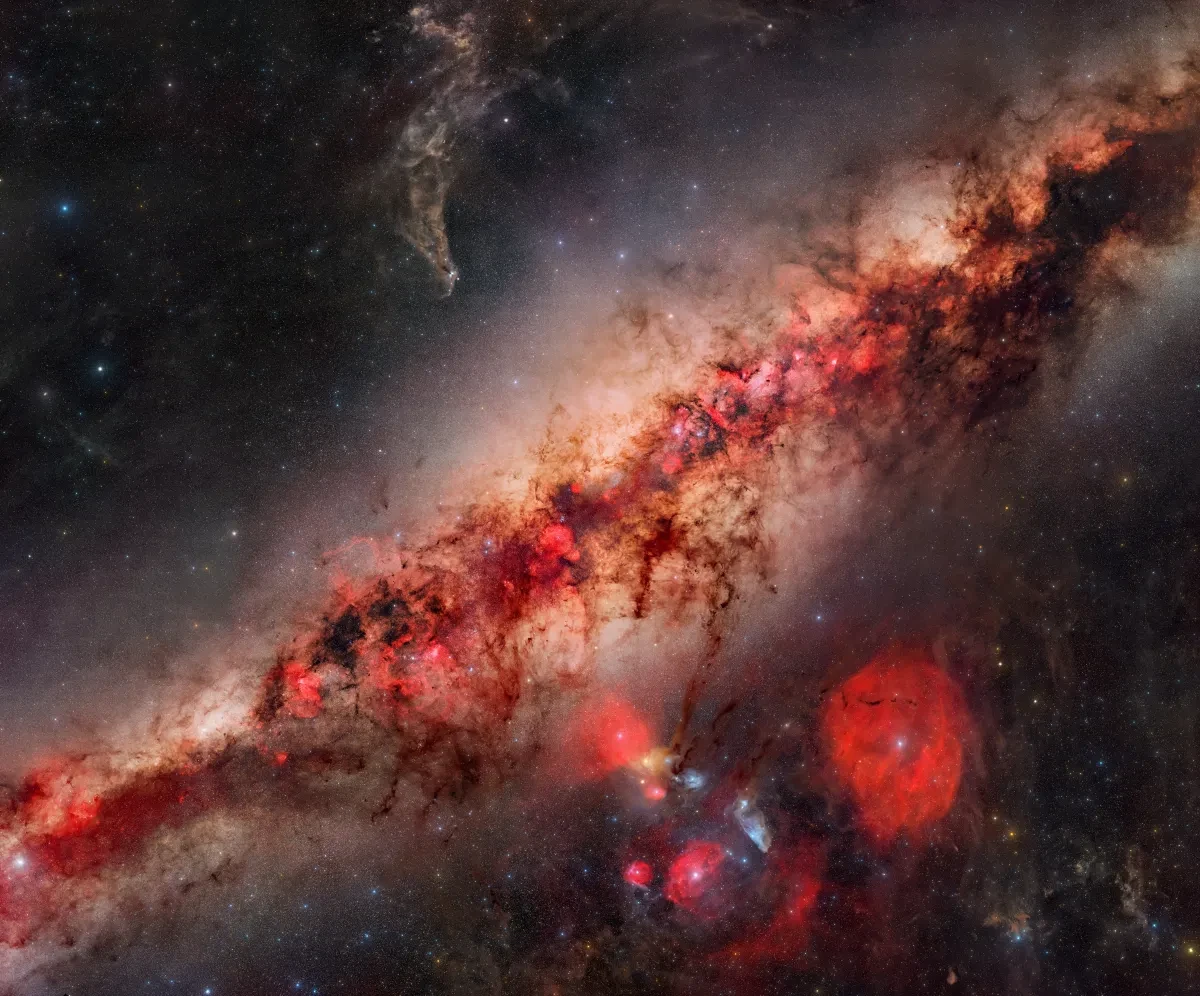
A Deep Look Into the Milky Way's Core by Jakob Sahner
Koireb, Windhoek Rural, Namibia
‘I captured this mosaic with two cameras – one for RGB colour and one for H-alpha – to capture as much detail and structure as possible.
'The project nearly fell apart when unexpected Newton’s rings (an optical phenomenon that can occur when you work with filters) appeared in many of the panels after stacking. I considered abandoning the entire dataset, but eventually found a way to correct most of it and keep the image intact. In the end, this became a roughly 750-megapixel mosaic. It was hard-won and took many weeks to refine, but I finally had the version I set out to create. It was an unforgettable adventure!’
Learn more about ZWO Astronomy Photographer of the Year

Read more
Discover stories from previous competitions
Billions of stars, one winning photograph: the core of Andromeda
A trio of photographers from China won the ZWO Astronomy Photographer of the Year 2025 competition with a breathtaking image of the core of the Andromeda Galaxy
A happy accident: photobombed by a meteor
Learn more about this breathtaking accidental capture of a fleeting fireball meteor, winner of Best Newcomer in ZWO Astronomy Photographer of the Year 2025
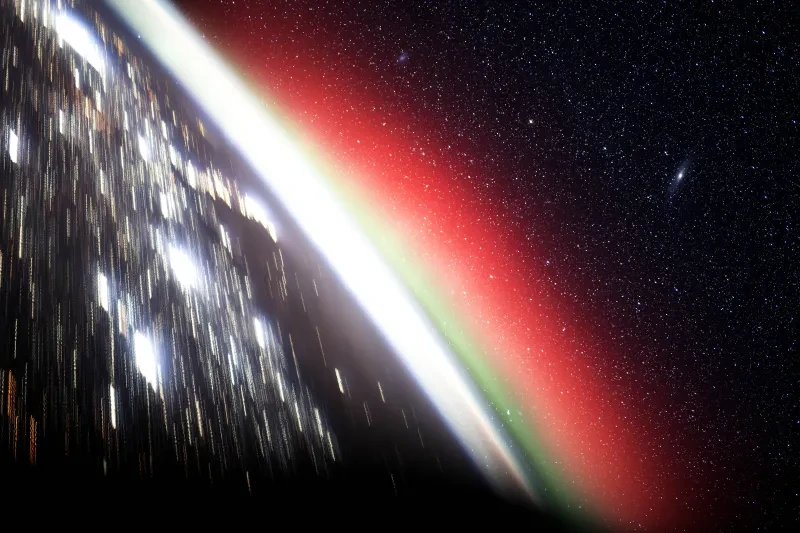
Earth and space through an astronaut's lens
Discover how NASA astronaut Don Pettit takes out-of-this-world photographs from the unique and constantly moving vantage point of the International Space Station
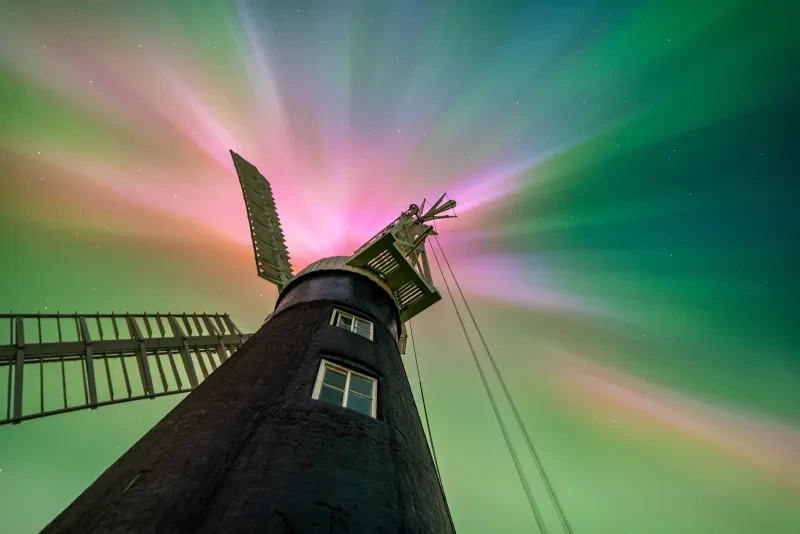
A rare spectacle: photographing the aurora in England
An incredibly strong solar storm in May 2024 made the aurora visible across the UK. Astrophotographer Darren Flinders seized this once-in-a-lifetime opportunity
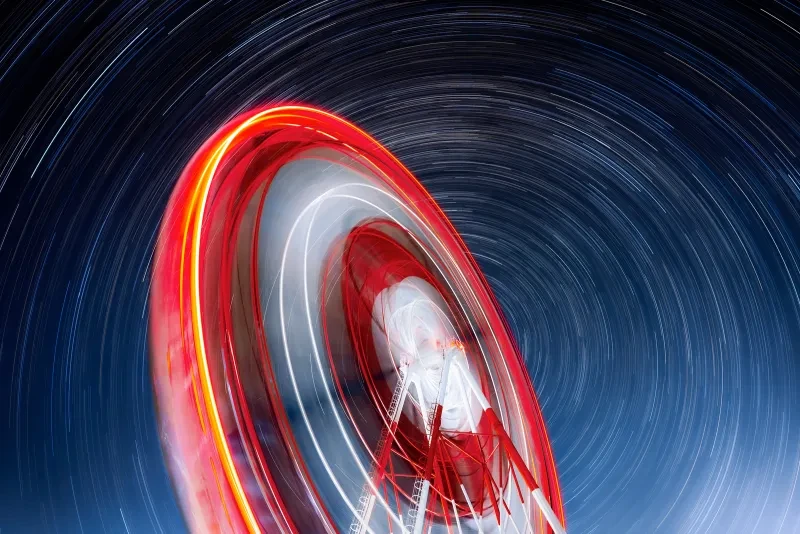
'Observing the Universe reveals how small yet precious we are'
An accident led Takanobu Kurosaki to rediscover life’s beauty and fall in love with astrophotography. Explore his image shortlisted in ZWO Astronomy Photographer of the Year 2025
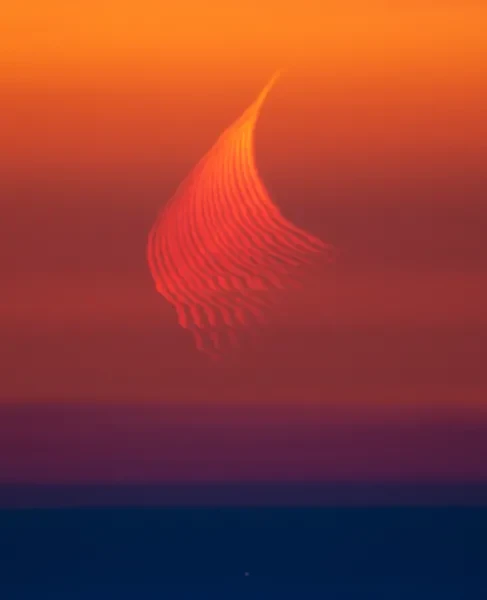
Photographing a natural optical illusion
Meet Marcella Giulia Pace, who won the Our Moon category of the ZWO Astronomy Photographer of the Year 2025 competition with her unique image of a natural optical spectacle
Beads of sunlight: photographing an annular solar eclipse
Ryan Imperio's spellbinding image of our Sun earned him the top prize in Astronomy Photographer of the Year 2024
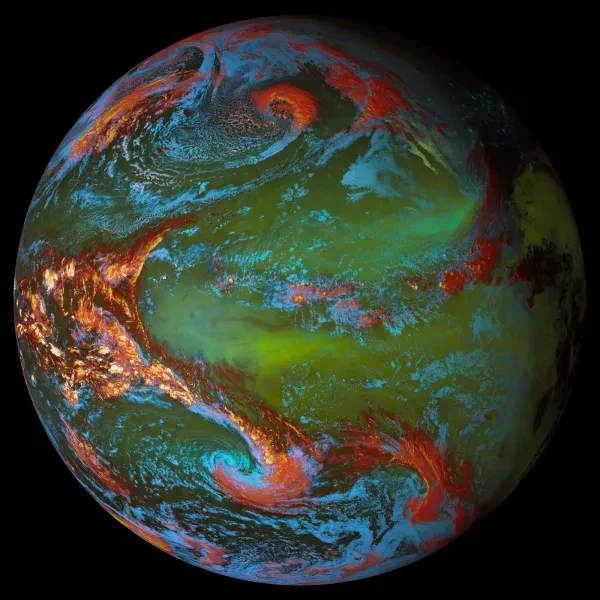
Anatomy of a habitable planet: Earth as you've never seen it before
Sergio Díaz Ruiz uses satellite imagery to explore climate change by creating an image of Earth as it might be analysed by a distant alien civilisation
A stellar duo: two young astrophotographers shooting for the stars
Meet the youngest entrants in Astronomy Photographer of the Year 2024: brothers Benjamin and Joshua Lawler
Finding community through astrophotography
Sophie Paulin and Tom Williams struck up a friendship in an online astrophotography forum. Discover how they combined their expertise to win a prize in Astronomy Photographer of the Year
Behind the lens with Monika Deviat
Dancer, educator, heavy metal fan and astrophotographer, discover more about the Aurorae winner of Astronomy Photographer of the Year 2023
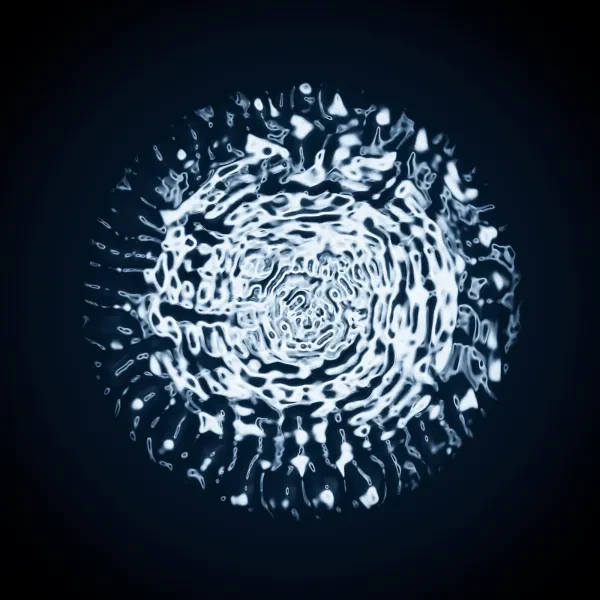
Seeing the sound of a black hole: the story of Black Echo
How do you picture something that is invisible and inaudible to humans? Artist and photographer John White has the answer
Sponsors and supporters


Header image: Gum 37: The Southern Tadpoles (or 'Teapot Nebula') © Ani Shastry