
The best time to see and photograph a planet is when it is at 'opposition'. Find out more and check the key opposition dates for Mars, Jupiter, Saturn, Uranus and Neptune.
What is a planet in opposition?
All the planets in the Solar System orbit around the Sun. At certain points during these orbits, the Earth finds itself directly between the Sun and another planet. This is the moment at which that planet is said to be 'in opposition'.
When Saturn is in opposition for example, Earth is between the Sun and Saturn. From our vantage point on Earth, Saturn is on the 'opposite' side of the sky to the Sun: when the Sun sets in the west, Saturn appears in the east.

Only planets that are further out in the Solar System than the Earth can be in opposition: Mars, Jupiter, Saturn, Uranus and Neptune. Because Venus and Mercury are closer to the Sun than the Earth, they can never be in opposition.
Why is a planet in opposition important?
Some of the best times to see planets in the night sky occur when they are at opposition. During opposition the planet appears at its largest and brightest, and it is above the horizon for much of the night. For stargazers and astrophotographers, it's an ideal time to view and photograph the superior planets.
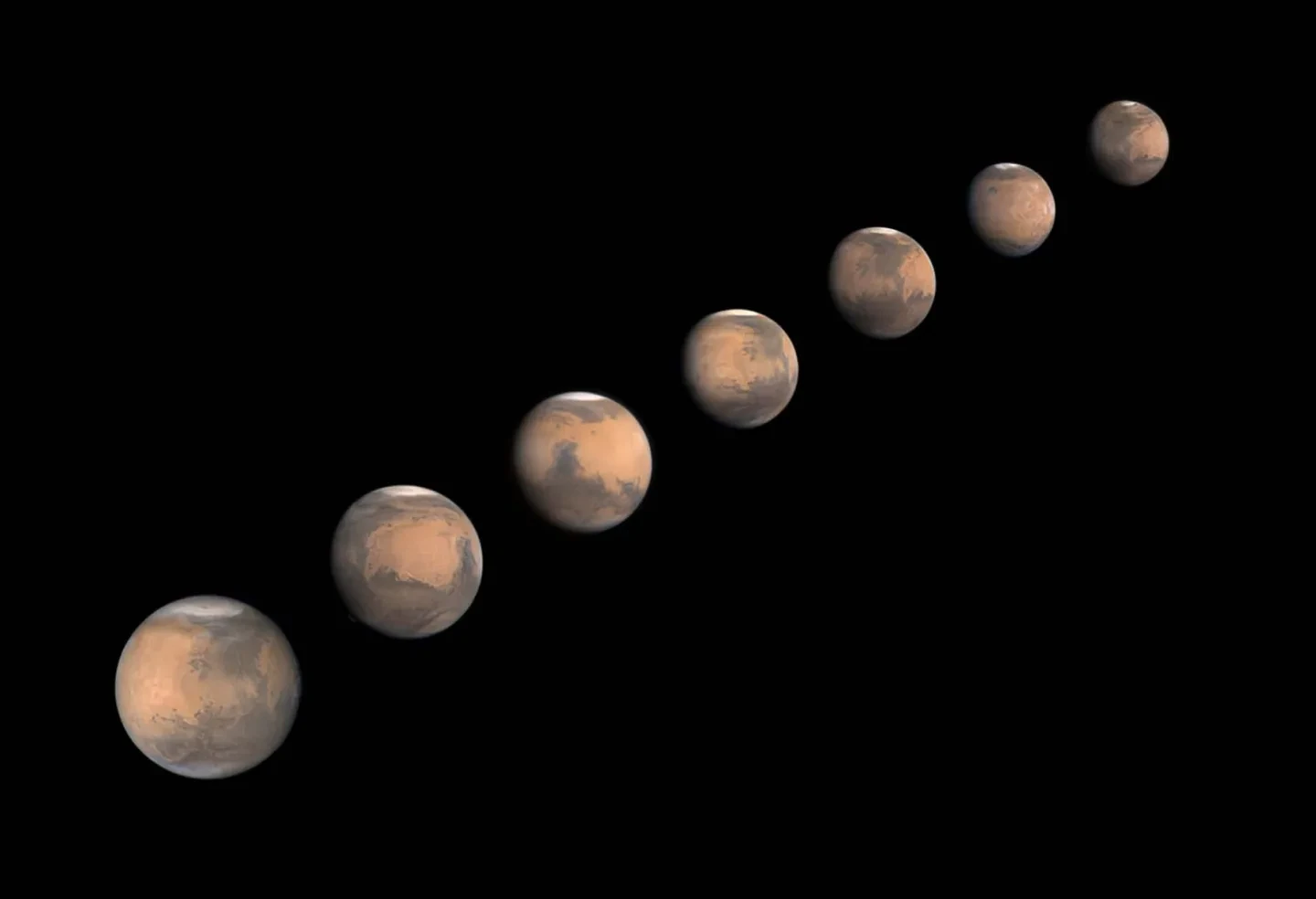
Planet opposition dates
Planetary oppositions for Jupiter, Saturn, Uranus and Neptune occur almost every year, as Earth on its much faster orbit passes between these planets and the Sun.
Mars is slightly different: because Earth and Mars are relatively close together in the Solar System, an opposition of Mars happens roughly every 27 months.
Below are the upcoming dates when planets will be at opposition:
| Planet | Date of opposition |
| Uranus | 25 November 2026 |
| Jupiter | 11 February 2027 |
| Mars | 19 February 2027 |
| Neptune | 28 September 2027 |
| Saturn | 18 October 2027 |
| Uranus | 30 November 2027 |
How to photograph a planet in opposition
"If you really want to get the best photo of a planet you want to try and aim for when it’s riding really high in the sky and ‘at opposition’," explains Steve Marsh, ZWO Astronomy Photographer of the Year judge and BBC Sky at Night Magazine art editor.
"You want the air to be nice and still," he adds. "If you can get all those three things combined then you are going to have a really great picture at the end of it."
See stunning space photos at the ZWO Astronomy Photographer of the Year exhibition
Never miss a shooting star
Sign up to our space newsletter for exclusive astronomy news, guides and events.
Discover more space and astronomy
from the Royal Observatory Greenwich.
Astronomy blog
Read our monthly guides to the night sky, and check out the latest news from the Royal Observatory Greenwich astronomy team
Meteor shower guide 2026 and 2027
Want to see shooting stars? Check the key dates for major meteor showers in the UK in 2026 and 2027, and how to see them in the night sky
Astronomy with the naked eye
Learn what you could see in the night sky with no equipment from the Royal Observatory Greenwich; from galaxies and meteor showers to comets, star clusters, cloud formations and more
Full Moon calendar 2026 and 2027
Check the dates for every full Moon throughout 2026 and 2027, learn about the Moon's phases, 'supermoons' and more
What are the Pleiades?
Take a closer look at the Pleiades, an extremely hot cluster of young stars. Also known as the 'Seven Sisters' or M45, this stellar family has been the subject of numerous myths in cultures worldwide

The dwarf planets: Pluto, Ceres, Haumea, Makemake and Eris
We’ve all heard of the planets, but what is a dwarf planet? And why isn’t Pluto a planet anymore?
Summer and winter solstices explained – how the Sun determines the longest and shortest days of the year
Find out how the position of the Sun determines the longest and shortest days of the year in this special Royal Observatory Greenwich Illuminates extract
Noctilucent clouds: what are they and when can you see them?
Discover more about the astronomy phenomenon that makes clouds appear to glow at night
Lunar eclipse guide: When and where to see in the UK
Find out what a lunar eclipse is and when the next total lunar eclipse in the UK will occur
Solar eclipses explained
Find out everything you wanted to know about partial and total solar eclipses, including when to see them in the UK

Photographing a deep-space shark from the Kuwait desert
Explore Ali Alobaidly’s incredibly detailed photo of the Shark Nebula, which was crowned the winner of ZWO Astronomy Photographer of the Year 2026

‘I think everyone benefits from being out under the night sky’
Go behind the lens with Jennifer Rogers, who was shortlisted in ZWO Astronomy Photographer of the Year 2026 with her photo of star trails above a Cornish tin mine
Header image: Jupiter Opposition © Chayaphon Phanitloet - shortlisted in Astronomy Photographer of the Year 2024