

The Milky Way is the galaxy that we live in; a vast, gravitationally bound collection of stars (and their respective planetary systems of planets, moons, asteroids, comets, etc.), gas, dust and dark matter.
The Milky Way has captivated humanity for millennia, since certain sections of its vast spiral arms are visible with the naked eye alone.
Learn more about the Milky Way below, including its shape, structure and where Earth sits within this giant galactic city.
This text is an edited extract from Jake Foster’s new publication Galaxies, which explores the Universe on an expansive scale, showcasing and examining the gargantuan structures that populate our cosmos.
Milky Way facts
Type: Barred spiral galaxy
Number of stars: 100−400 billion
Number of planets: 100−400 billion
Age: Roughly 13.6 billion years old
Size: Approximately 87,000 light years wide (isophotal diameter) and 1,000 light years thick at its spiral arms, increasing to around 10,000 light years thick at its central bulge.
Nearest large galaxy: Andromeda Galaxy
What does the Milky Way look like?
There are no photographs of the Milky Way from the outside since no spacecraft has ever ventured far enough away to take one, as to do so would require a journey of several thousand light years. Consequently, all images showing the Milky Way from outside of it are either artist’s impressions or data visualisations.
Despite the disadvantages that come with attempting to map a galaxy from the inside, we have been able to discern the structure of the Milky Way to a good approximation, with a few caveats.
Image
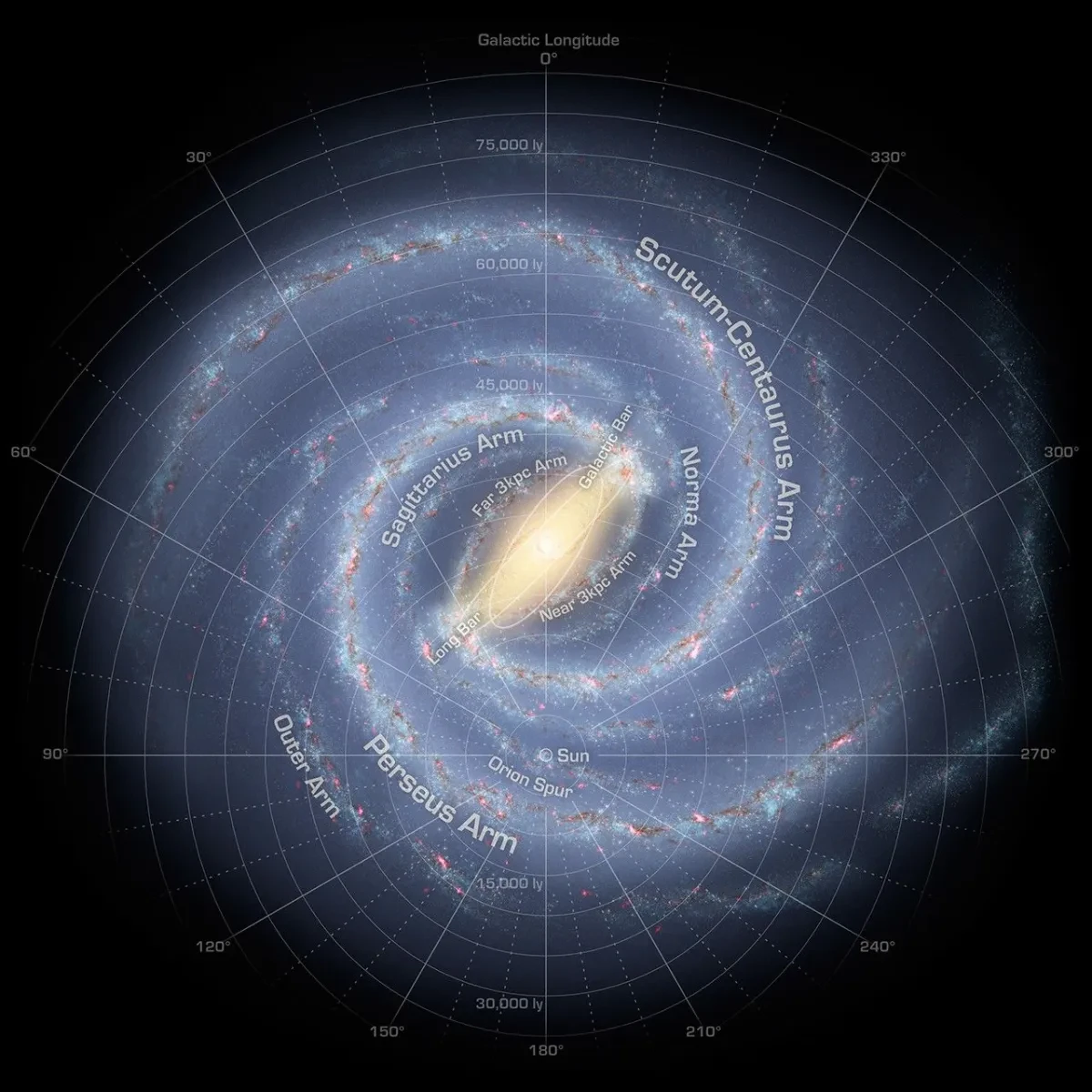
Spiral shape
There is clear consensus that the Milky Way is a spiral galaxy with a central barred region.
Spiral arms of stars and gas emanate from each end of the central bar, but exactly how many is not yet conclusively known. Current evidence strongly suggests that there are four major arms, plus some minor arms and spurs.
The dominant arms are all named after the constellations that they pass through as seen from Earth. They are the Perseus Arm, the Scutum-Centaurus Arm, the Sagittarius Carina Arm and the Norma/Outer Arm. It is within the nebulae of these arms that the majority of the galaxy's stars are formed.
Our Galaxy is not a perfect pinwheel; there are a few quirks in its structure.
This includes the minor arms, which are less prominent, less dense and often thinner than major arms. The Solar System resides in a minor arm called the Orion Arm, which lies between the Perseus and Sagittarius Carina Arms.
There are also spurs, which are arm segments that branch off or sit between spiral arms. Both are notably smaller and contain fewer stars than their larger cousins.
Central bar
This bar is approximately 30,000 light years across. The existence of a central bar wasn’t conclusively proven until 2005, when a team of researchers used NASA's Spitzer Space Telescope to survey stars at the galactic centre.
Visible light, emitted from stars in this region, is blocked from view by a thick band of dust, but, fortunately, infrared radiation can pass through this obstacle more easily.
The galactic bar, which is made up of several billion stars, accounts for around 10% of the total stellar mass of the Milky Way. It is an extension of its central component: the bulge.
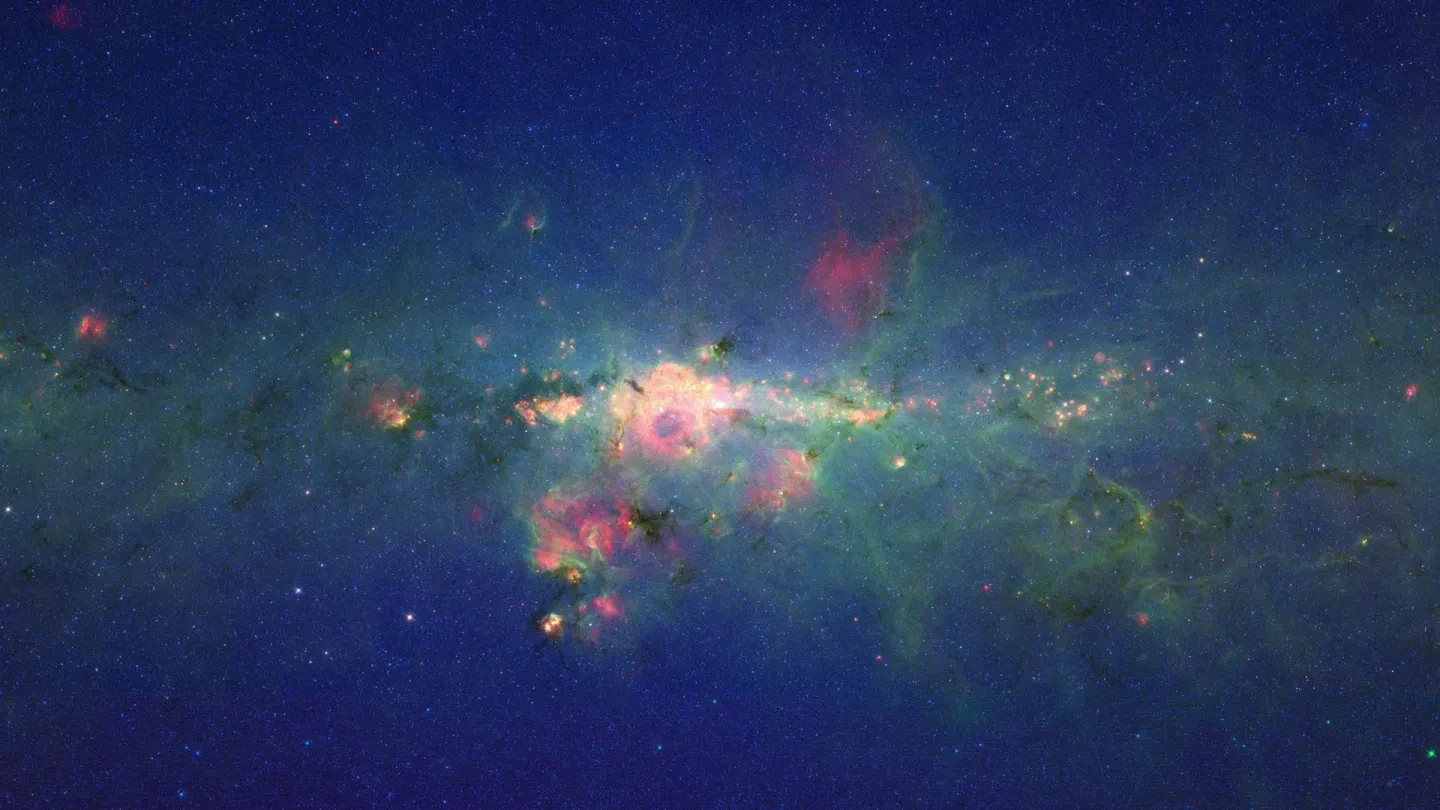
The bulge
The bulge is the thickest part of our galaxy, made up of a tightly packed group of older, redder stars that orbit the galactic centre. The bulge protrudes vertically from the main disk, and it is recognisably peanut-shaped.
It is thought that when the bulge formed billions of years ago it was more of an elongated disk, but over time its midpoint buckled under its own gravity and developed a distinct ‘waist’.
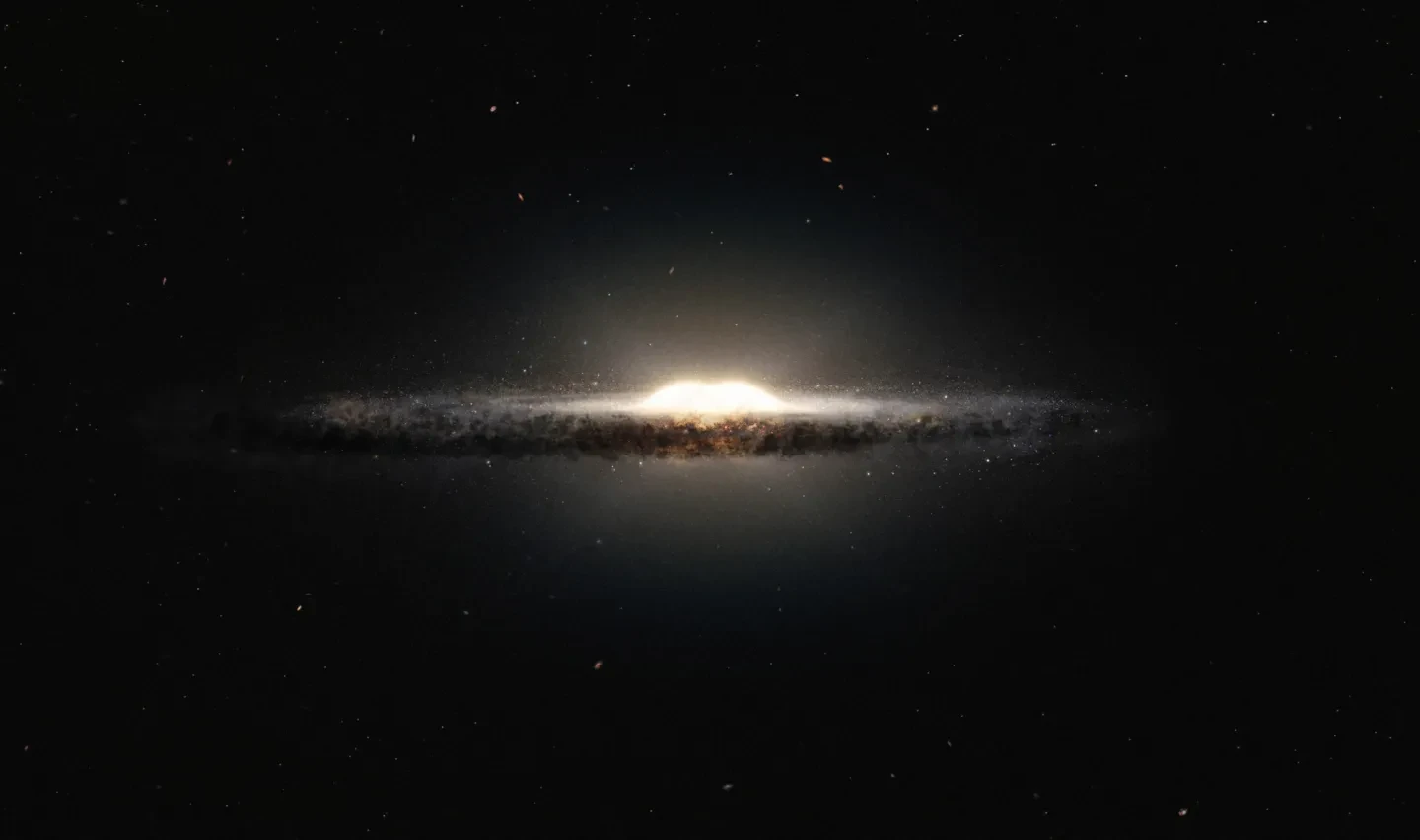
In the middle of the Milky Way’s bulge sits the supermassive black hole Sagittarius A*, which weighs the equivalent of four million Suns.
Inside the bulge, a few hundred light years from the black hole and encircling it, is a ring of giant gas clouds called the Central Molecular Zone (CMZ), the galaxy’s densest accumulation of gas.
The central bar of our galaxy connects to the bulge on two opposite sides, like a pencil skewering the peanut lengthways. The bar siphons gas from the spiral arms and funnels it inward towards the bulge and the CMZ.
Beyond the disk
Outside of its main disk, the Milky Way is surrounded by a stellar halo – a roughly spherical formation of loose stars and globular clusters.
Thought to be over 300,000 light years in diameter, it is significantly larger than the main disk of the galaxy but only contributes 1% of the total system’s stellar mass, and so is incredibly diffuse.
The most famous occupants of this region are its globular clusters, tightly packed balls of hundreds of thousands to millions of stars. There are around 160 known globular clusters in the Milky Way.
Scattered between the clusters and spread out across the rest of the halo are a few billion loose stars, relatively isolated from one another.
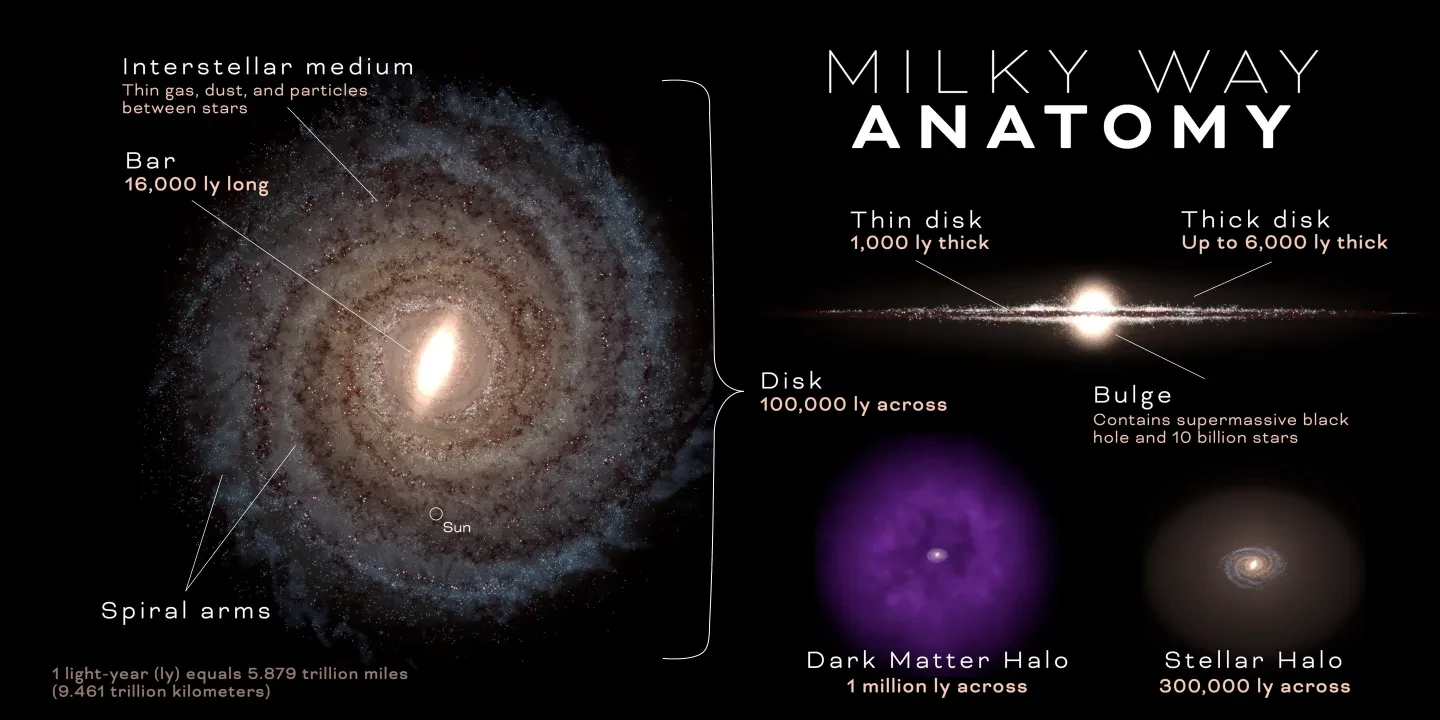
Dark matter halo
Enveloping all this ordinary matter is our dark matter halo, a roughly spherical cloud of dark matter approximately one million light years wide that provides 90% of the Milky Way's total mass.
Within the dark matter halo, the Milky Way’s disk spins with a rotational velocity of 220 kilometres per second (137 miles per second). The disk itself is distinctly warped in appearance due to a ripple passing through it.
Does the Milky Way have satellite galaxies?
Satellite galaxies are smaller companion galaxies that are gravitationally bound to a larger host galaxy, orbiting them as a result.
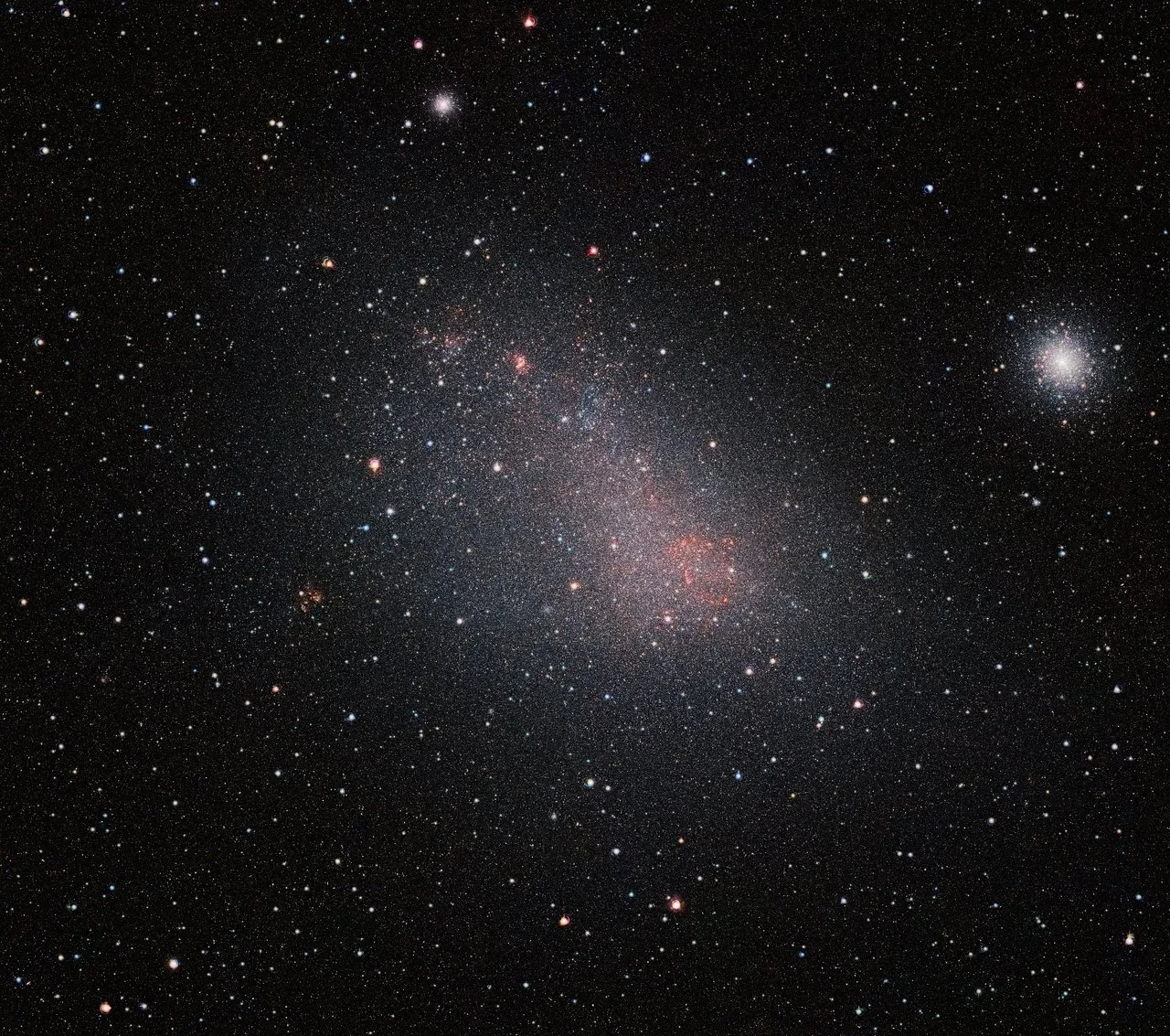
The Milky Way currently has around 60 known satellite galaxies, but some interpretations of data from deep sky surveys suggest that the number may be well over 100. Most satellite galaxies are dwarf galaxies, like the Large and Small Magellanic Clouds that orbit the Milky Way.
What does the Milky Way look like from Earth?
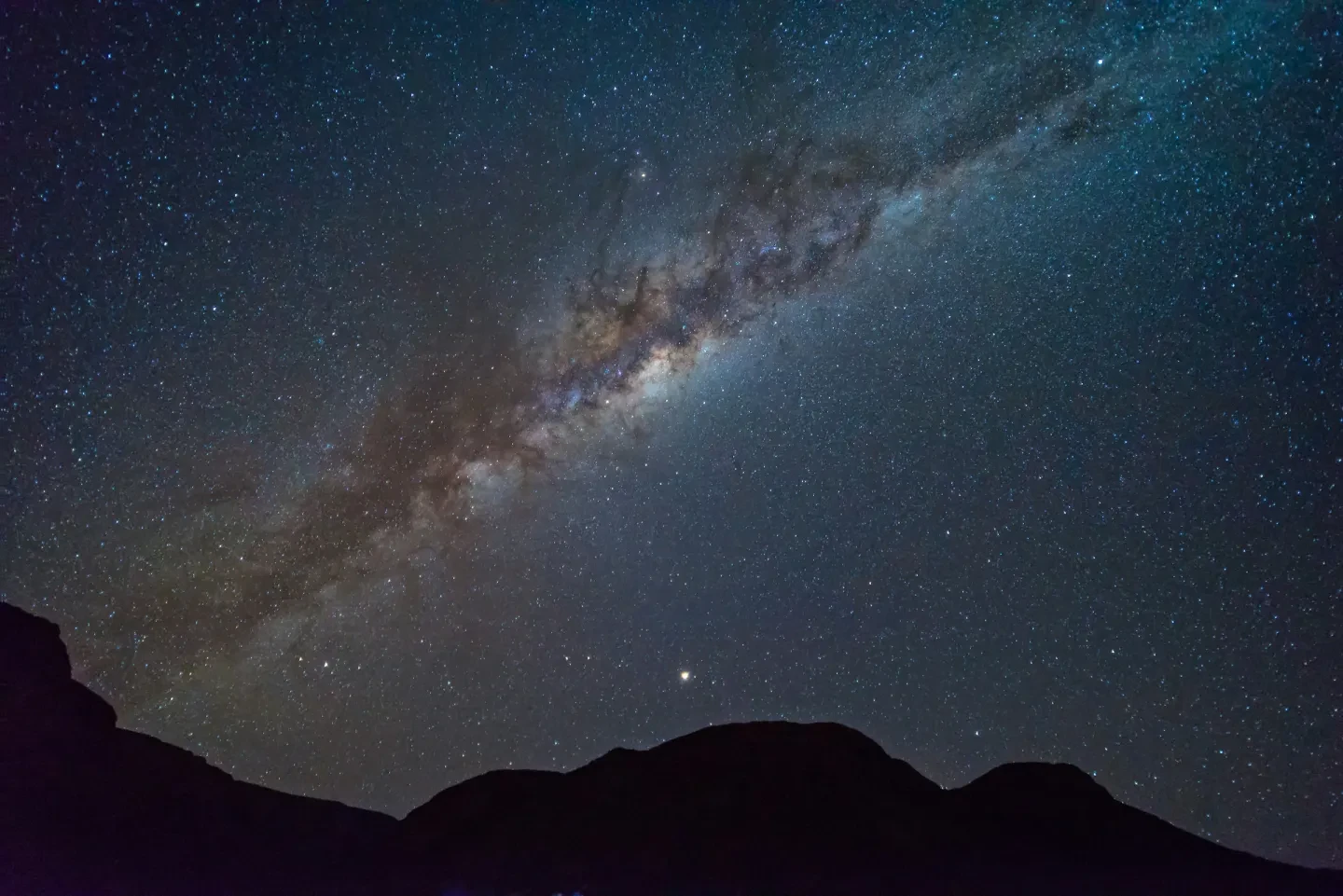
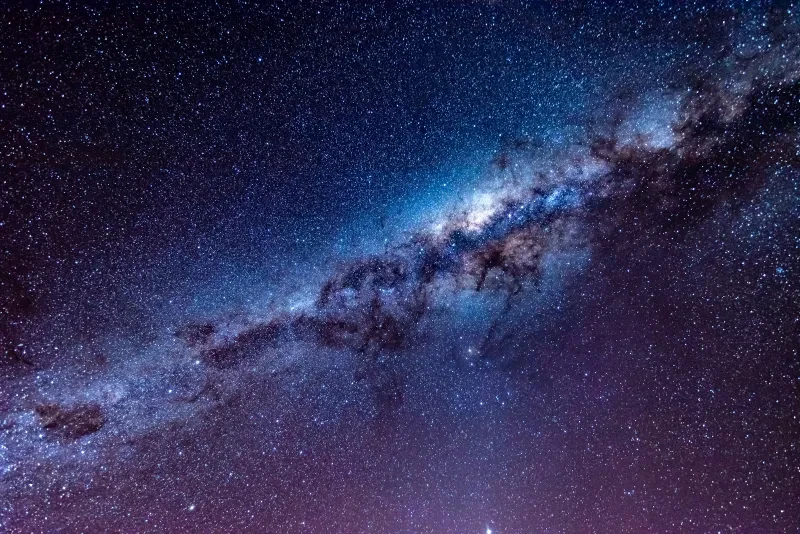
The streak of the Milky Way is visible with the naked eye under dark enough conditions, but it looks noticeably different in the northern hemisphere to how it does in the southern hemisphere, since the Earth’s north and south poles point towards opposite parts of the galaxy.
In the northern hemisphere, we generally face towards one of the outer arms of our galaxy, looking away from the dense gas clouds that obscure the galactic centre.
Conversely, in the southern hemisphere, the central core of the galaxy is prominently seen and reaches much higher in the nighttime sky than it ever does on the occasions it appears north of the equator.
Why is it called the Milky Way?
The ancient Greeks and Romans were fascinated by the Milky Way. This enchantment was explored both through a mythological and scientific lens.
The origin of the Milky Way was explained in a story involving the goddess Hera, whose breast milk splattered across the night sky while she was nursing the infant demigod Heracles.
This story is embedded in our scientific language to this day, with the word ‘galaxy’ deriving from the Greek word ‘galaxias’, meaning ‘milky’.
Where does our Solar System sit in the Milky Way?
Studies have measured our Solar System’s distance from the galaxy’s centre as around 26,000 light years, about halfway out.
The Orion Arm, in which the Solar System is nestled, is an estimated 20,000 light years in length, spiralling outward from the central bar.
When you look up at a clear night sky, most of the stars you can see with the unaided eye are in the same spiral arm as we are. Famous interstellar objects that can be seen with a pair of binoculars, including the Orion Nebula and the Pleiades star cluster, also reside here.
In our Solar System, the planets all orbit the Sun on a similar plane: the ecliptic. Our Solar System doesn’t sit flat in the galaxy; instead it is tilted at an angle of 60 degrees to the galactic disk. This misalignment is why the Milky Way always appears at a steep angle in our skies when compared to the paths of the planets or the Sun.
Is our Solar System moving?
Our Solar System, tilted as it is, is constantly on the move. As a single unit, it travels around the galaxy at a speed of 828,000 kmh (515,000 mph) in an orbit that takes us approximately 230 million years to complete. One full orbit is known as a galactic year.
As we orbit within the galaxy, we bob up and down, weaving in and out of the plane of its disk. This effect is caused by gravity. We complete one full up-and-down cycle every 60-70 million years.
What is the nearest large galaxy to the Milky Way?
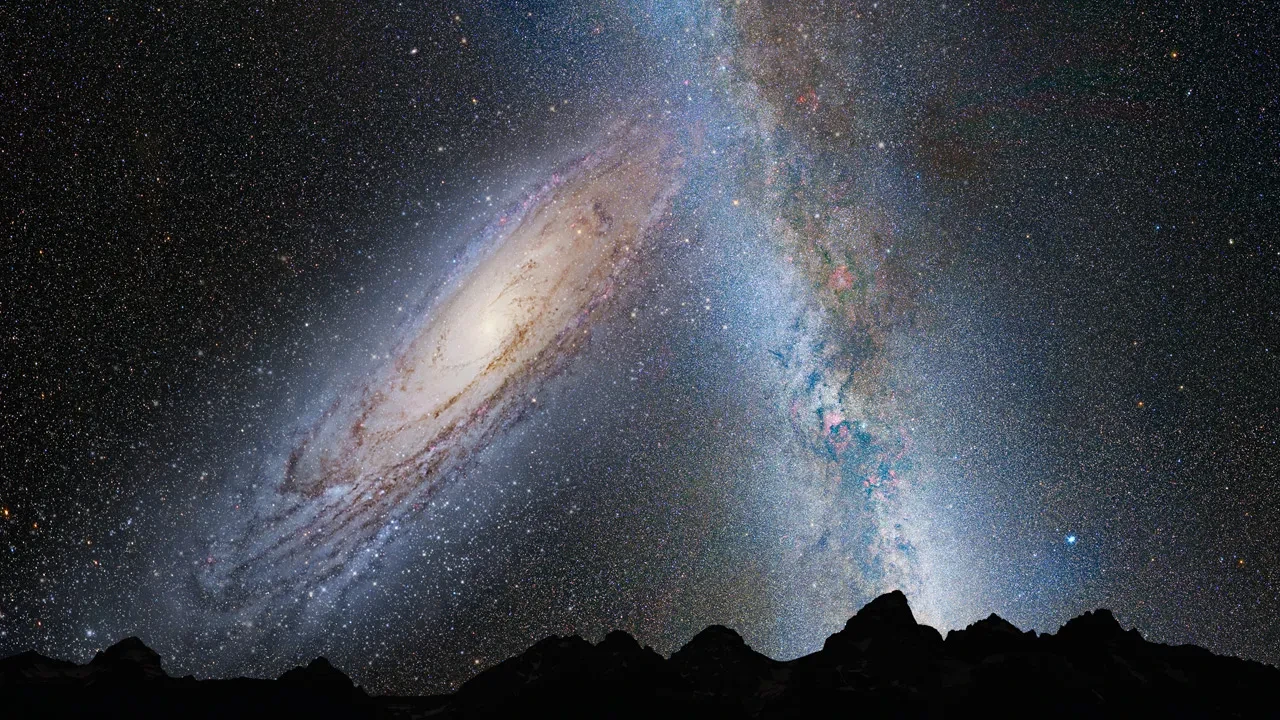
Our nearest large neighbour is the Andromeda Galaxy, which is 2.5 million light years away. It is approximately 152,000 light years wide and is notably bigger than the Milky Way, with more than twice as many stars.
Current estimates suggest that the Andromeda Galaxy gets 110 kilometres (70 miles) closer to the Milky Way every second, with a possible collision due to occur in four to five billion years’ time. The spiral structures of our galaxies would be scrambled and erased as the two meld together to form a single giant elliptical galaxy. This hypothetical new galaxy of ours has been unofficially dubbed ‘Milkomeda’.
Image
Galaxies: A Beginner’s Guide to Exploring Galaxies
Galaxies explores the Universe on an expansive scale, showcasing and examining the gargantuan structures of stars, planets, gas and dark matter that populate our cosmos.
• Learn about the history of galaxy observation
• Explore the science behind galaxy formation
• Discover different galaxy types and learn about dark matter and black holes
• Take a deep dive into our own Milky Way
• Find practical tips on how to observe galaxies
Image
About the author
Jake Foster is an astronomer and science communicator at Royal Observatory Greenwich. He develops the Observatory’s public astronomy programme and delivers interactive workshops and planetarium shows for the public and schools, with the goal of igniting a curiosity about the Universe at any age.
Jake communicates his enthusiasm for the cosmos across various media, providing expert insight on space science via national television and radio interviews. He has also written for and provided specialist editorial support on multiple space-themed publications. He holds a BSc in Physics with Astronomy and an MSc in Science Communication.

More space and astronomy
From Royal Observatory Greenwich
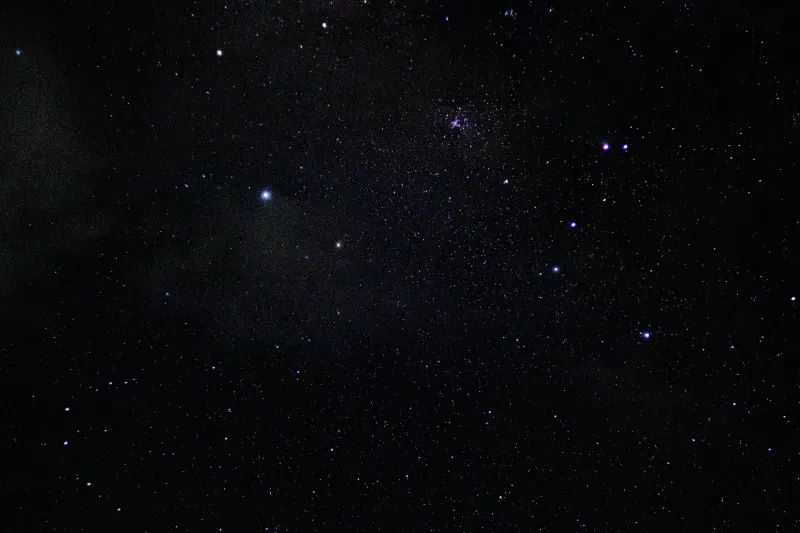
Astronomy with the naked eye
Learn what you could see in the night sky with no equipment from the Royal Observatory Greenwich; from galaxies and meteor showers to comets, star clusters, cloud formations and more
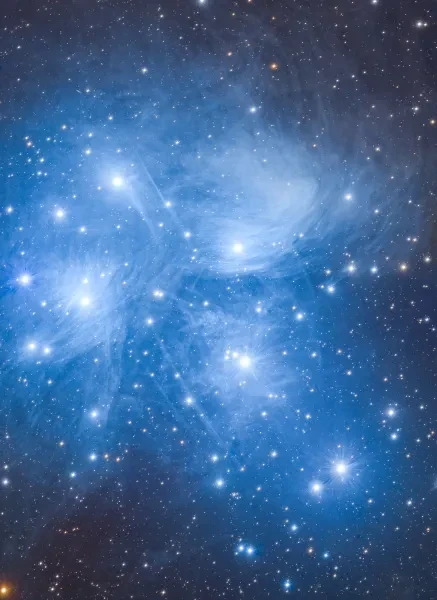
What are the Pleiades?
Take a closer look at the Pleiades, an extremely hot cluster of young stars. Also known as the 'Seven Sisters' or M45, this stellar family has been the subject of numerous myths in cultures worldwide
Poetry inspired by space and the Royal Observatory
Read a selection of poems inspired by 350 years of history at the Royal Observatory and the wonders of the Universe

A history of the Royal Observatory in six objects
Explore 350 years of the world-renowned institution and the people who worked there through six intriguing objects
Galaxies 2026 – ZWO Astronomy Photographer of the Year
See the stunning winning and shortlisted images in the ZWO Astronomy Photographer of the Year 2026 Galaxies category
What are the Pleiades?
Take a closer look at the Pleiades, an extremely hot cluster of young stars. Also known as the 'Seven Sisters' or M45, this stellar family has been the subject of numerous myths in cultures worldwide

Photographing a deep-space shark from the Kuwait desert
Explore Ali Alobaidly’s incredibly detailed photo of the Shark Nebula, which was crowned the winner of ZWO Astronomy Photographer of the Year 2026

The new space race: a high-stakes competition of politics and power
Competition between the USA, China and Russia will have consequences for all of us here on Earth. But how is this 21st century space race different to the last one?

Artemis Programme: what you need to know about NASA’s Moon missions
NASA's Artemis missions aim to land humans on the Moon again, create a lunar base, and lay the groundwork for a future trip to Mars
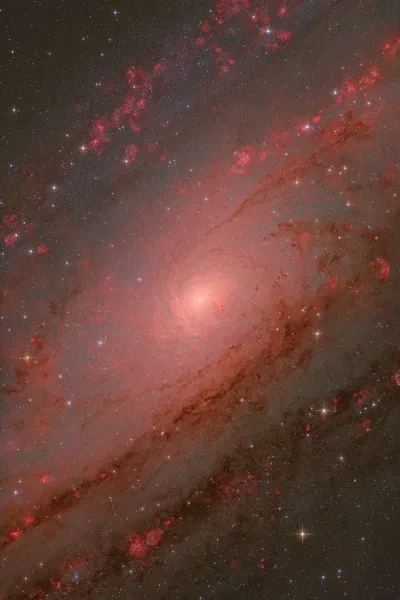
Billions of stars, one winning photograph: the core of Andromeda
A trio of photographers from China won the ZWO Astronomy Photographer of the Year 2025 competition with a breathtaking image of the core of the Andromeda Galaxy
Header image by Lucas Pezeta on Pexels