We offer a variety of guides, events and resources designed to help support visitors with diverse access needs.
Below you’ll find all the information you need about visiting the Queen's House.
If you have questions:
– During your visit, ask a member of museum staff at the Queen's House entrance desk
– Before your visit, email enquiries@rmg.co.uk with your queries
On this page
Please find information for the following below:
Blind and partially sighted visitors
The Queen's House features historic rooms with high ceilings. These can feel echoey and sound may carry between spaces.
There are Visitor Assistants throughout the House who will be happy to help with orientation or directions at any point during your visit.
Audio guide
A free audio guide to the Queen's House is available on the Smartify app. Download the Smartify app before you visit, and don’t forget to bring your own headphones.
The audio guide contains 32 chapters. It includes details about the architecture of the house itself, as well as historical context and descriptions of many of the different artworks on permanent display.
Audio-described tours
A number of our staff are trained to give pre-booked audio-described tours at the Queen's House.
Lighting
Lighting levels vary throughout the House. In some rooms, there is lots of natural light coming in through the windows and spotlights above the paintings. However, where there are delicate works of art, light levels are lower to protect the artworks.
d/Deaf and hard of hearing visitors
Inside The Queen's House there are many historic rooms, some with high ceilings. These can feel echoey and sound may carry between spaces.
British Sign Language (BSL)
The Queen's House guide on the Smartify app includes British Sign Language interpretation.
The guide contains 32 chapters. It includes details about the architecture of the house itself, as well as historical context and descriptions of many of the different artworks on permanent display.
Captions
All audio-visual displays in the Queen's House feature captions.
Hearing loops
A hearing loop is fitted at the Queen's House information desk.
Neurodivergent visitors
The Queen's House has an unusual layout, which some visitors may find confusing or unsettling at first. Visitor numbers are generally quieter earlier in the day and later in the afternoon.
If you need to change your route, take a break, or leave and re-enter the building, staff will be happy to assist.
Autism awareness
A number of our staff are trained in autism awareness.
Ear defenders
Ear defenders for adults and children are available on request from the Queen's House information desk. Please return these at the end of your visit.
Quiet spaces
We can provide a quiet space for those who need it at the Queen's House.
Sensory map
Use our sensory map to help you locate less crowded, quieter areas and multisensory experiences. This covers sound, light, smell and touch. You can pick up a free paper sensory map at the Queen's House information desk.
Wheelchair users and physically disabled visitors
All floors of the Queen’s House have lift access. There is step-free access to the Orangery via a ramp from the Great Hall. The floors in the Queen's House are a mixture of stone, marble and wooden surfaces.
Borrow a wheelchair
A limited number of wheelchairs are available to pre-book for free before your visit.
If you’d like to reserve a wheelchair, please email bookings@rmg.co.uk.
Please note:
- wheelchairs cannot be taken outside the Queen's House
- Queen's House staff cannot provide assistance around the site for wheelchair users
Mobility scooters
You are welcome to visit the Queen's House using a mobility scooter. However, some models of scooter do not fit in our lift, and ramps will be required if visiting the Great Hall and the Orangery.
Please email bookings@rmg.co.uk before you visit to check the details.
Before you visit
Book tickets in advance
The tickets booking office is open 9am-5pm, Monday to Sunday. Call +44 (0)20 8312 6608 or email bookings@rmg.co.uk.
Borrow a wheelchair
A limited number of wheelchairs are available to pre-book for free before your visit.
If you’d like to reserve a wheelchair, please email bookings@rmg.co.uk.
Please note:
- wheelchairs cannot be taken outside the Queen’s House
- Queen’s House staff cannot provide assistance around the site for wheelchair users
Accessible parking
There are five accessible parking bays in the National Maritime Museum Park Row car park.
Pre-book a space by contacting the Bookings and Customer Service team on +44 (0)20 8312 6608 or emailing bookings@rmg.co.uk.
Assistance animals
Guide dogs, hearing dogs and other assistance dogs are welcome at the Queen's House.
Getting around the Queen's House
When inside the Queen's House, there’s a recommended route to follow. The layout of the House can feel confusing for visitors.
The Queen's House is separated by a carriageway and forms two distinct halves, with The Great Hall on one side and the Orangery on the other.
There is no level access from the Great Hall to the Orangery. There are three small steps from the Great Hall and three steps up into the Orangery. Portable ramps are available for those with mobility issues. Please ask a Visitor Assistant and they will set the ramp up for you.
The first-floor galleries are accessible by lift and are all on one level.
While both the front and the back of the Queen's House are on level ground, the House is on a steep terraced incline, meaning the front entrance is at ground level and the Orangery on the park-side of the House (while at ground level) is floor 1.
There is an external lift, approximately 50m from the Queen's House entrance for those unable to use the steps or walk up the steep incline.
Lifts
The onsite lift from the Undercroft to the Great Hall and floor 2 is accessible from the main entrance. The lift has a mirror to aid reversing in a wheelchair.
Stairs
There are three staircases in the Queen’s House. All three have handrails.
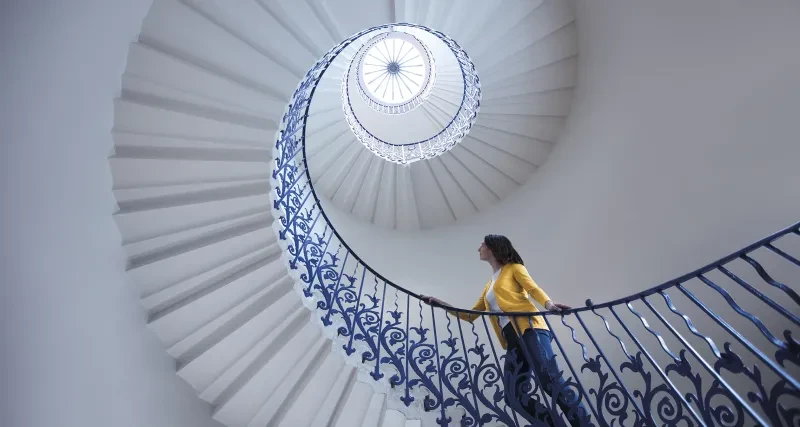
- The sweeping Tulip Stairs are one of the original features of the Queen’s House. The stairs are in a wedge shape; at their thinnest point, they are 23cm deep. There are 22 steps from the Undercroft to the Great Hall; and 35 steps from the Great Hall to level 2.
- The West Stairs are right next to the lift and are much more modern than the other staircases in the House. There are 20 steps from the Undercroft to the Great Hall; 15 steps from the Great Hall to a landing area; and a further 15 steps before you reach level 1. The steps are made of smooth stone with a non-slip black stripe on every step.
- The Orangery Stairs are the only way to reach the Orangery from level 1. There are 35 steps in total, made of smooth stone.
Toilets
The toilets, including an accessible toilet, are in the Undercroft on level 0, to the left of the entrance. There is a small incline to get to the toilets.
These are the only toilets within the House.
There is a Changing Places toilet in the National Maritime Museum around 100m from the back of the Queen’s House.
Seating
There are a limited number of portable stools to take with you around the House. There is also seating throughout the House.
Please speak to our friendly staff members who can help you identify the nearest rest area.
First aid room / Quiet room
There is a small First aid room opposite the accessible toilets in the Undercroft.
This room can be used on request as a changing room or a quiet space. The doorway is narrow, at 74cm wide, so may not be accessible for all wheelchair users.
Lockers
Lockers are available in the Undercroft at Queen's House, costing £1.
Due to the delicate nature of some of the items on display, visitors are not allowed to wear backpacks or carry large bags around the House.
Sensory map
Use our sensory map to identify sensory-friendly spaces in the House – you can pick up a free paper sensory map at the Queen's House information desk.
If you have any further questions or feedback on our accessibility information, please email enquiries@rmg.co.uk so we can continue to improve.
Read more