
This research guide has been produced as part of ongoing research and engagement with the Museum’s collections by Queer History Club members: S.L. Grange, L. Maertens, Ema Sala, K.A. Harper, Steph Morris, Jas Bevan Nis, Cas Bradbeer, Phil Mikulski, Tim May.
You can also download a PDF of this guide.
What
First of all, we'd like to introduce you to what this guide covers, what we're talking about, and what the Royal Museums Greenwich (RMG) collections might - and might not - offer. This guide uses the terms 'queer history' and 'LGBTQ+ history' interchangeably. We acknowledge that the reclaimed term 'queer' can still be a difficult word for some people, given its history as a slur.
When talking broadly about histories and past lives at different times when gender identity or sexuality were understood differently, or looking at cultures from around the world where sex and gender are not defined in the same way as in the UK, we find 'queer' to have the most room for manoeuvre. This research guide is less about instructing you on how to 'prove' the homosexuality of any historic individual, for example, but is more intended to provide some different pathways into the RMG collections, and to broaden the possibilities of what LGBTQ+ research might encompass: not just the content but the forms, processes, outputs and motivations for LGBTQ+ historical research, and the experiences of the researchers themselves.
This guide is a bit different to most of the other research guides, because researching queer history often involves queering research: the ways and means by which we research need to be queer themselves because the archives and cataloguing systems usually aren't constructed with queer history in mind. This guide will cover a few of the reasons why we might be researching LGBTQ+ history, what kinds of information could be available in RMG's archive, library and collections, and explores some areas researched by RMG's Queer History Club members, to provide case studies and inspiration. We've also provided some possible starting points, next steps, and links to other resources.
Whenever we're using a particular collection or library to research queer history, it's helpful to know why that collection came to be in the first place, as it helps us plan how and what we might research. What were the motivations and areas of focus for the people putting that collection together? What might this mean about what's missing, the language they used, how they catalogued and understood the different collection items in relation to each other and their beliefs and understanding of social constructs?
Read about the creation of the Caird Library.
The TLDR version is that RMG's collections were gathered primarily to document and celebrate the UK's Navy and merchant shipping, and colonial activities. The main motivations were heavily influenced by pro-Royal Navy and pro-colonial attitudes of wealthy white men in the 1920s and 30s. This means queerness was not of interest, and what entered the collection was informed by an inherently homophobic set of values, leading to gaps and erasures, and a bias towards items that painted the 'right' picture of Britain's maritime past. This makes LGBTQ+ history hard (but not impossible!) to find.
Having said this, the RMG collections are vast, wide-ranging and cover a massive scope historically as well as globally. There are also many items relating to the history and work of the Royal Observatory and the Queen's House, alongside the more explicitly nautical histories.
We know that despite the challenges, there is huge potential for finding evidence of queerness in any number of times and places, and for intersectional research that acknowledges the complications of queerness, colonialism, and histories of other/connecting oppressed and marginalised groups.
Why
There are many reasons to explore LGBTQ+ history in the RMG collections. Each 'why' will have its own 'what' and 'how'. These are some of the reasons members of Queer History Club have been doing their research:
Finding and tracking individuals (falling in love)
We might have a historical crush on someone and be drawn to find out more about that person. This could be because we read someone from the past as also being queer, or we could just find them attractive, fascinating, beguiling or puzzling in some way.
Embodiment
Having an embodied sense of connection with the past, thinking through our own experience to understand how people lived and what their worlds were like. This might involve some 'method history' - for example, reconstructing historical clothing to make outfits for yourself, learning historical practices and 'lost' techniques or artforms, stewing your own oak gall ink or cutting your own quill pens.
Uncovering injustices
Queer lives are often explicitly present in historical archives because various expressions of queer identity were illegal and often harshly punished. We might want to unearth the victims of previous punishment so that we can bear witness, celebrate or dignify those who experienced violent repression.
Good stories
LGBTQ+ history is so often the history of trauma. It can be really empowering also to explore people who survived and resisted, bashed back, and lived their own lives in their own way. Seek out queer joy in archives as an act of resistance!
'Outing' people
We might want to shift power balances and question assumptions about who was valued and who held power in the past by highlighting where queerness was hidden, repressed or permitted for some but not for others. Complicating previously unquestioned histories about powerful people in the past can help to shift narratives about who assumes power now.
Inspiration for structural change, style, life choices
We might want to explore how and why people lived in the past as a way to find inspiration and opportunities now. For example, Admiral Lord Nelson, Lord Hamilton and Lady Hamilton lived in an openly acknowledged and accepted ménage-à -trois (throuple) in the early nineteenth century. This might help show that alternative non-monogamous relationship structures are not a new invention and could be used to argue for legal status now.
'Gaydar as epistemology'*
Going round a portrait gallery with our gaydar switched on, paying attention to who or what in a collection flirts with us - if it resonates with us as queer, then we can include it in our own queer histories. It doesn't have to be about 'proving' anyone was gay or trans, it can be about enhancing our own experience of otherwise exclusionary archives or institutions.
Historical arcs, cycles of salience**
The bigger picture: it is both interesting and important to build a sense of how cultural attitudes shift and change, how humans in different times and places understand themselves, their genders and sexualities. Royal Museums Greenwich holds material from across the globe as well as across time, and all of this helps us understand a bigger, deeper picture of human experience.
Connection to the past
Just knowing that LGBTQ+ people existed in the past, and feeling a connection to their experiences, can be really validating and meaningful for LGBTQ+ folk now. So much queer history remains hidden.
Collective and community connection
Queer History Club members describe the positive feelings of being part of a group of like-minded people meeting in a conducive environment, being able to be themselves and unmask, and that it can be exciting and motivating to discuss, learn and share ideas with everyone. One member said, ‘It's helping me to find words for things I'm interested in.’
* A term used by Margaret Middleton in the article Queer Possibility, to refer to gaydar as a way of understanding knowledge and the world.
** A term coined by historian Valerie Traub to describe the way history doesn't follow a linear path of 'progress', but rather loops and repeats. History has not been a story of progress for many colonised and oppressed peoples, for example.
How
Royal Museums Greenwich offers three main resources for research - the Caird library, the archive and the object collections.
The library
This is the collection of published books (including bound printed atlases), and they are mainly secondary sources - this means people writing about historical events, individuals, cultures or places not from their own first-hand experience, but through research they've conducted by reading other books, or viewing primary sources (original documents or accounts from first-hand experience). You can search for books by title, author, year of publication or keyword. You can also browse many of the library items on the open shelves in the Caird reading room.
The library is catalogued by broader historical themes rather than having a specific LGBTQ+ section. For example, books on sailors who were gay or assigned female at birth (AFAB) are mostly in an unnamed section between Merchant Shipping and Shipwrecks, 656 index area.
Other areas include books that touch on women's histories, including aspects of female masculinity, such as the family history section, encompassing some books on life in colonised countries.
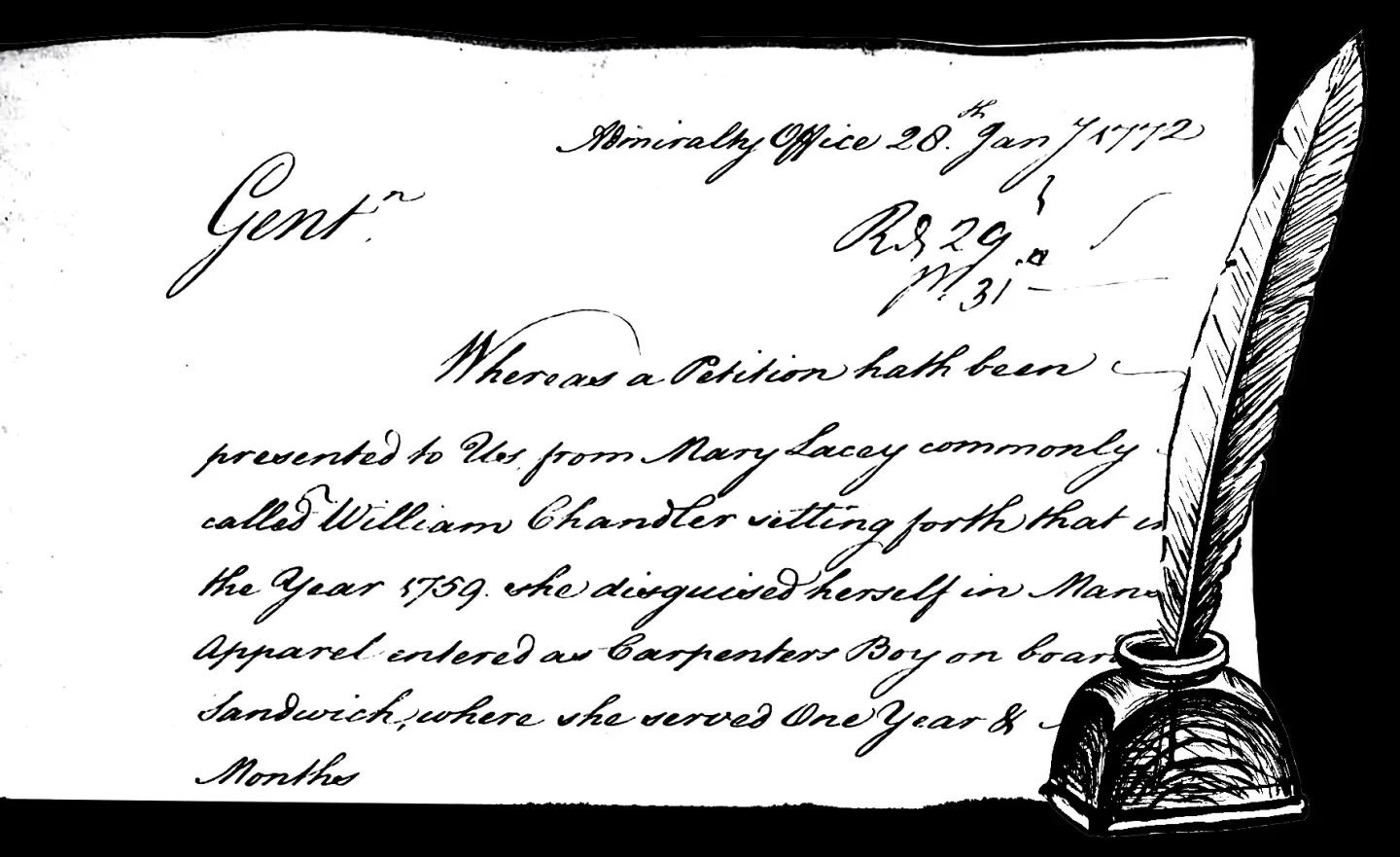
Mary Lacy, a female sailor and shipwright, is in section 92, biography, along with Nelson, Emma Hamilton and other persons of note, including Royal biographies (there are no biographies of Queen Anne though!).
A publication on sexual and gender difference in the Navy is catalogued in 359, the very end of the Navy history section, alongside histories of the Women's Royal Naval Service (WRNS).
Piracy and Slavery have their own sections: 326 and 341, respectively.
A history of Polari is in storage and needs to be specifically requested.
The archive
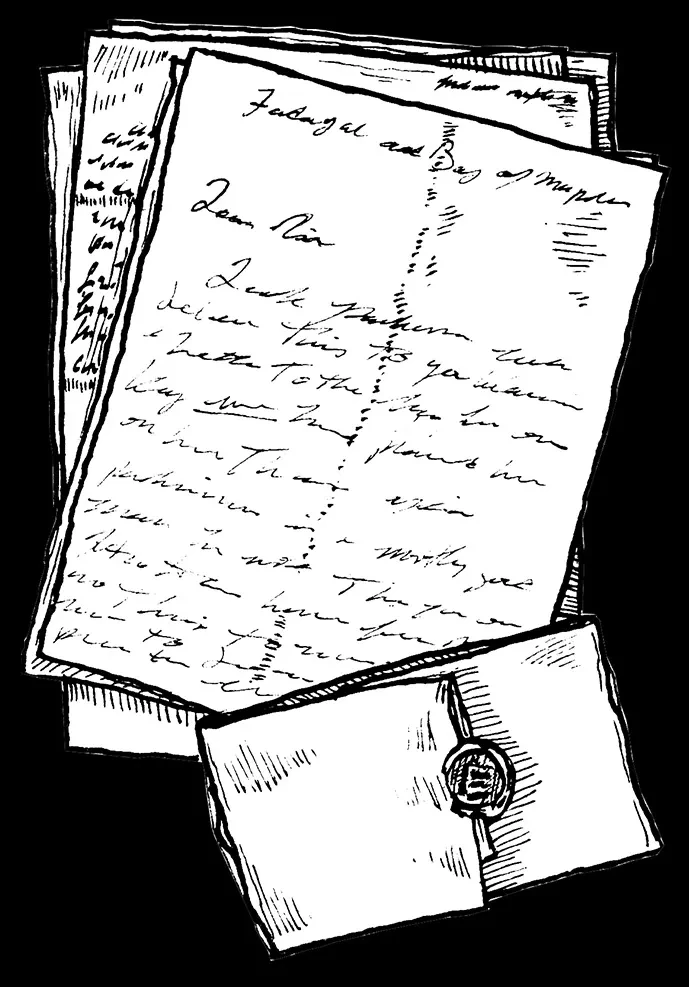
This is the collection of documents and manuscripts, many of which are primary sources. It includes letters, official documents, journals, ship plans and bound manuscript atlases. One of the oldest archive items is from before 1282 (Kitab al Aqualim [Book of Routes and Regions]), but the majority of the manuscripts are from around 1500 onwards. The archive can be challenging for researchers as not everything has been digitised, and a lot of the material is handwritten and can be tricky to read. It has been catalogued to prioritise themes and topics related to seafaring, important personalities, or navy procedure and bureaucracy, so items will not be obviously relevant to LGBTQ+ history. See below for some notable items related to queer history.
The object collections
This includes all the 'objects' in the museum's possession, such as artworks, craft works, clothing, ceramics, navigation and seafaring tools and equipment, single sheet rolled or flat maps and charts (as opposed to the bound atlases in the library and archive), weapons, items from other cultures and countries... It is a huge collection, and, like the archive, hasn't been created or catalogued with LGBTQ+ histories, experiences or interests in mind.
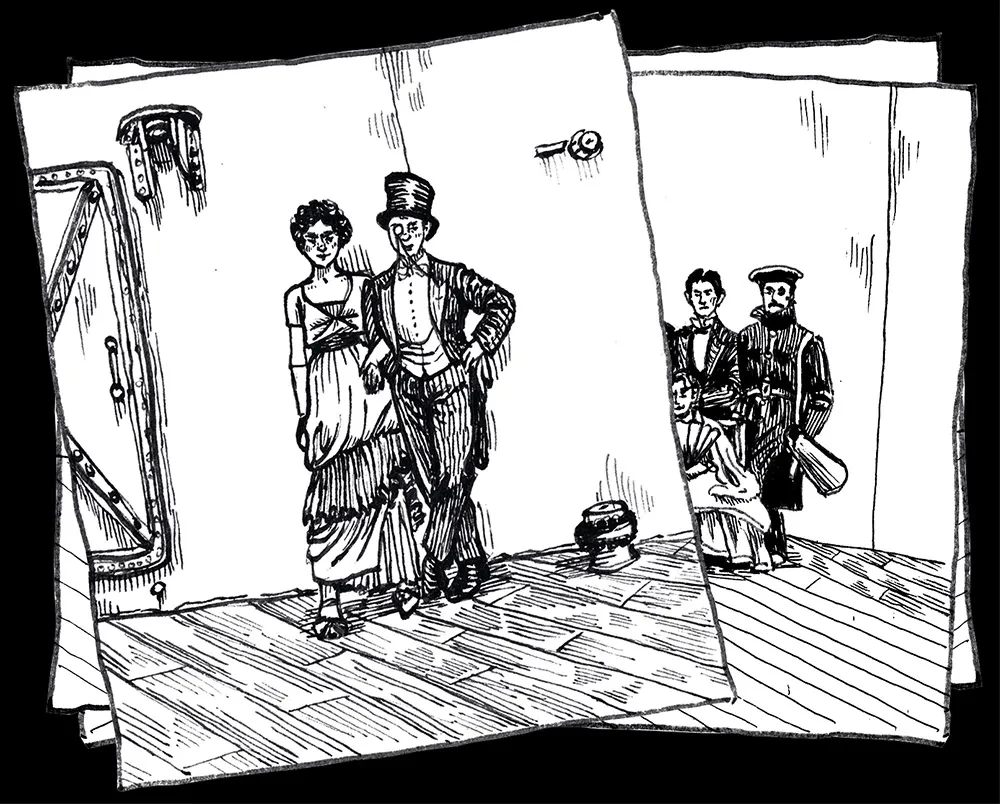
The tip of the object collection iceberg is on display in the Maritime Museum, Cutty Sark, Royal Observatory, and in the Queen's House (predominantly artworks), with thousands more items stored at the Prince Philip Maritime Collections Centre (PPMCC) in Kidbrooke. A few other objects are kept elsewhere, including the Gunroom Glee Club photographs, which are well worth a look in the online catalogue! (from N16512 to N16550).
Search terms
To search for queer experiences in historical archives, we often have to use outdated or punitive terms that may be offensive to us now. Several Queer History Club members describe their community as being a great way to seek support when doing difficult or triggering research. Please be aware, we have listed some of these terms at the end of this section. You might want to consider bringing a friend and some self-care strategies when carrying out research that might be upsetting.
Some search terms also carry multiple meanings, as some sexual activity was conflated with other, also illegal, types of sexual behaviour. This is because we are searching through older languages and - quite often - documents from times when homosexual or gender nonconforming activity was illegal, and the state used derogatory language to describe this activity.
The best-known example of this is the term 'sodomy'. This could mean anal sex between men, but at various points in the past, it also meant adult men abusing underage boys, humans forcing sex on nonhuman animals, and all forms of oral sex. There is one case of sodomy documented in multiple sources in the RMG archive and library: a court-martial case in 1807 involving Lt Berry abusing an underage cabin boy. Employing the search term ‘sodomy’ in the online catalogue brings up only two results: one oblique reference to this case, and one other case involving a man named John Cates, similarly accused by two cabin boys.
Other search terms that might be necessary to employ include: buggery, tribadism/tribade, virago, Ganymede and hermaphrodite. More often than not, though, items have not been catalogued with notes of whether they include these terms, and so they remain invisible. One real benefit to having lots of people researching LGBTQ+ history in an archive like the museum's is that we might spot these hidden references and recognise their importance. It is possible to request items be tagged when we do, thus increasing the searchability and presence of LGBTQ+ history.
It's also worth looking at some of the other Research Guides if you have intersectional elements to your research, for example:
- Research guide V5: African Caribbean family history: Finding Black and Asian Sailors in RMG Collections
- South Asian History Research Guide
- Research Guide K1: Pirates and Privateers
- Research Guide L1: Women and the Sea
- Research Guide G series on Passengers
How to figure out where an item is and get hold of it
When you run your search in the online catalogue, you can choose to search everywhere, or to narrow it down to Library, Archive or Objects. The item page will tell you if it's on display, available to request, or not available. If you don't see a 'Request this item' button, you may need to check the flow chart at the bottom of the page (especially for archive items). It is not always possible to request a whole folder, so clicking the plus (+) signs will allow you to go deeper into the folder and pick specific documents that you can request.
Library items are usually freely available to browse and select from the open shelves, though some are held in storage and will need to be requested in advance.
Archive items can be requested for the same day if you get your request in before 1pm. Otherwise next day is usually available.
Objects held at the PPMCC will need a longer time-frame to request, and you will need to arrange a specific date and time to view them.
Some fragile objects are not available to view as they are simply not in a condition to survive any handling. Many have been digitally documented, and these images will come up in the online catalogue search results. If something you really want to look at is listed as not available, do email or speak to a library staff member, as they may be able to help you make a special request.
See the case studies that follow for some ‘pro tips’ on getting started and keeping going. Sometimes just taking a tour and ‘cruising’ the displays, online catalogue, or collection centre can be a great way to start. One member of QHC says, "I started by responding to the feelings I've experienced in relation to the museum/collections. Flickers of things drew me in on the first visit - the materialities of objects, colours, forms, and their relationship to the sea/landscapes, environments, hidden narratives. etc - I came away buzzing with ideas - my ways in are messy, watery, silty - all over the place... I experienced a strong physical/emotional response on the [PPMCC] tour, which I'm also carrying with me as I research".
Case studies
Here are some case studies of research projects from Queer History Club members. They show some ways you might get started, some of the resources you might want to use, and some tips and suggestions for what to do if you get stuck. We've included object reference numbers throughout; use these in the online catalogue search bar to bring up the records for each one, and you will also start to get the hang of how this catalogue works. The case studies include strong emotional reactions to archive experiences, struggles with health conditions, or having to deal with bad press. Queer(ing) research is an emotional and embodied experience, so we offer these experiences up as part of the truth, reality and importance of our research.
"Female sailors"
Researcher: Ema Sala
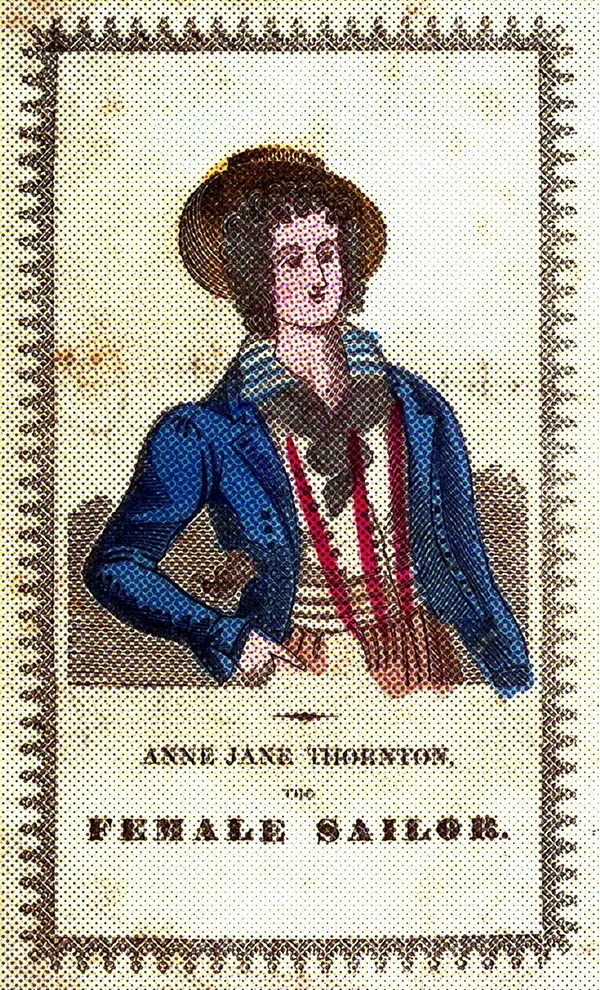
I research people who were assigned female at birth but who worked on ships as men, full-time or part-time, in the nineteenth century. I do traditional archival research, in the sense that I examine primary sources to produce new knowledge on the subject, but I also have a creative practice alongside, where I connect to female sailors on a more personal level by writing them love letters.
I have always been interested in nautical history, and for me it has always been linked to queerness, for instance, I was obsessed with gender-transing pirates as a queer teenager, when I larped* as a female sailor-like figure with my friends. During the pandemic, I started looking at nineteenth-century nautical history, and I was surprised to find that female sailors were such a huge phenomenon at the time, with many ballads talking about their adventures and articles in the press whenever one of them got outed. Getting to know about them at the time was a huge part in my coming out as nonbinary, as I found their relationship to gender and the reactions they provoked so fascinating. I came to the Queer History Club knowing that I wanted female sailors to be my research focus and I never looked back. I feel like I understand them so much better now, and that they have enriched my life and the vocabulary with which I understand gender.
My first year of research was completely focused on one sailor, who was first known as William Bruce. In the Summer, I had amassed a fair amount of material on his life up to 1865, and I thought I would not be able to discover anything further about him, but one day, as I was scouring the British Newspaper Archive database in search of female sailors, I found him again, in 1868! It felt like a fate as they had referred to him by his female name, but they had spelled it wrong, so I would never have found the article by searching for it specifically.
Resources and references
The collection:
- Female sailor images: PAI9693, PAI9694
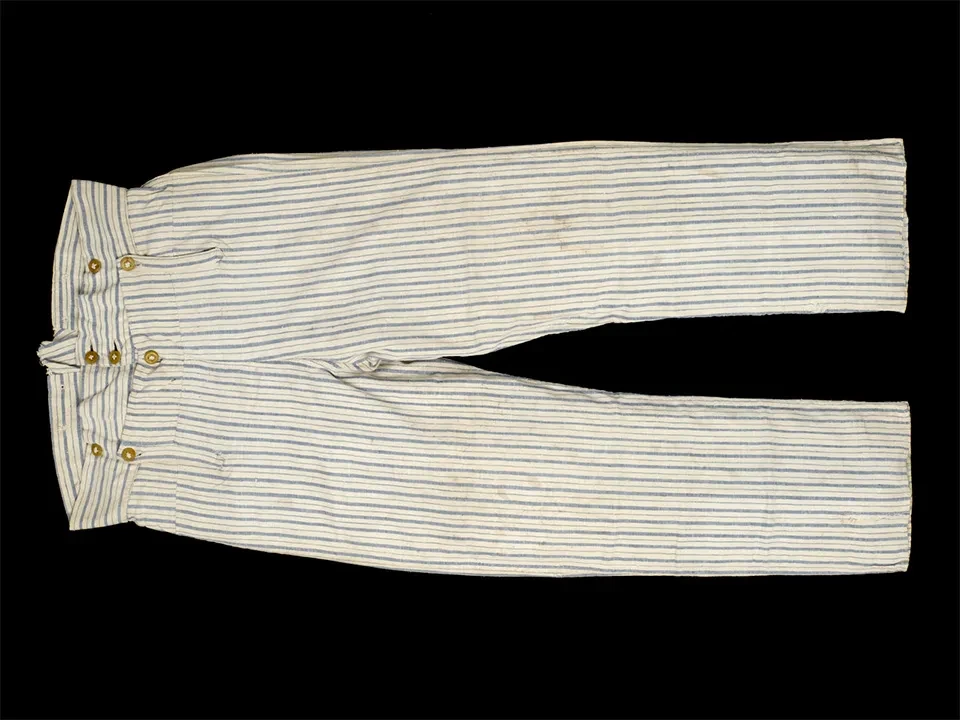
- Sailors clothing and accessories: AAA2119, UNI3377, UNI0081, ZBA4566, UNI3945, UNI3946, AAB0235, UNI0092, AAA2035
The archive:
- Ballads: PMR/3/5
- Ships logs: RSS/CL series (these also record cases of sodomy, see Search Terms section)
- I recently started looking at letters and diaries of (cis) ratings to get an idea of how female sailors might have sounded, as there are no autograph sources, but we know some of them wrote letters: MSS/80/081, JOD/224/2, AGC/B/26, and the ACG/36 series.
Pro tip
- Take detailed notes when at the archive, or even just to record thoughts.
- Write the date on your notes.
- Make a spreadsheet of all the documents you accessed.
- Back-up.
* Colloquial term for Live Action Roleplay, or a kind of structured make-believe
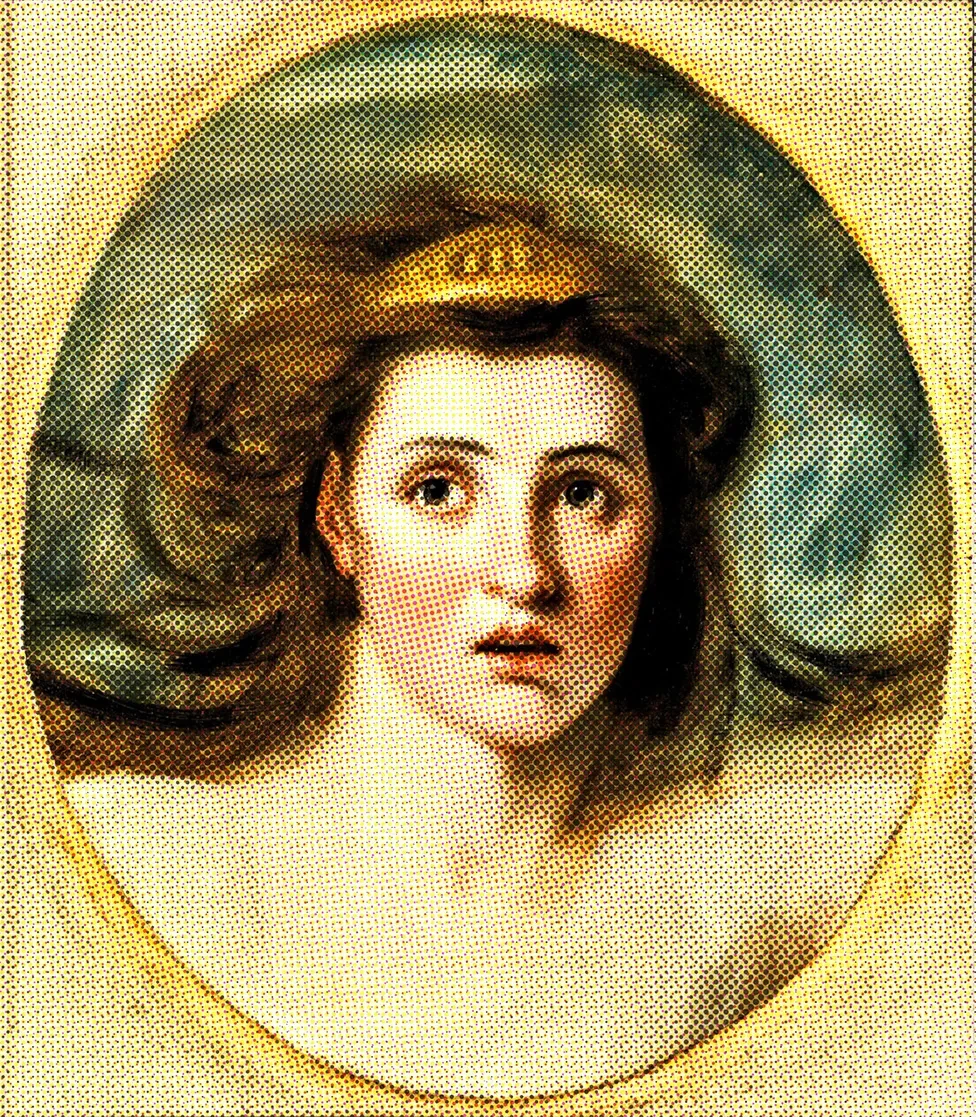
'Attitudes'; Emma Hamilton & the Nelson-Hamilton throuple
Researcher K.A Harper
My research project ‘Attitudes’ is a re/discovery, an/archive and que(e)r(y)ing of Lady Emma Hamilton, which subverts the kyriarchal* gaze through image-making, performance and improvisatory practices. Reframing the Nelson/Hamilton ménage à trois as an overlooked example of an unconventional, queer relationship model, the reorientation towards Emma moves away from the idea of her as a side character in the Horatio Nelson story.
During our visit to the Collections Centre in Kidbrooke for the first Queer History Club session, I was really drawn to a portrait of Emma held in the collections (BHC2261). Hearing a little bit about her life trajectory got me even more interested, and when I began my initial research, I discovered that we come from the same place! (The Wirral). Like me, Emma also worked as a life model, musician, and performer, and these overlaps felt very serendipitous. From there, I started exploring different parts of the collections, such as her personal correspondence, to get more of a sense of her personality, which viscerally comes through in her writing - her humour, emotional expression and performative side in particular.
When I was first familiarising myself with the online catalogues and Caird Library booking system, I searched every item that came up when I typed in ‘Emma Hamilton’. I kept a document with any objects that sounded interesting (which was vast!), and slowly worked my way through them - I soon realised I’d have to be a bit more selective. I’ve found it always takes longer to really take in what you’re looking at, particularly reading correspondence, so I started to request fewer items on my visits to really deep-dive rather than skimming through loads. I took a punt on some items without images that drew me in and particularly enjoyed the images of her in various mediums. I was lucky to be able to have a private tour at Kidbrooke, where I looked at objects held there – pieces of clothing, jewellery, personal effects and so on.
Some objects are labelled as ‘dubious provenance’, which means it can't be verified if they really belonged to Emma. I’ve reframed this as an element of the unknown which I can use as part of the performance – tuning into her energy, trying to pick up from the objects whether or not they were hers, visualising her using/wearing them etc.
My research has resulted in a performance outcome. ‘Attitudes’ has been performed twice as a live participatory ‘happening’ at the Queen’s House. I channel Emma using costume and gesture while singing and performing alongside my collaborators, folk duo Buckner Building. Audiences are invited to respond by drawing or writing as I hold poses – a nod to my own work as a life model mirroring Emma’s unique performance art. She termed this her ‘Attitudes’; tableaux vivant in which she portrayed male and female figures from paintings and mythology. These events felt so special, and this project has taken me to places I wouldn’t have expected, including conferences in Amsterdam and the USA.
Resources
- Emma Hamilton's correspondence with Charles Greville: LBK/6
- Star of the Order of the Bath, with Tria Juncta in Uno motto: REL0784
- Needlework picture probably made by Emma Hamilton: TXT0056
- Life-drawing of Emma Hamilton performing an 'Attitude': PAD3221
- Emma Hamilton's scarf: TXT0305
Pro tip
Utilise your own resources – I've pulled on my own personal histories of where I grew up to do site visits linked to Emma, as well as utilising my freelance work as a model to meditate on her and using one of the venues I sit at as a location for a photographic shoot, which I got my partner to assist me with. I’m lucky that they are a theatre designer with lots of costumes to pull from! Is there a way you can reinterpret your own resources in a similar way? Could you make interventions in them? Can you see any connections to your place of work/home that could become sites of practice/research?
*kyriarchal: a term for intersecting systems of oppression, including race, gender, sex, sexuality and ableism.
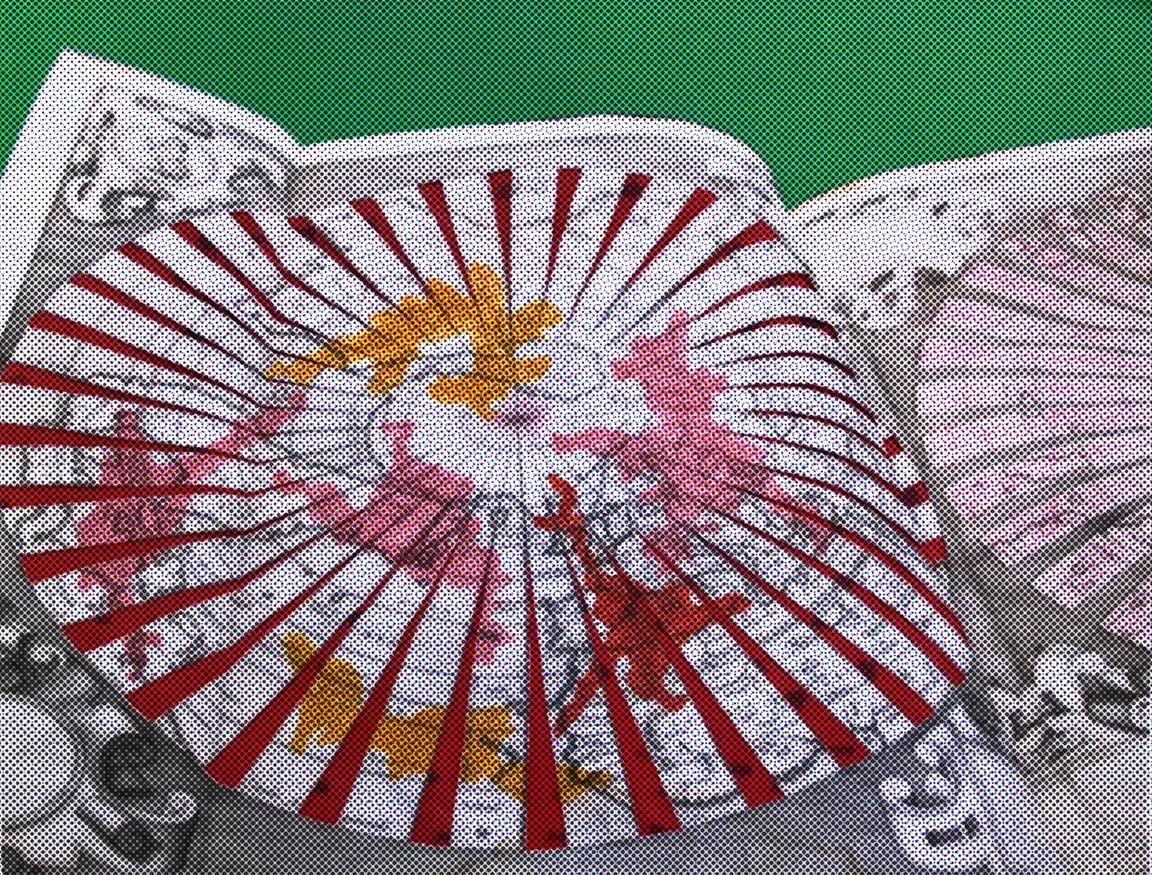
Queering maps
Researcher: Steph Morris
My research aims were deliberately open. I took the approach of not knowing what I was looking for till I found it, sort of negative capability. I am a creative practitioner (poet and artist), rather than a historian so I looked for evidence of creativity, and as a queer artist, for anything which deviated from the ‘normal’. I was interested in the unscientific, unnecessary or unproductive aspects of the documents I found in the archive – the creative interventions. I started looking for more of those and adding my own. I am now creating collages which accentuate, recontextualise or subvert these unfunctional, creative moments.
I was drawn to maps largely on an aesthetic level, and decided to lean into this. It seemed historic maps often used visual elements which weren’t necessary, or took decisions which couldn’t be explained except as products of the draftspeople’s imaginations. That had me hooked.
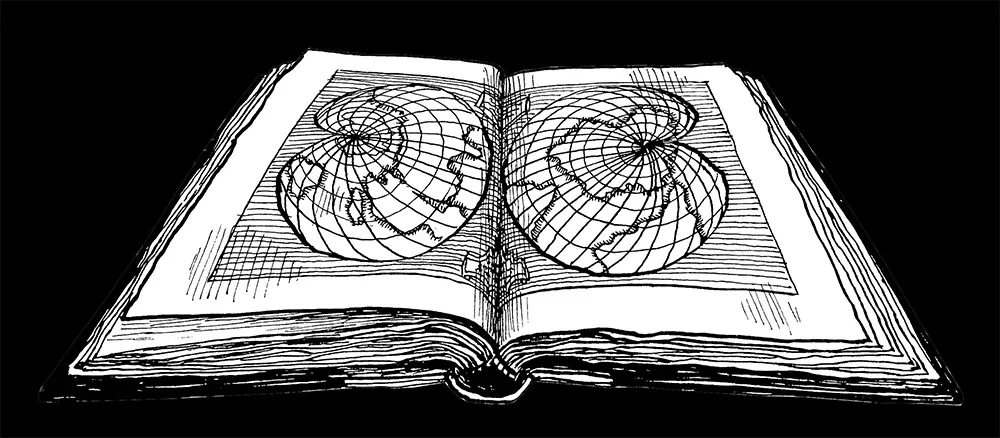
When I saw that the maps had physical, bodily echoes, the draftspeople had made land masses and seas and the planet itself feel living, I realised they might speak to queer bodies, and queer bodies might speak to them. I was also inspired when I first saw object PBC3995(1), an extraordinary split globe, and wondered what was in the triangular gaps, and when I saw the way object PBC3995(6) envisions the planet. What’s that cleavage about? Why do the lines of longitude converge where they do, and what is at that spot? Who is interested in it? …I wondered.
Resources and references
The collection:
- Lafreri’s Atlas: PBC3995 - a composite atlas of maps and illustrations by various people, published by Antonio Lafreri (a French man who settled in Rome and Italianised his name).
The library:
Pro tips
Start by ordering something, anything, to view at the Caird Library and at the store in Kidbrooke. Leave them a bit more notice than the booking system suggests you should.
If an avenue of inquiry leads nowhere, then take up another. Some things I ordered from the archive proved uninteresting for my lines of enquiry, but I’m still glad I tried. The main problem is penetrating the digital surface of the collection to get at the physical items hidden in storage. Try the most random search terms.
Make friends with the processes for viewing items and the people facilitating them, observe the various rules and preferred procedures, but be wild and tangential in your choices. Don’t be shy about viewing things, any things. These are our things – publicly owned.
Don’t be put off by internalised voices telling you your reasons for looking at the things are too bent, slant, queer or ‘artistic’ – you can do what you want with the items, and the staff are likely to be delighted at any interest of any kind in the collection. There’s no right way to approach the inventory.
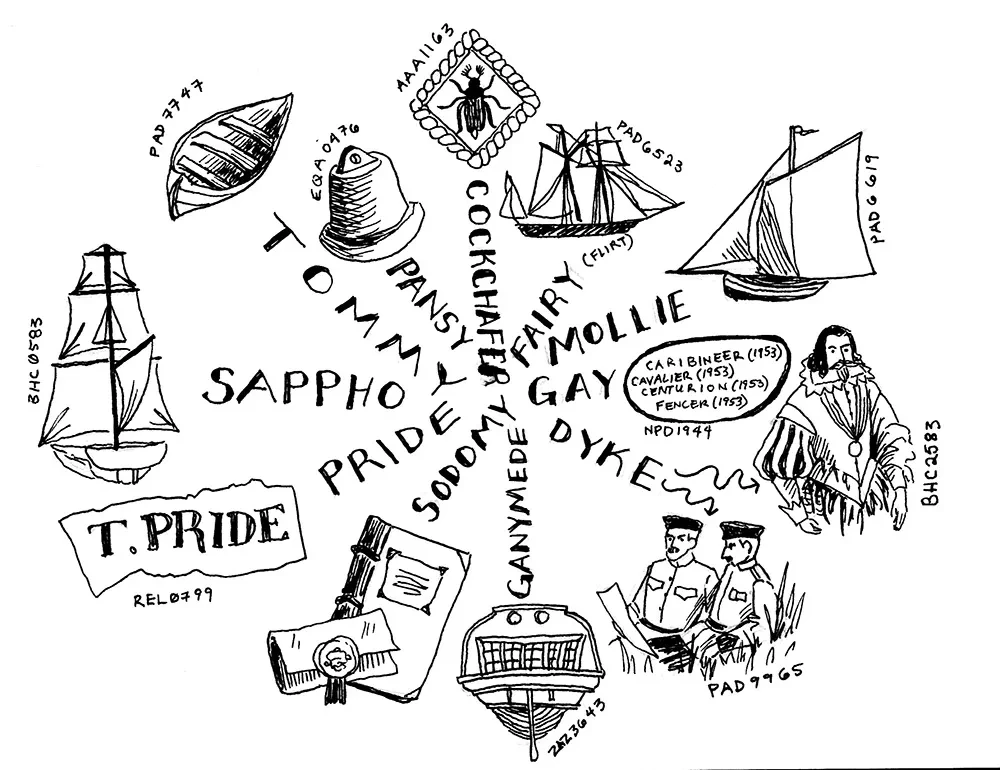
Counter Mapping* The Archives
Researcher: L. Maertens
I created two concept pieces to explore queer cartography; one used the RMG online collections database, the other mapped the journey of three ships called Sappho as a way of looking at Western colonialist history through the maritime journeys of one ship’s name.
I was honestly overwhelmed and didn’t know where to start when it came to research, but what I got hooked on were the maps in the collection, particularly the very early ones, which represented place in a different way than our contemporary maps do. That led me down the dual paths of the cartographic history and the study of queer theory, queer time, and queer phenomenology**. I started to think about how heteronormative and sterile the maps we are used to are, and how I could think about queerness in the collections through the frame of queered maps.
It's been hard figuring out what to do with my research, since I really took the cruising metaphor to heart, I wasn’t really building lasting relationships with a lot of what I was exploring, so it felt hard to develop it into one outcome. I’m not sure if I've resolved that entirely, and I'd still like to work with and develop that research into a more concrete something.
There's been surprise and excitement in all of it; I've enjoyed just the feeling of being valued and supported by the group while learning and developing new ways of thinking about research.
Resources and references
I used a variety of sources, but the main resource I used was RMG’s digitised collections. I explored the database and its metadata through searching words associated with queerness through time and chose objects that caught my eye. The highlights ended up being lots of ship names and plans, including the Sappho, the Gay class boats, and the Cockchafer.
Pro tips
The advice that I've really carried with me throughout this is the main mantra of Queer History Club, just chase what flirts with you! What you like and how you see the world as an individual and a queer person is enough of a reason for a topic to be interesting. My best research tip would be, if you're going into the library or the collections or the archive and you don't feel confident, bring a friend.
* A subversive mapping practice which is used to highlight and subvert and destabilise the dominant powers who control the narrative through traditional map making.
** Coined by Sara Ahmed, a queering of the philosophical term phenomenology, which analyses an individual's senses, emotions and experiences to understand the world.
Admiral Nelson and the Hamiltons
Researcher: Jas Bevan Niss
My focus, somewhat by accident, has been the relationship between Horatio Nelson and William and Emma Hamilton. Their letters, the information seemingly edited out of official stories, and what little we know about how they may have behaved together when alone. On the side of this, I also became interested in the national mourning of Nelson’s death at the Battle of Trafalgar on October 21, 1805.
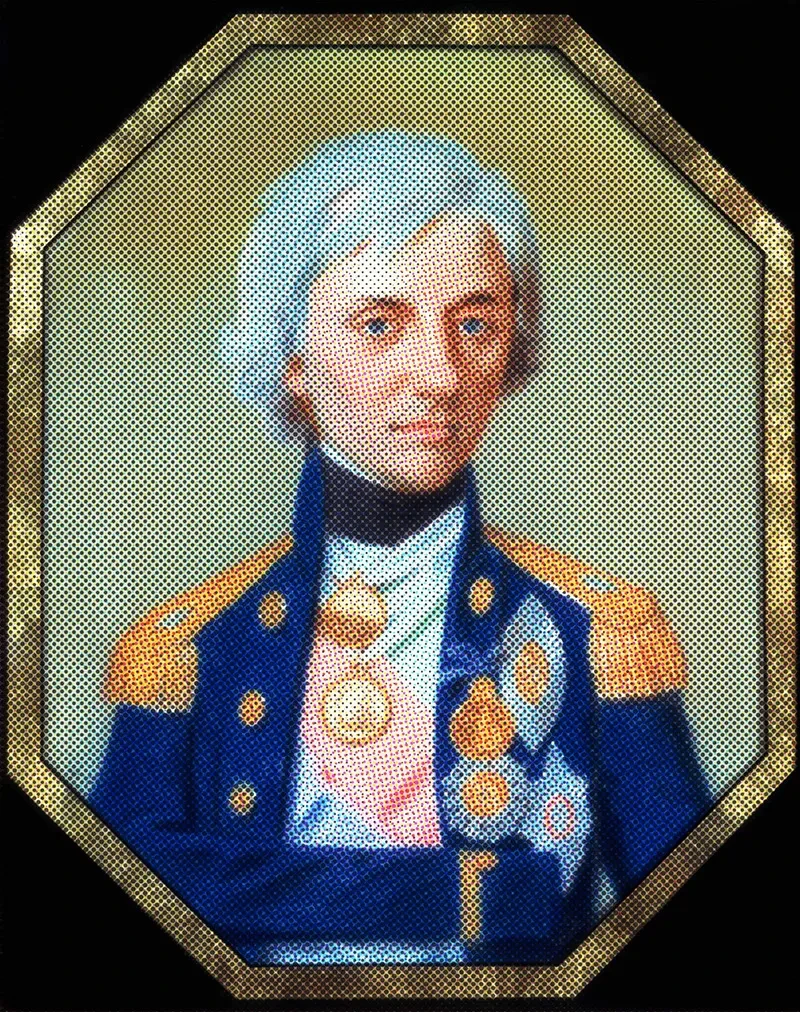
The initial draw came from a glass item, said to have belonged to Nelson and the Hamiltons. I recall them being described as a ‘ménage à trois’. That caught my attention. I then cruised the archive and found object PAJ3939, a portrait of Nelson. I had not, to my knowledge, seen a proper depiction of him prior to this. This is still the image of him that comes to mind whenever I think about him, which is often. I call it one of the twink portraits (the other being BHC2901). After that, it was a quick descent into a crush, then into adoration. I now get flustered if I look at him or talk about his personality and small details for too long.
A high point was the very first time I realised I was holding something Nelson had actually written himself. No gloves, just me and him. It felt voyeuristic, reading his letters to Emma. She was supposed to destroy them, but I am selfishly relieved she didn’t. There was also a moment early in my research into his funeral. I was feeling a bit delicate that day after a late night and too many glasses of wine the night before. I was reading newspaper articles about the funeral, and about reactions to his death. There is something very visceral about putting yourself in the mindset of those who were there. I read the long, thorough account of Nelson’s death [HIS/6] written by the surgeon himself. I left my desk for a while, and sat in the Nelson, Navy, Nation gallery in front of the coat he had been wearing, listening to canon-fire, thinking about his last moments. It was very emotional. I’ve never felt more connected to him.
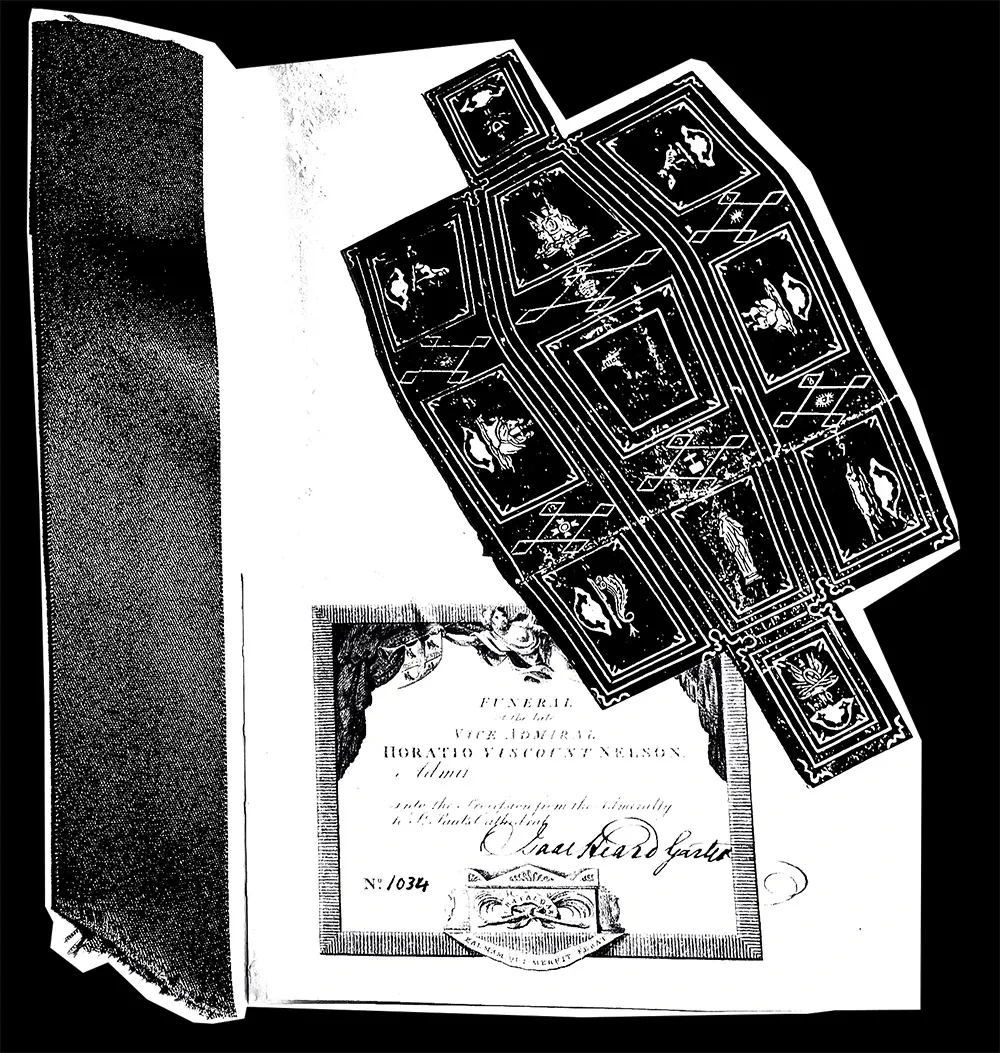
In January 2024, I hosted an event called #NELSONFEST. 16 friends followed the route of Nelson’s funeral from Greenwich all the way to St Paul's Cathedral. We got a boat down the river just like he did. The reception alone was incredibly exciting. Leading my friends around the museum, being lifted like Nelson in his coffin, sitting in St Paul’s listening to a recital and crying. These are memories I will keep forever. I also got to attend the Navy’s private commemoration of the Battle of Trafalgar on board HMS Victory in 2024, at the invitation of Commander BJ Smith. That was mostly surreal. My most poignant moments at the museum have been while exploring the documents surrounding Nelson’s will and funeral arrangements.
The majority of my research has come from reading between the lines. I am still plagued by my lack of ability to trace one specific person in Nelson’s life. An old book on Nelson contains a letter written by someone named as ‘Prince of the Empire’ and later ‘Maximilian of Bavaria’. Nelson hosted him, and he later wrote to Nelson to invite him to visit. The letter extract supposedly reads ‘You shall see here very pretty little midshipmans which I dare say will teach you French with a method which will please you and improve you’. Nelson only turns down the offer because he is in love with a woman in England who later rejects him for being too poor. Nelson writes to his brother that ‘my heart is quite secured against the French beauties: I almost wish I could say as much for an English young lady’. The interesting thing here, of course, is the boldness of Maximilian to so plainly offer homosexual relations in Paris, and Nelson’s coy ‘French beauties’ vs the ‘English young lady’. I am desperate to find the identity of this man, and the original letter: I wish old books kept clean reference lists! This isn’t written to dissuade, more that it keeps me coming back. I can’t let this story go until I find him.
Another block, which I did overcome, was the unexpected press attention surrounding my research. I should have foreseen that the British public would be distressed to hear that someone was giving Nelson ‘a gay makeover’ as the Sun put it (I wish!). The Telegraph wrote a long piece on it, full of derision. I made the mistake of looking up reactions online. It gave me a sense of queer shame that I was surprised by. The article used the inside cover of my research journal, which features on the Museum's website for the event I was speaking at. I felt exposed, vulnerable, and silly. But I spoke to other Queer History Club members, and they built me back up to the lusting, admiring Nelson girl I remain today. I think the support of peers cannot be understated, especially in an area that is less researched, like queer history, where we may be trying to find or say things that people are not prepared to hear yet. All the more reason to say it, I think.
Resources and references
- Nelson's 1803 will: BRP/19
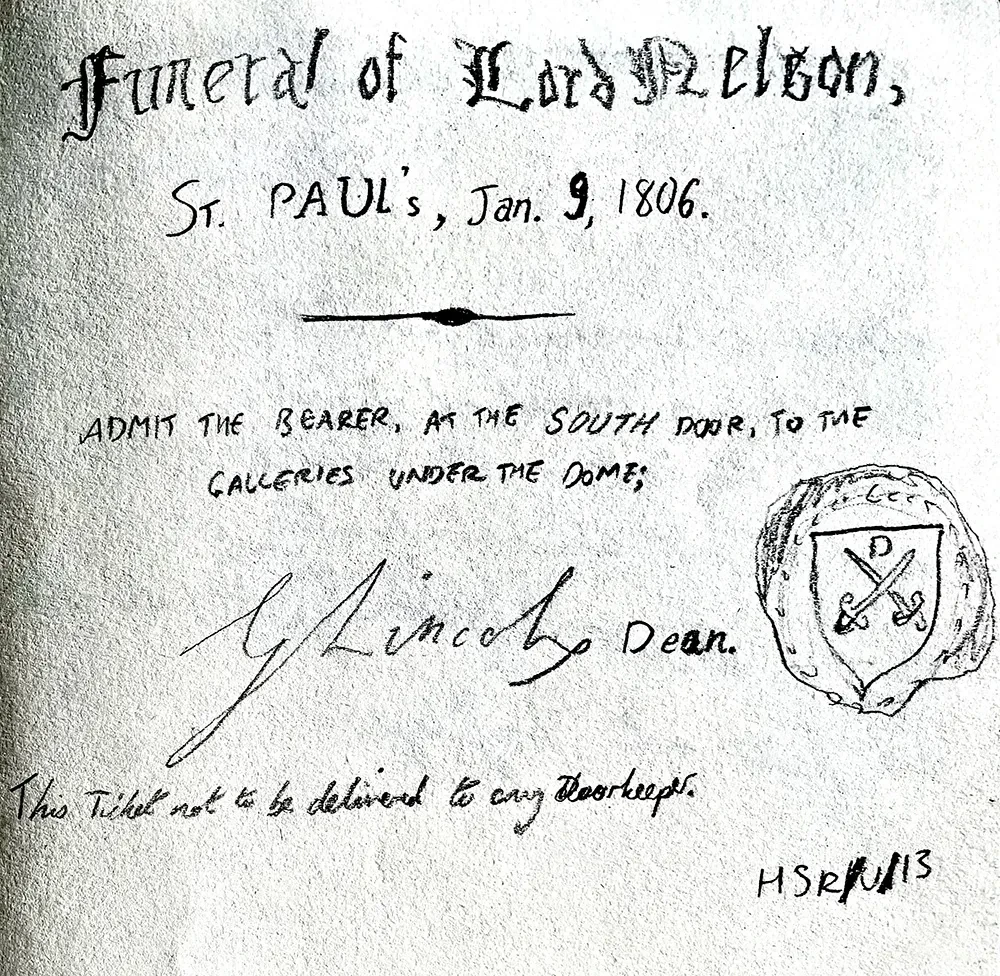
- Ticket of admission to Nelson’s funeral at St Paul's Cathedral: HSR/U/13
- Mrs Bereford Hawkins' rubbing of the coffin inscription: HSR/U/15
- Letters in a collection series by Nicholas Harris Nicholas: PBP5887/1
Pro tip
Write the catalogue numbers clearly!
Journal alongside the research - write down how things feel. I had forgotten about my day of reading the Beatty account and looking at the coat afterwards. It’s only because I wrote it down that I have it in my head.
Also, just ask! You’ll be amazed what you can get away with. My attendance at the Navy event came from my cold emailing the Portsmouth Historic Dockyard and asking how I get an invitation. It was a high point of my year.
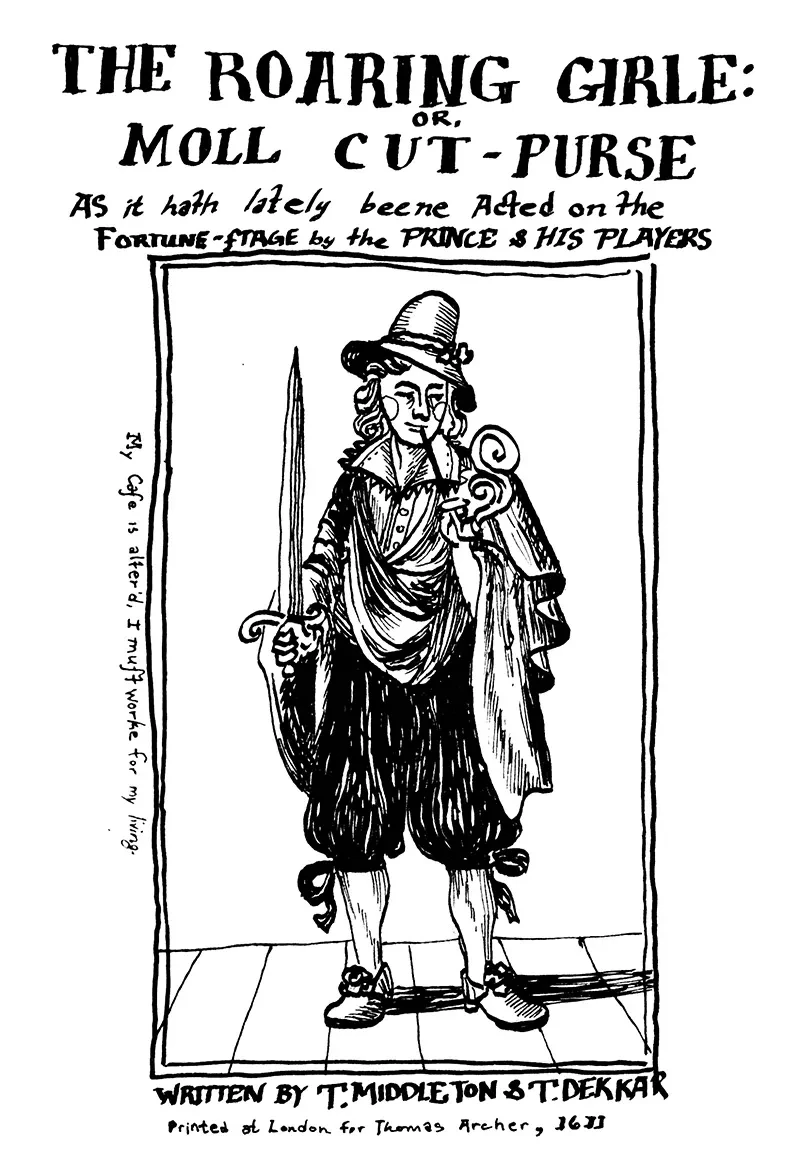
Artist representations of GNC figures
Researcher: Cas Bradbeer
I’ve been studying contemporary artists’ representations of gender non-conforming (GNC) historical figures, ranging from Moll Cutpurse to an unnamed two-spirit person depicted by a Victorian pseudo-anthropologist. I am interested in critical fabulations of these histories by gender non-conforming artists today, such as SL Grange and Kent Monkman. I aim to demonstrate how museum displays can be enhanced by speculative readings of such figures by gender non-conforming artists.
I was reading Christopher Reed’s Art and Homosexuality (2011) and I encountered the work of George Catlin, an American writer and painter who travelled among Native American communities in the 1830s and exhibited his depictions of them across the US and Europe. In the book, I found his painting of a two-spirit person, which he described as ‘one of the most disgusting things I have ever seen’. I then found the work of Kent Monkman – a two-spirit contemporary artist who painted a new version of this painting entitled Honour Dance, which reimagines who this two-spirit person was, imagining that she was lulled by Catlin’s false promises to leave her nation and tour Europe as one of his touring exhibits, before escaping, interacting subversively with Europeans, and heading back to her nation. I was inspired by this approach, whereby a contemporary person resonates with a historical figure and creates a story to contribute to their cultural heritage. I then discovered more about this approach to history through reading books by Saidiya Hartman and Kit Heyam.
I have enjoyed finding objects and archival materials that are tangential to my searches, but are nevertheless interesting. For example, when looking in the Museum’s collections for objects that a Native American two-spirit person may have used in the 1830s, I couldn’t find objects from exactly the right period and place as the Sac and Fox Nation that George Catlin visited. However, I was able to find objects made by Cree people in the 1830s, which is an indigenous people group from which Monkman’s Fisher River Cree Nation is from. For example, I found moccasins reminiscent of those that Monkman paints in his version of Catlin’s painting (AAA3943).
I found it frustrating when I couldn’t verify information about some of the historical figures I’ve studied. For example, I really hoped to verify the identification of the subject of a painting at the V&A that was thought (by the bisexual writer David ‘Bunny’ Garnett) to be Moll Cutpurse. I was only able to find that he’d compared it to an engraving of Moll at Stowe House, but I couldn’t trace the print in the National Trust’s collections (who now own Stowe House). However, I found a different print in the National Portrait Gallery’s collections, which is similar to the V&A’s painting, and so I posited that this may be what Bunny was referring to. Regardless, I was able to demonstrate through Bunny’s letters that at least he (in 1945) thought it to represent Moll Cutpurse, and that’s interesting in itself.
Resources and references
I was looking for records of Kent Monkman’s ancestral land from the early 19th century, and I knew it was next to Lake Winnipeg, so I searched ‘Winnipeg’ in Explore our Collections (under Objects), and I found HOP247:12/5 – Captain John Franklin’s 1825 expedition to the Arctic, which identified the area of Monkman’s Fisher River Cree Nation only by its limestone deposits.
By searching ‘George Catlin’ in Explore our Collections (under Archive), I found STN/5/53 – an 1839 letter from American author Washington Irving, suggesting George Catlin exhibit his collection of “Indiana” in London.
Pro tip
Be aware of how terminology has changed over time. For example, I started searching for records of the play about Moll that debuted in 1611, which is now known as The Roaring Girl, but it took me a while to realise that it was historically titled ‘The Roaring Girle. OR Moll Cut-Purse’. It’s also interesting to look into slang terms for queerness during the period. For example, ‘ganymede’ was used in 18th-century London to refer to gay men.
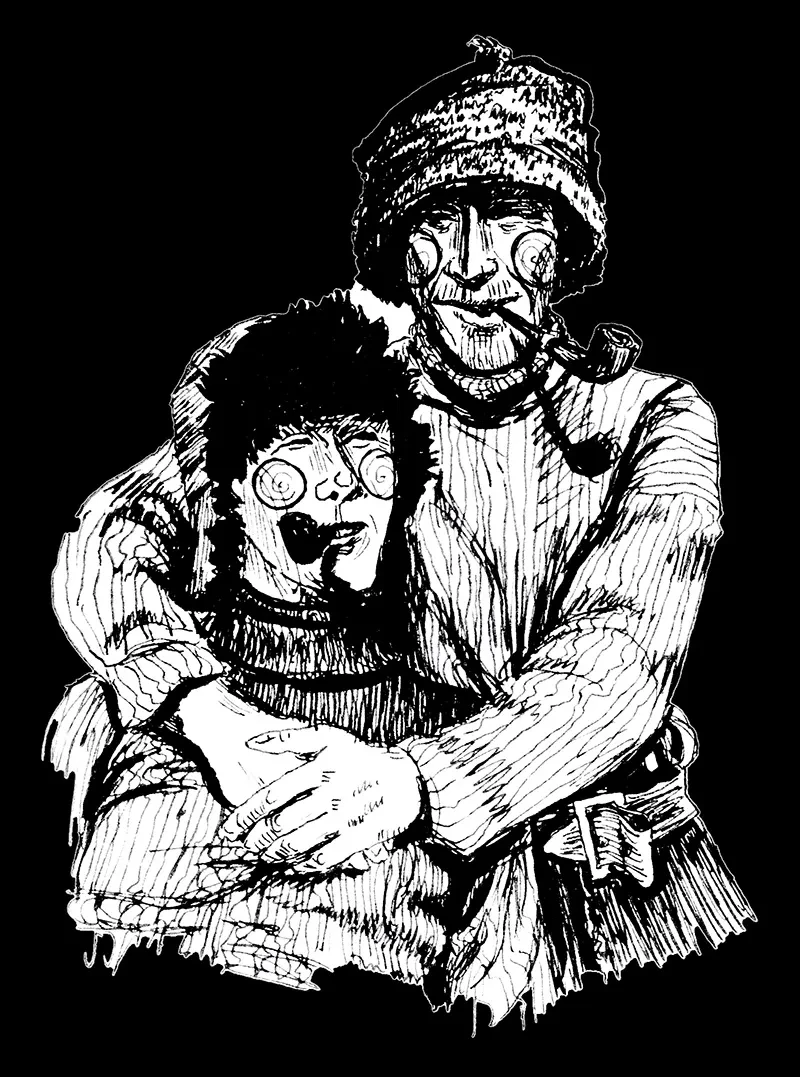

Masculinity, gender performance, and physical intimacy in polar exploration
Researcher: Phil Mikulski
My project is focused around the themes of masculinity, gender performance, and physical intimacy in polar exploration and the wider age of sail period. I am looking in particular at the Ross Antarctic Expedition (1839-1843) and the later expeditions led by Captain Robert Falcon Scott and Sir Ernest Shackleton in the early 1900s.
I already knew about Ross and Crozier’s tight-knit friendship before I started my research. I wanted to know why Ross went on the first search for the Franklin Expedition in 1848, after he gave his word to never sail again once he got back from the Antarctic in 1843 and married his sweetheart. I knew there must have been a deeper connection for him to go out looking after Crozier, and I wanted to explore this.
In terms of masculinity and intimacy, the photographs of the Heroic Age of Antarctic Exploration period really made me interested in looking into the ideas around acceptable forms of male intimacy and the closeness allowed in male friendships while out at sea. There is a photograph from the Terra Nova expedition showing a pile of lads lying on top of each other in all sorts of configurations, which really struck a chord with me, as well as the one from the Endurance expedition with Cheetham and Crean, where they’re basically cuddling.
In his letter, Davis describes the New Year’s party the expedition held to welcome 1842, and highlights that the expedition leader, Ross, showed up to the party as Miss Ross and opened the ball dancing with Captain Crozier - I was definitely not expecting that! There were other men who were also dressed in drag. Reading this was definitely a huge highlight of my research! First drag party in Antarctica: January 1842!!!
Another joyful moment was when I realised that the copy of Ross’ book I was reading was actually signed by him - something about connecting with another person despite space and time separating you, connecting to my main themes of physical touch and intimacy.
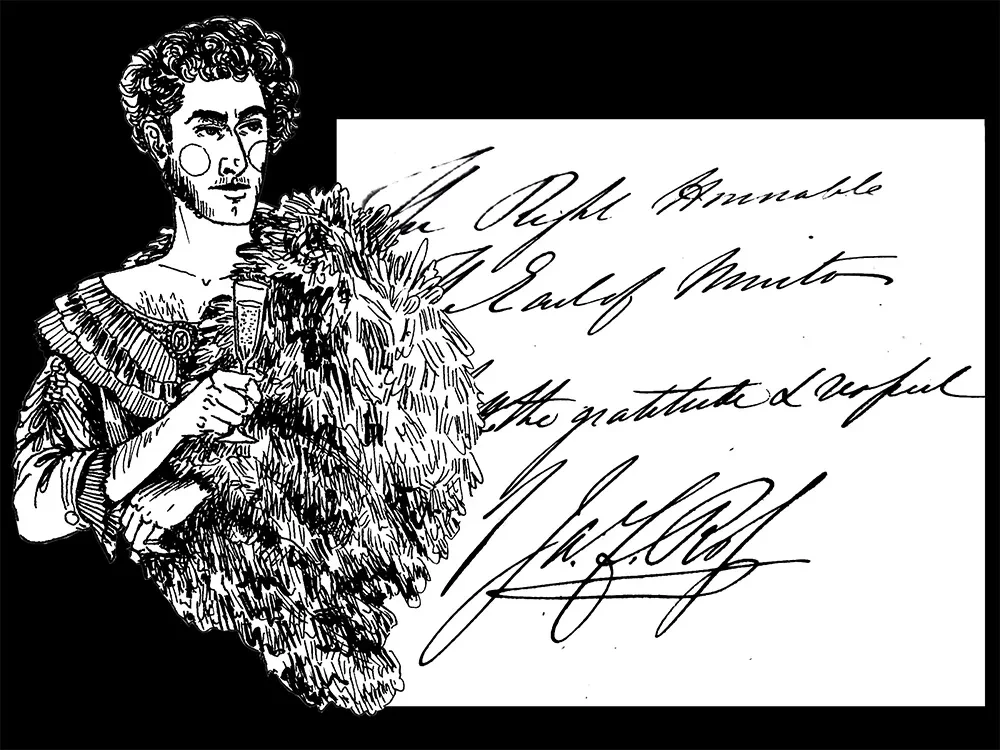
My most frustrating moment was finding out from the modern publications that Ross burnt all his letters before he died. A classic move as far as queer history goes, and it definitely made me further wonder about the nature of his relationship with Crozier, but I really wish he hadn’t done this and that there was more to read from him other than customer service complaints (AGC/R/4)!
Another obstacle was reading people’s handwriting in the letters I could get my hands on, this was solved through community support and deciphering them with a group of friends who are also polar history nerds. Never underestimate the power of your networks!
Resources and references
I have found journals and ship’s logs held in the museum collections particularly helpful, as well as books published on the subject. The journals, letters, and personal expedition narratives gave valuable insight into personalities and actions taken by individuals outside of the “official” expedition narratives, which is what I was primarily after. Ship’s logs and muster books were helpful as a starting point to look for additional sources - journals are most often under someone’s name, rather than the expedition they were on, so it’s easier to find them this way.
- The arming and fitting of English ships of war: 1600-1815 by Brian Lavery; PBA3294
- Ross’s accounts of voyages: PBB4118; PBE7801; PBE7804
- McCormick’s accounts of voyages: PBB4030/1; PBB4030/2; PBD5960
- Cunningham’s journal transcription PBH6389
- A letter published posthumously in 1901 by Davis’ family
- Some examples of Shackleton’s papers: HSR/V/17; D2007.011.2 REG07/000217.1 REG07/000217.2 D2007.011.1; HSR/V/18/1; X1999.052.1 DUP
- Some examples of Scott’s papers: MRK/46; HSR/Z/53/1; MSS/79/123 MSS/79/123.0 MS/79/123
- Seaver’s “Edward Wilson of the Antarctic: naturalist and friend”: PBD6715
- The Polar Rosses: PBD4983
- Polar Pioneers: PBP4449
- Sir James Clark Ross, Aylesbury: letter to an unknown correspondent, 4 September 1845: AGC/R/4
Pro tips
Go into the uncatalogued collection entries. You never know what you might find in those, and it can turn out to be a treasure trove. You might not find what you are looking for, but they can often lead you onto another research path, or another person to look into, which is super exciting.
If you’re looking at a historical figure who has living descendants, it’s always worth reaching out! And same for reaching out to small or obscure archives to ask about their items. More often than not, people are very happy to help.
And last but not least: write everything down, no matter how trivial. It might save you later. Feelings and thoughts are worth noting as much as quotes and catalogue numbers.
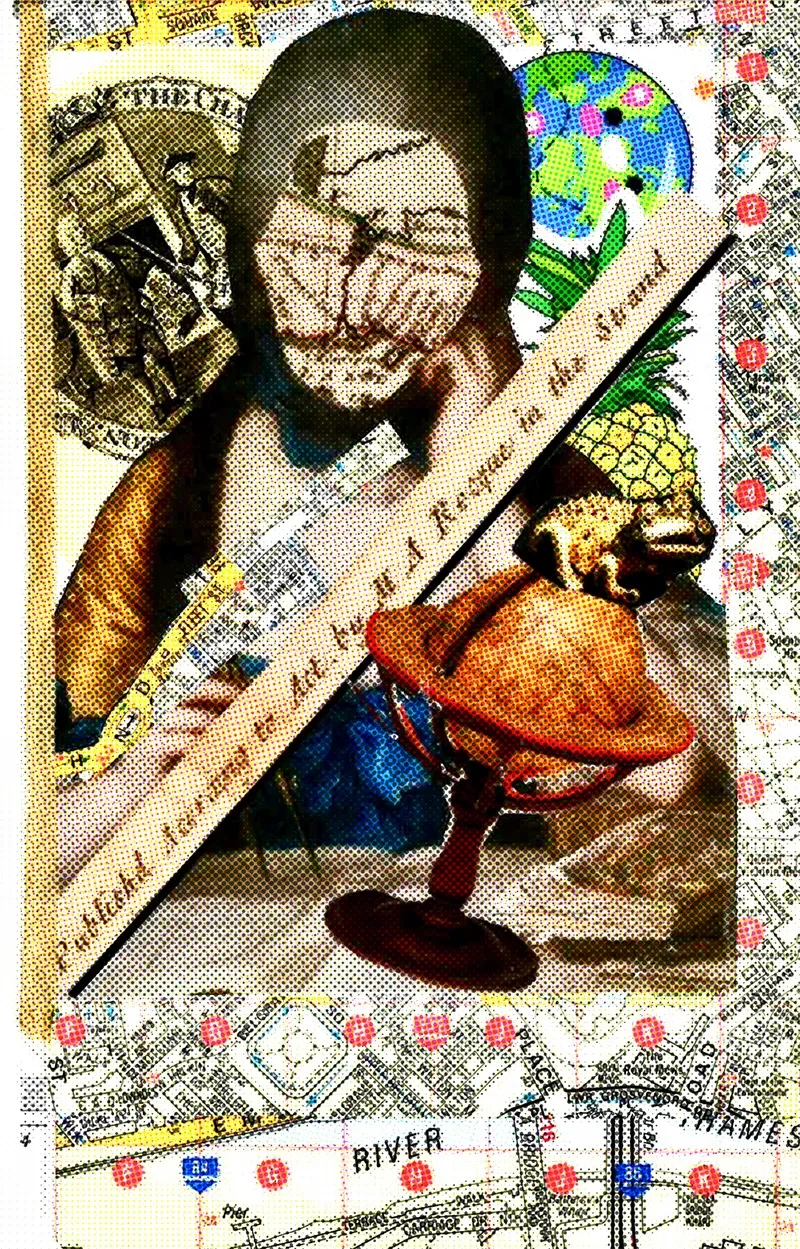
18th-century women mapmakers
Researcher: Tim May
My research is focused on 18th-century women mapmakers operating in London. In lieu of being able to find out more information without significant archival research across London, I chose to adopt a queer methodological approach, carrying out site visits to walk in these women’s shoes, and connect to them on a more emotional level. I visited the homes, churches, and streets where the women were born, married, buried, worked, and lived. In these places, I carried out ‘pilgrimages’, reciting their words, lighting candles, and placing printouts of their cartographic objects.
Since starting my role as Curator of Maps and Mobilities at RMG, I’ve wanted to uncover queer histories and queer mapmakers. However, I didn’t see an entry point into this subject, nor did I have much time at my disposal around my work tasks. Luckily, a researcher’s work enquiry led me down the route of women mapmakers. The researcher wanted to know more about the globemaker John Senex, through whom I discovered his wife, Mary Senex, who continued her husband’s business for years after his death. With further reading and online research, I realised the numerous other women mapmakers in similar situations. The objects didn’t pull me towards the women (none of them are on display), rather I found the women online, and then looked to see if there was anything in RMG’s collection linked to them.
The most exciting moment of my research so far has been realising that RMG has more objects in the collection made by women than I knew (and catalogued as such). I have identified one map, and possibly a globe made by women mapmakers. There are also a few other possibilities which require further investigation. I was also really surprised to discover that one of the objects we have on display in Atlantic Worlds (a Beothuk Birch Bark Canoe AAE0190) was made by an Indigenous map maker. Although the story of the maker, Shanawdithit, is mentioned briefly, nothing is stated of her role as a mapmaker. To have a physical link to her life is very exciting.
I was quite confident that a map of North America in the collection was made by the mapmaker Mary Ann Rocque (G292:2/4). However, RMG only possesses the north sheet, and the south sheet is the one which would display her signature. Conflicting dates online only added to the confusion. To confirm my suspicions, I contacted an expert map historian to visit the map and discuss the possibilities. Through working out the timeline, we eventually concluded that this must indeed have been made by Mary Ann Rocque.
Resources and references
- PBF8231: Globes at Greenwich: A Catalogue of the Globes and Armillary Spheres in the National Maritime Museum (Dekker, 1999)
- Plus wider online searches, blogs and contacts
Pro tip
There’s more information available online than you think. I wasted time piecing together information that was already freely available if I had searched better initially. If you’re interested in something, the likelihood is that somebody else is too! Connect with as many people as possible, even if they are lofty academics, they’ll likely be happy to discuss their passion and share information with you.
Get out of your comfort zone! Having previously only engaged with more 'conventional' academic practices, the creative and emotional aspects of queer methodology were new and a little intimidating to me.
When carrying out my pilgrimages to women mapmakers, I worried what others around me might think, whether I was 'making a scene' or being silly. But I'm so glad that I did, I got so much out of it. Queer methodology, like us, is valid and disruptive, embrace it!
Useful info and links
Webpages
- Registering with the Caird Library and your first visit. This page includes a downloadable PDF of clear instructions and all the information you should need.
- More information on accessing the library, collections and archives.
- Access information for all RMG sites.
- Read about the Caird Library's creation.
Contact information
Contact the library and archive team
Tel: +44 (0)20 8312 6516
Email: library@rmg.co.uk
Contact the collections team
collectionaccess@rmg.co.uk
Specific research enquiries if you cannot find what you need online first
research@rmg.org.uk
Queer History Club
Find out more about the club, including our sea shanty choir.
To register your interest, please email learning@rmg.org.uk with the subject title 'Queer History Club'.
Image information
Header image: colourised version of N16513
Illustrations by Linnea Maertens.