
Humans have been mapping the Moon for centuries. Lunar maps and globes sit in the junction between art and science and reflect our fascination with our closest celestial neighbour.
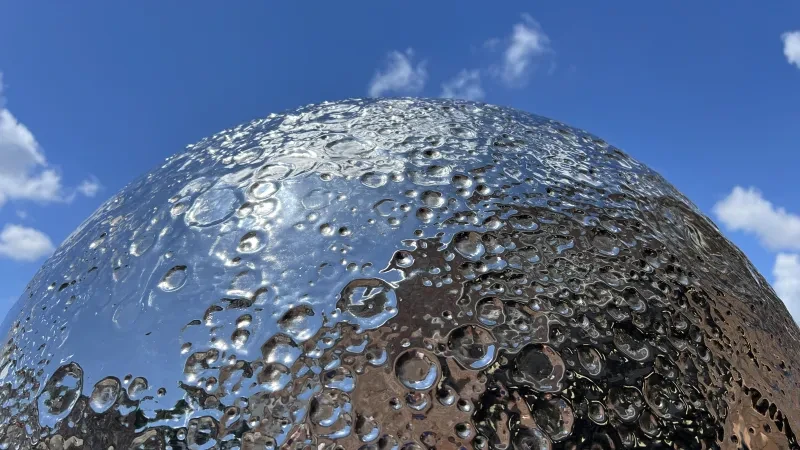
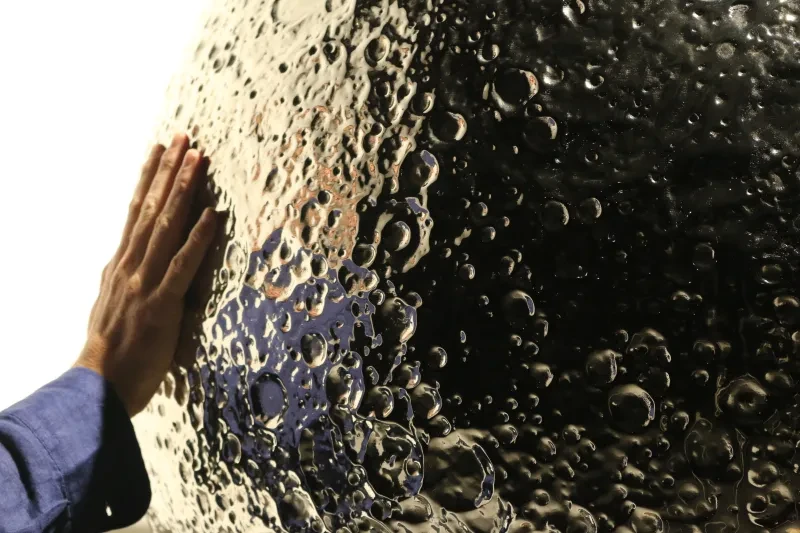
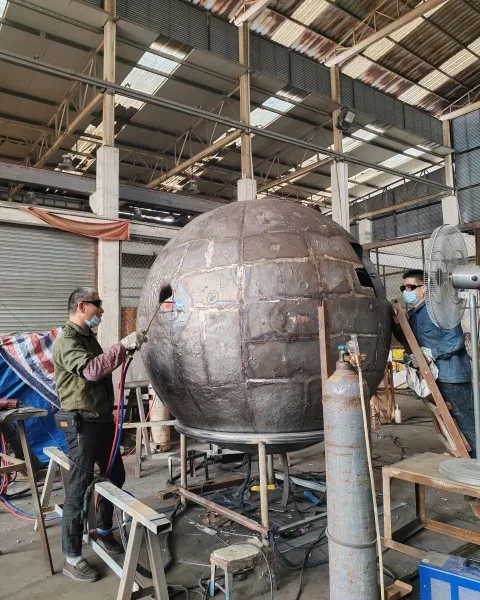
With the arrival of Mirror Moon at the Royal Observatory Greenwich, we dig into the collection to shine a light on those who came before Luke Jerram.
Here are eight special Moons from our collection, the lunar ancestors of Mirror Moon. These visions of the Moon through history come in a range of media, from hand-tinted prints, paper, copper, linen and even plastic. Their development from meticulous hand-drawn creations showing only what was visible at the time to plastic souvenirs of the 1969 Moon landings charts our Moon-mapping history.
Jump to
- Hevelius' Tabula Selenographia, 1647
- John Russell's Selenographia, 1797
- James Reynolds’ Telescopic Appearance of the Moon, 1846
- Working Men’s Educational Union, The Moon, telescopic appearance, 1850s
- Hugh Wilkins' Moon Map, 1951
- Lunar table globe, 1961
- The Wightman Lunaglobe, 1971
- George Tarsoudis' Best of the craters, 2013
1. Johannes Hevelius, Tabula Selenographia, 1647
From the age of 28, beer merchant and lawyer Hevelius' main interest was astronomy. In 1641 he built an observatory on the roofs of his three connected houses in Gdansk, equipping it with splendid instruments. From here, he spent four years observing and recording the moon’s topography.
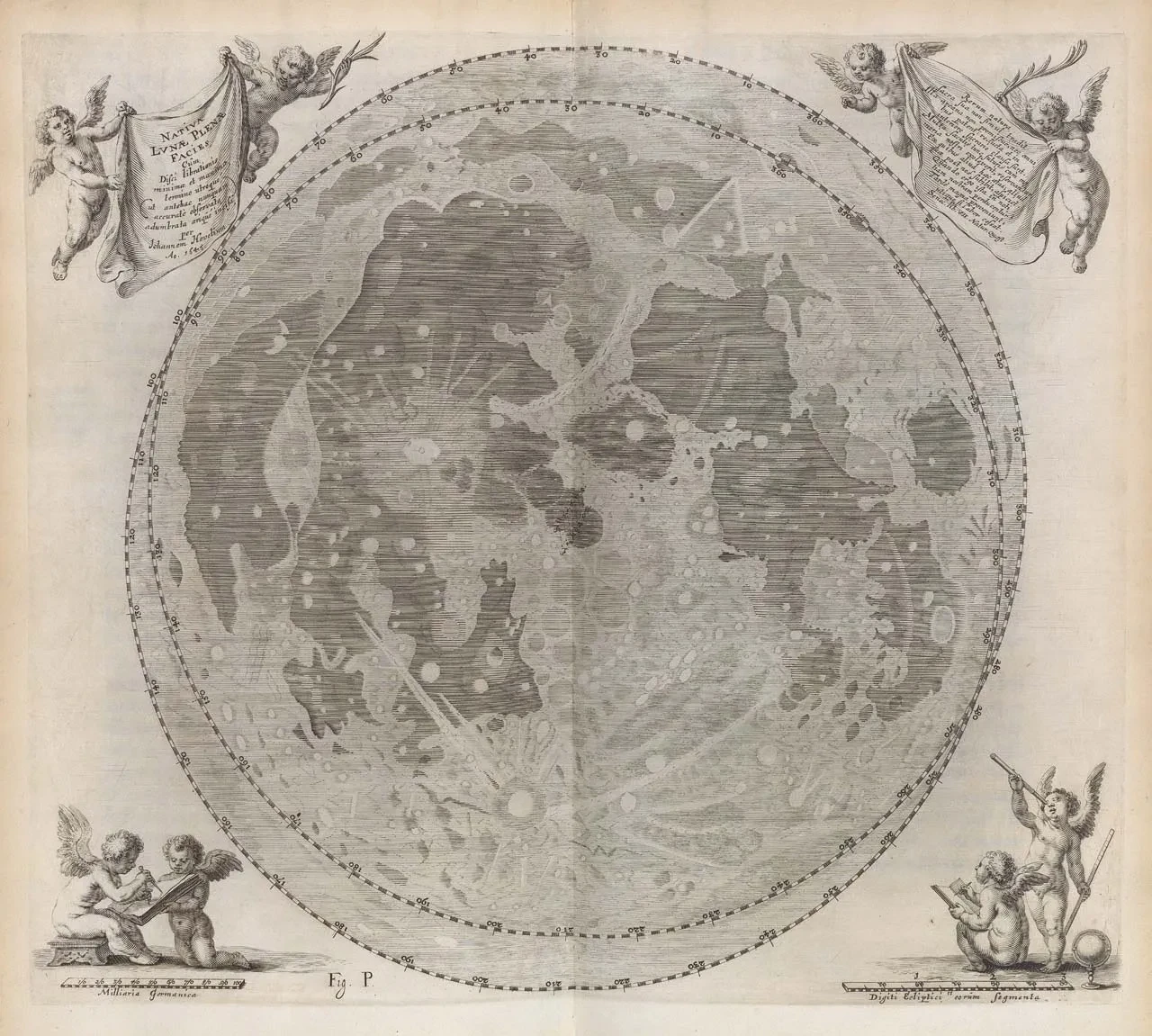
Selenographia, sive Lunae descriptio (Selenography, or A Description of The Moon) was printed in 1647 and remained the standard map of the Moon for more than a century. The first half of the book is dedicated to showing his readers how he’d seen what followed: how Hevelius ground his lenses and how he built his telescopes. These explanations built trust in an audience learning about Moon observations for the first time at the very start of this new field of study.
2. John Russell's Selenographia, 1797
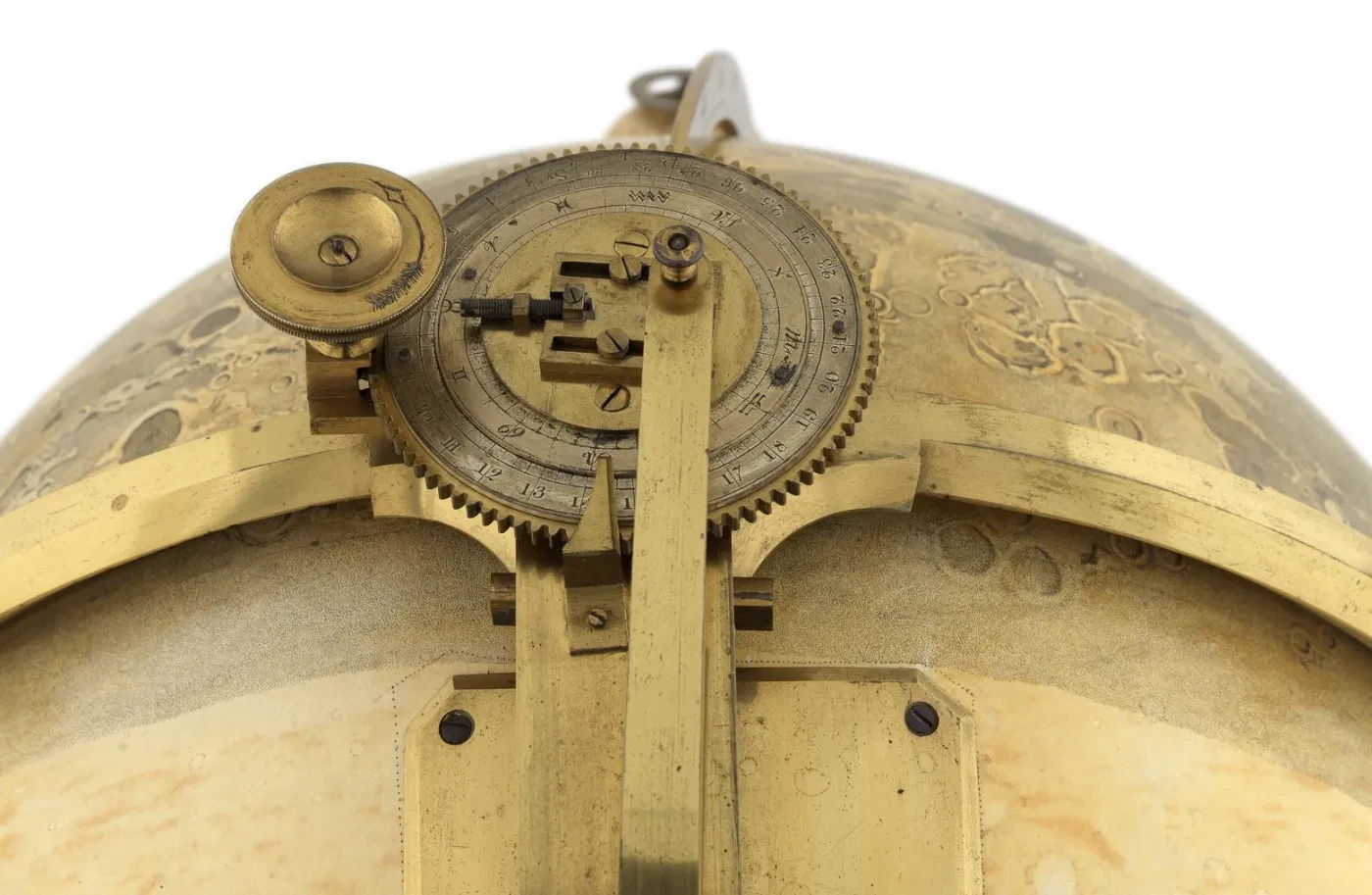
John Russell’s Selenographia is the result of years of near-obsessive lunar observation. A portrait painter by profession, Russell spent more than 30 years observing, drawing and mapping the moon, using a micrometer and a Dollond achromatic refracting telescope, the latest technology for the time.
Selenographia is mounted in an elaborate brass stand, designed to demonstrate the ‘lunar libration’, the slight wobble of the Moon as it rotates. Selenographia was financed through private subscription, so only small numbers were ever produced; 11 survive.
The first of its kind, Russell himself wondered about the legacy of his Selenographia, writing that it was not ‘possible to say how precious, in future time, such a representation as this may become.'
Tim May, Curator of Maps and Mobilities says, ‘Russell had this quite intense, emotional connection to the moon. A man of deep religious beliefs, in his own words, he was “stricken by the beauty of the moon”.’
1 / 6
John Russell's Selenographia
This Moon model consists of a large lunar sphere and a small terrestrial sphere. It is constructed to reproduce the librations, or 'wobbles', of the Moon with respect to the Earth
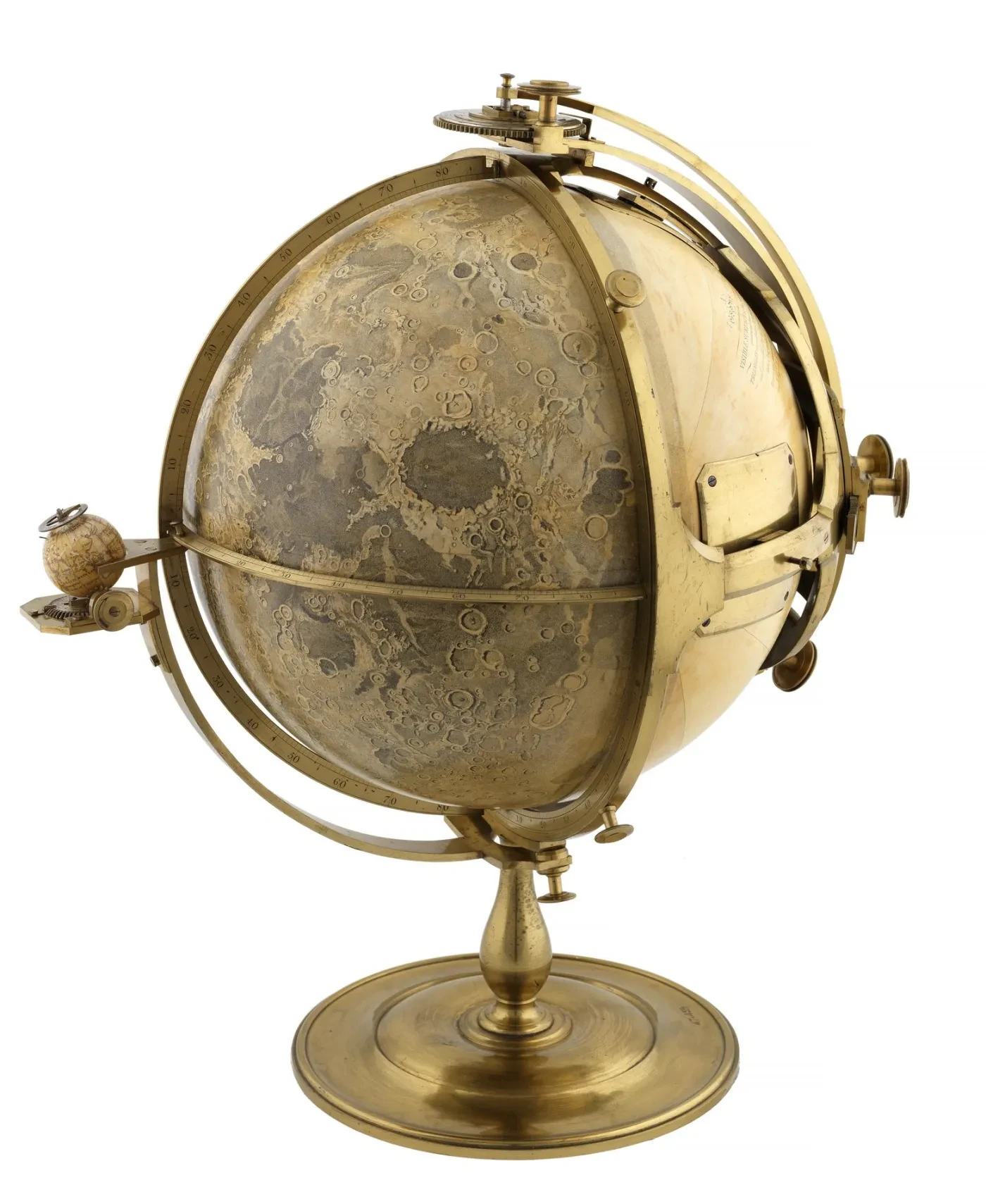
2 / 6
John Russell's Selenographia
The Moon's craters, 'seas' and the mountains are delicately drawn but they're not labelled. The main craters are marked with a cross.
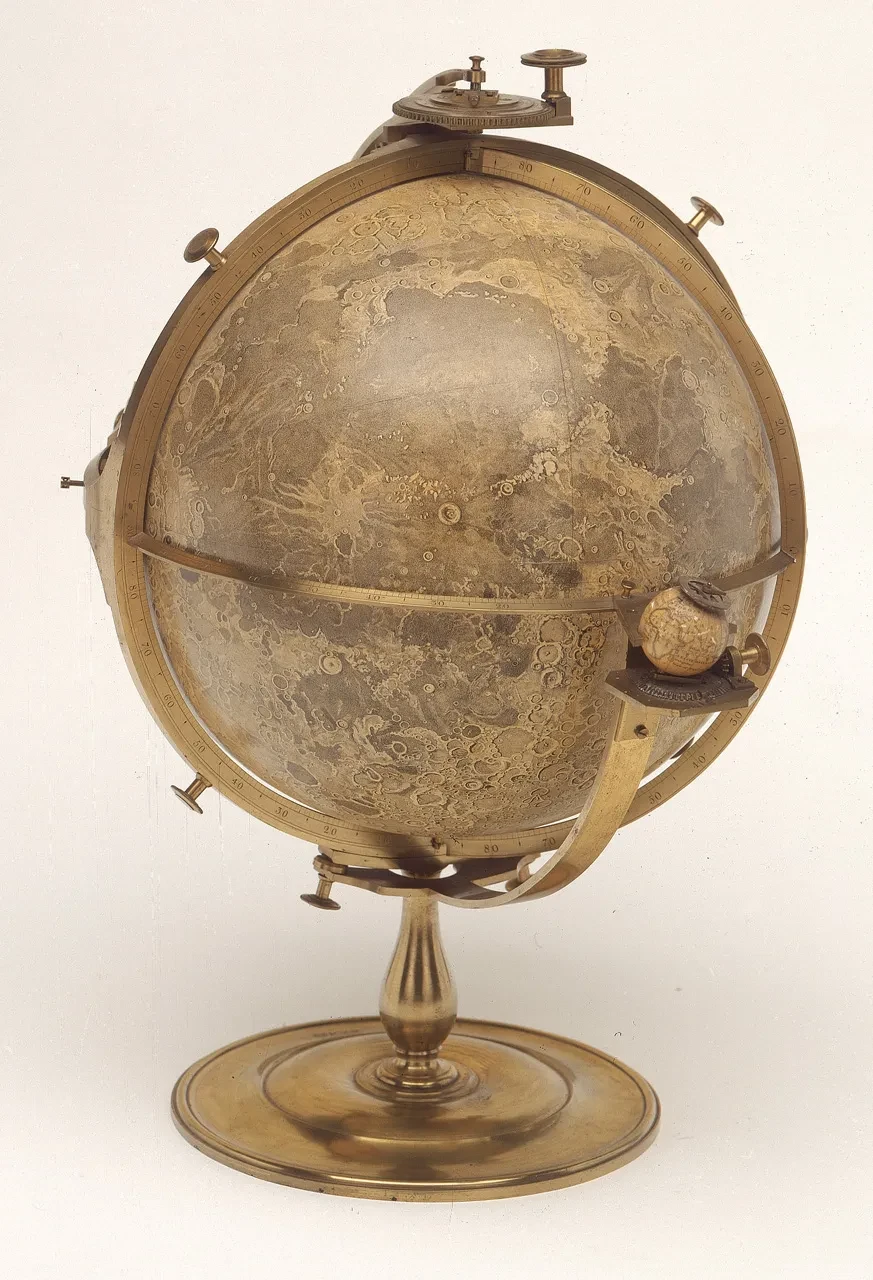
3 / 6
Detail from Selenographia
The terrestrial globe is inclined at 66.5 degrees to the ecliptic and supported by a quarter circle rising from beneath the lunar globe. A number of different mechanisms represent the various relative motions of the Moon and the Earth.
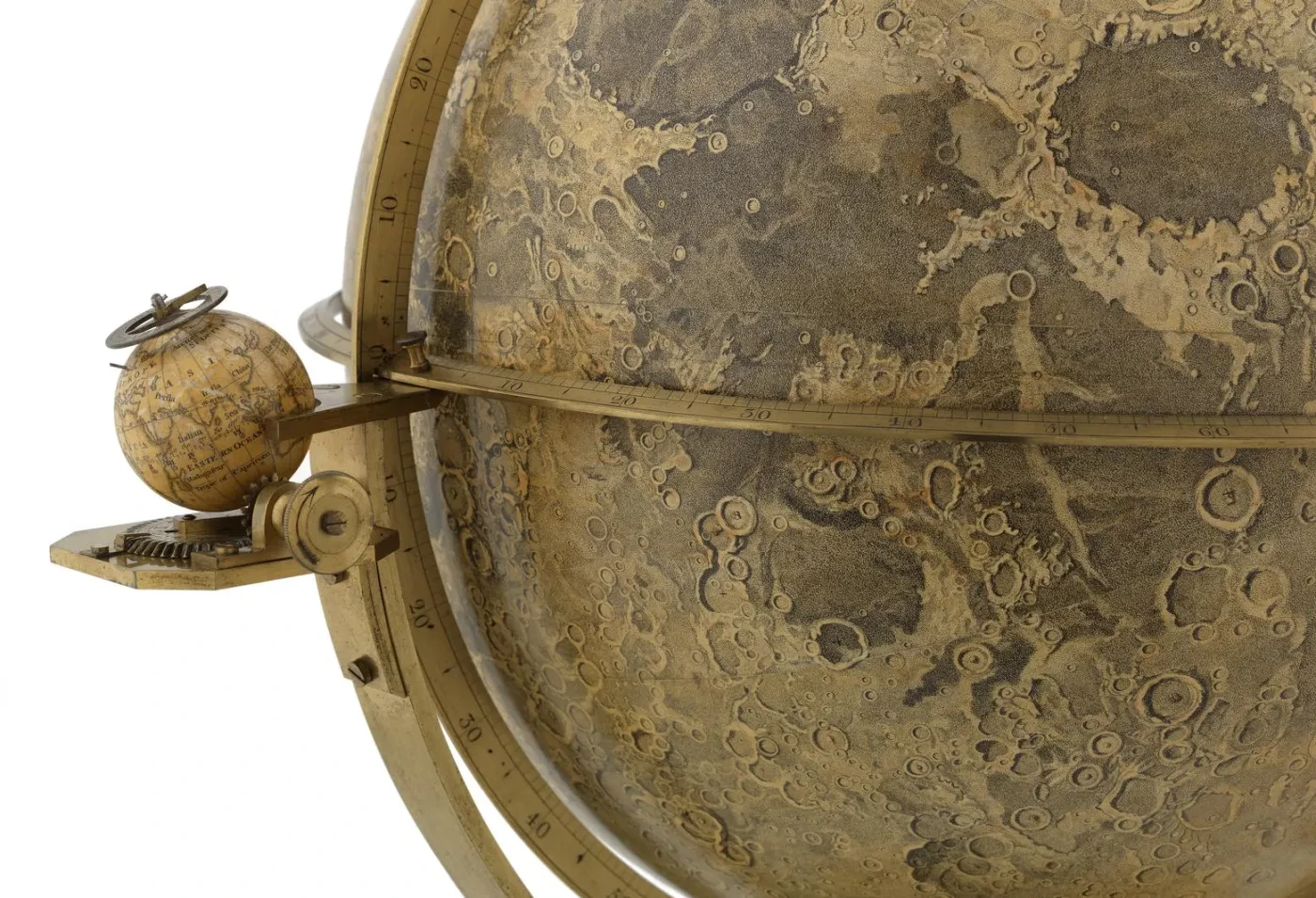
5 / 6
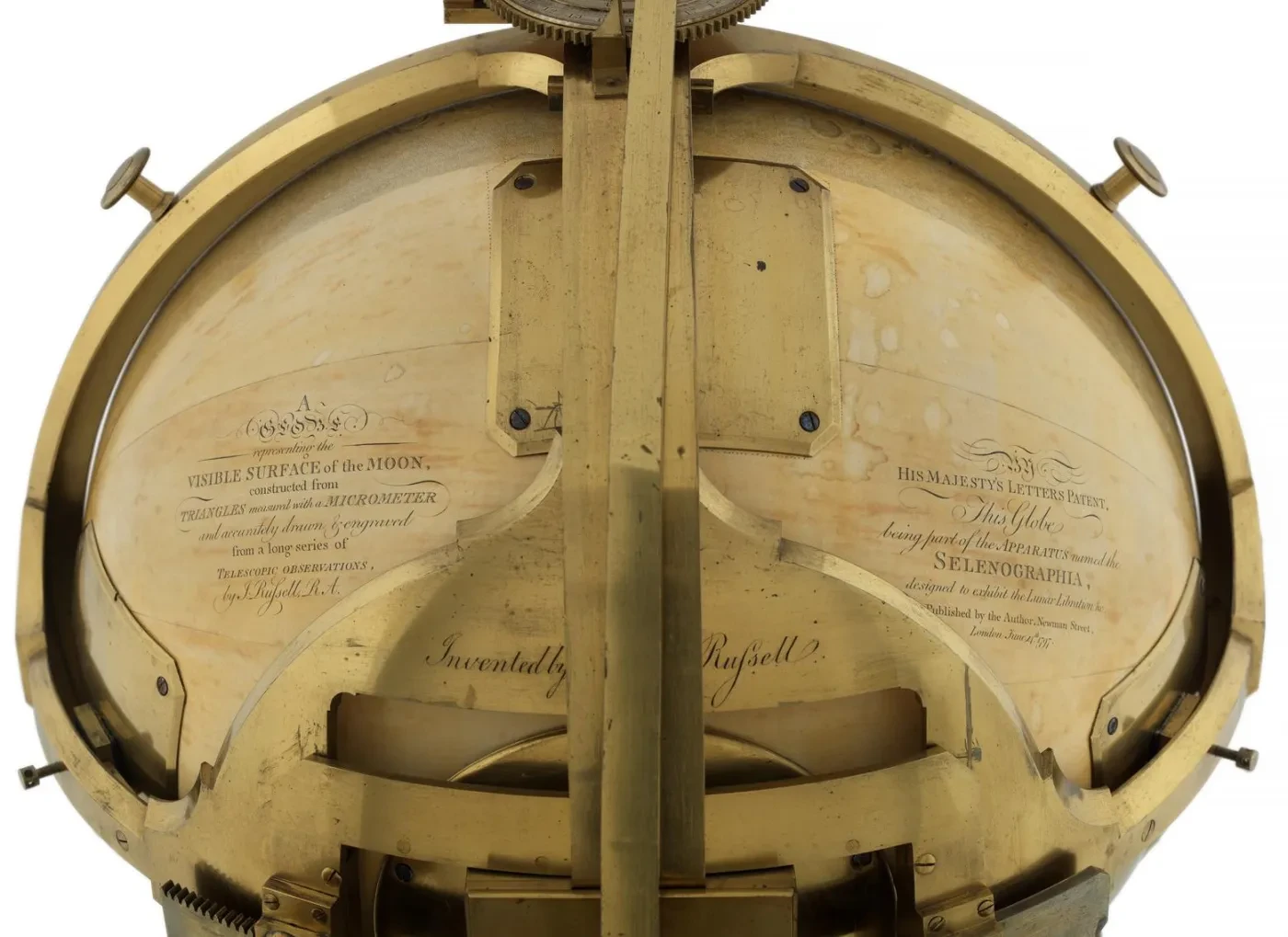
The 'far side' of Selenographia
The inscription on the far side of the Moon includes the words, 'This Globe being part of the apparatus named the Selenographia, designed to exhibit the Lunar Libration.'
The date shown is 4 June, 1797.
6 / 6
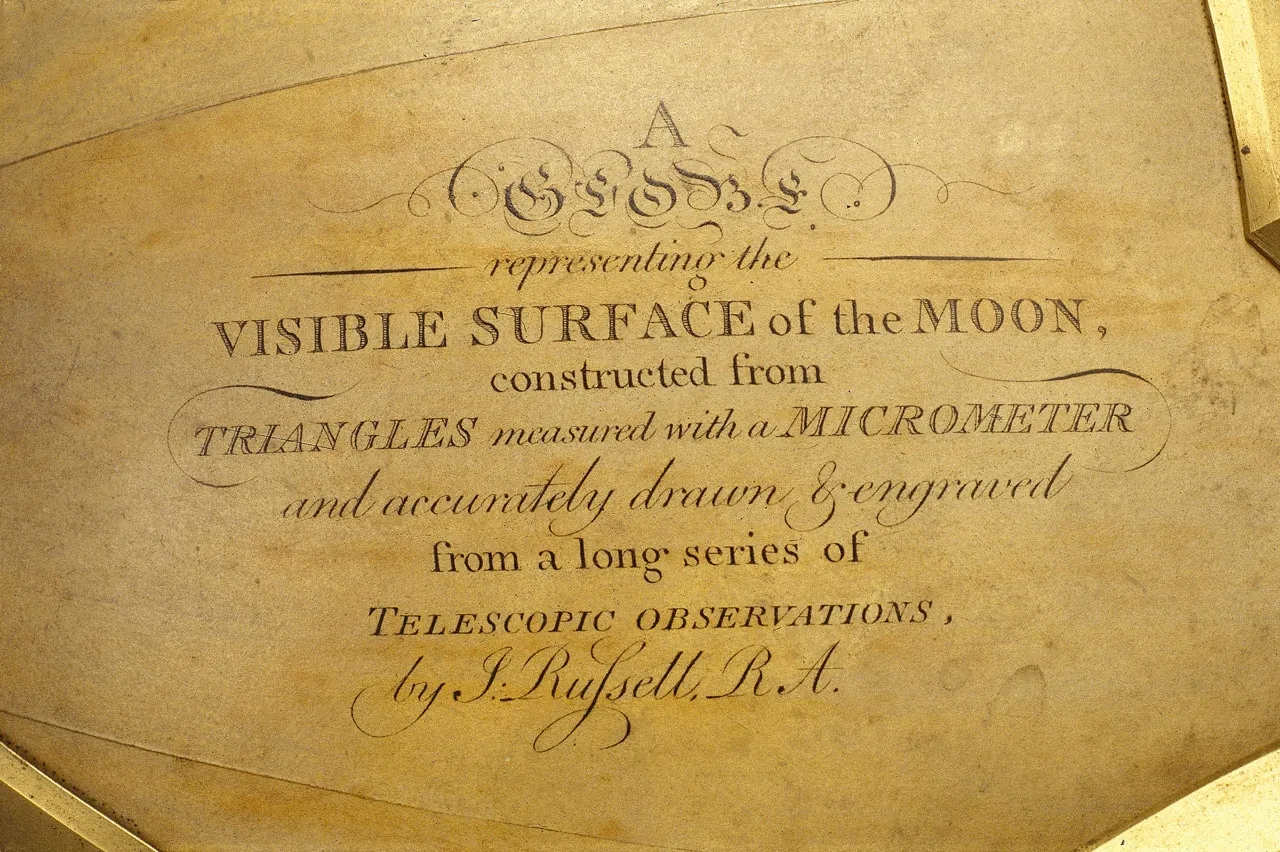
The inscription on Selenographia
'A globe representing the visible surface of the Moon constructed from triangles measured with a Micrometer and accurately drawn and engraved from a long series of telescopic observations by J Russell RA'.
3. James Reynolds' Telescopic Appearance of the Moon, 1846
Exactly 180 years before Mirror Moon, printer James Reynolds created this Telescopic Appearance of the Moon. The size of a school textbook, the Telescopic Appearance of the Moon is a hand-tinted print from 1846, intended for informal learning within the home.
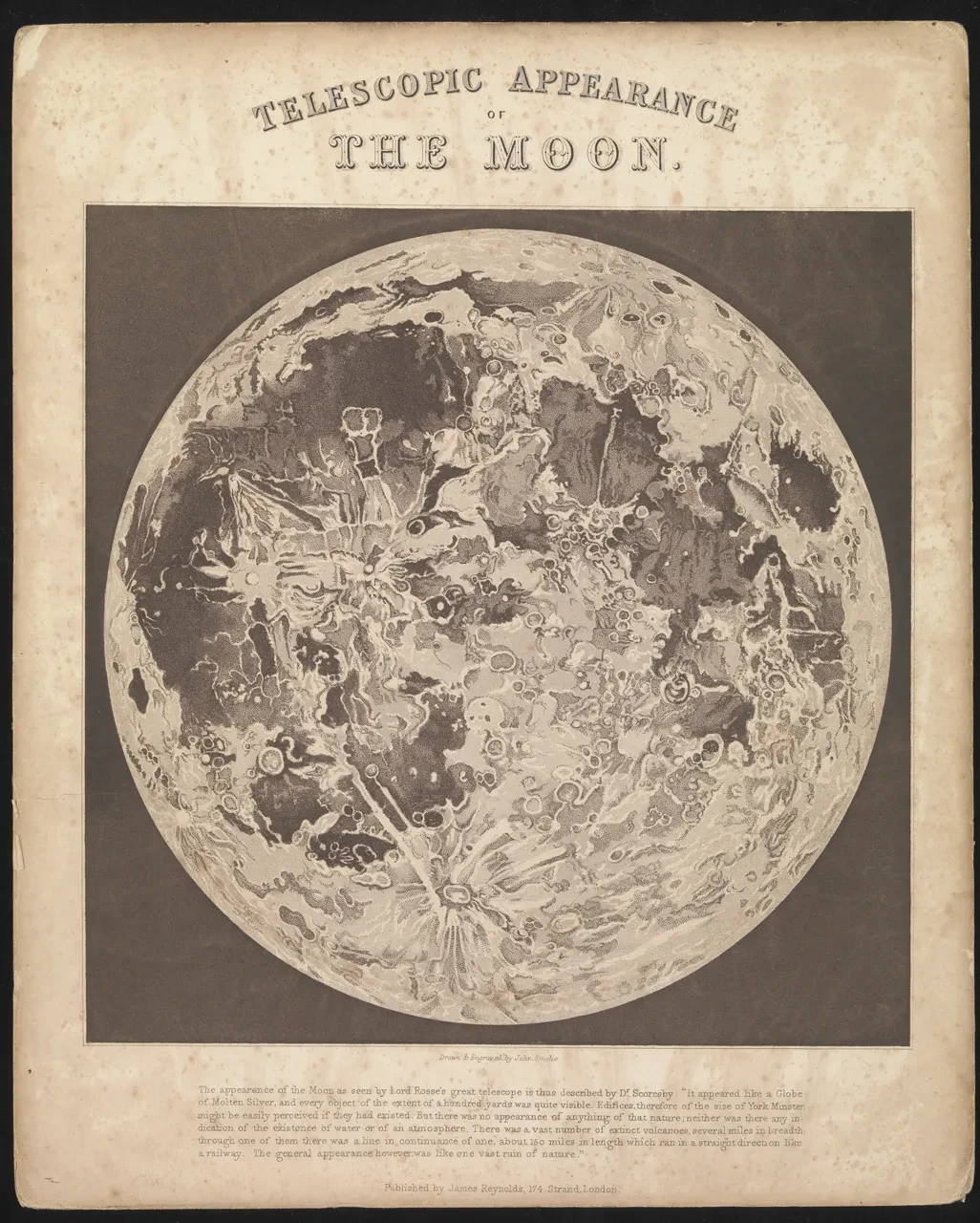
Created in response to a surge in interest in educational science products, this print is part of a set of 12 that could either be bought as a set or singly; single prints cost around 1 shilling, perfect for the growing middle-class audience of the time.
4. Working Men's Educational Union, The Moon, telescopic appearance
Roughly the size of a yoga mat, this lithographically printed cotton map of the Moon is among more than 400 produced by the Working Men's Educational Union in the 1850s. The Moon, telescopic appearance is one of a set of nine wall hangings used in lectures to illustrate the latest advances in knowledge.
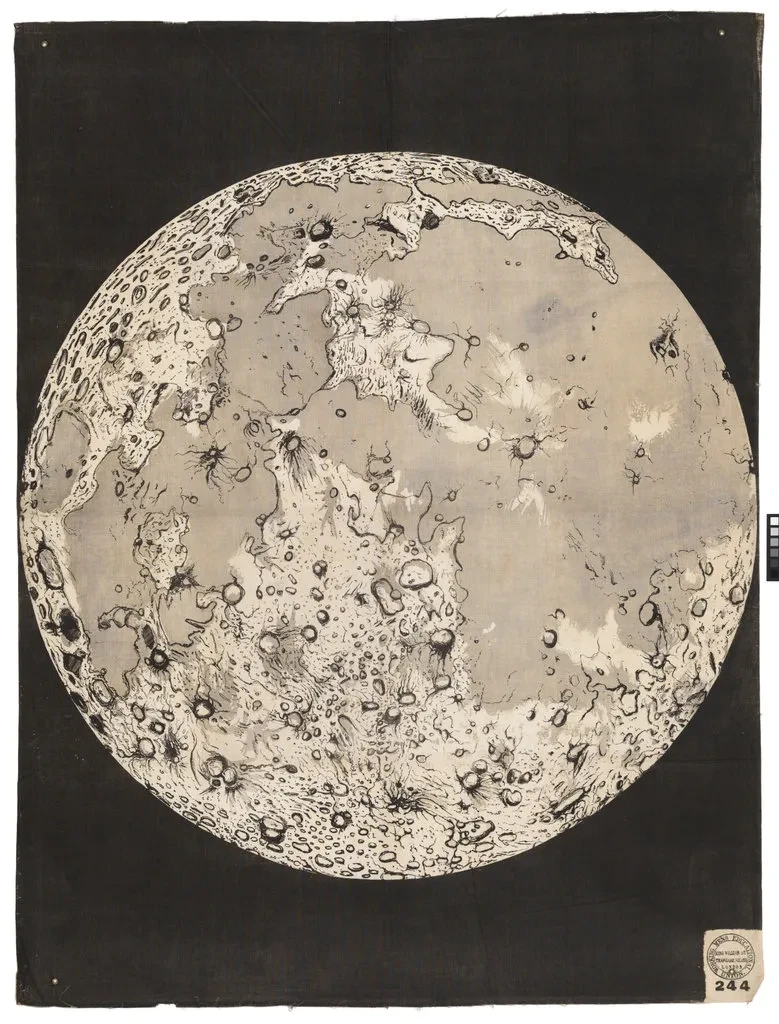
The Working Men's Educational Union was formed in 1853 as a philanthropic society with the object of 'the elevation of the working classes, as regards their physical, intellectual, moral, and religious condition'. They encouraged popular literary and scientific lectures ‘by preparing suitable Diagrams and other aids to lecturers’ and to promote lending libraries and 'mutual instruction classes' – working people teaching each other. At the time, these lectures were a form of entertainment as well as educational: the elements of 'show' – using models, pictures and even live experiments was all part of the fun.
- Attend one of the special talks and tours on offer at Mirror Moon, and you’ll be following in the footsteps of the WMEU...
5. Hugh Wilkins' Moon Map, 1951
Created in the 1950s, Hugh Wilkins' astonishingly detailed hand-drawn Moon Map hails from a very particular moment in the history of mapping the moon, exactly 75 years before Jerram's Mirror Moon.
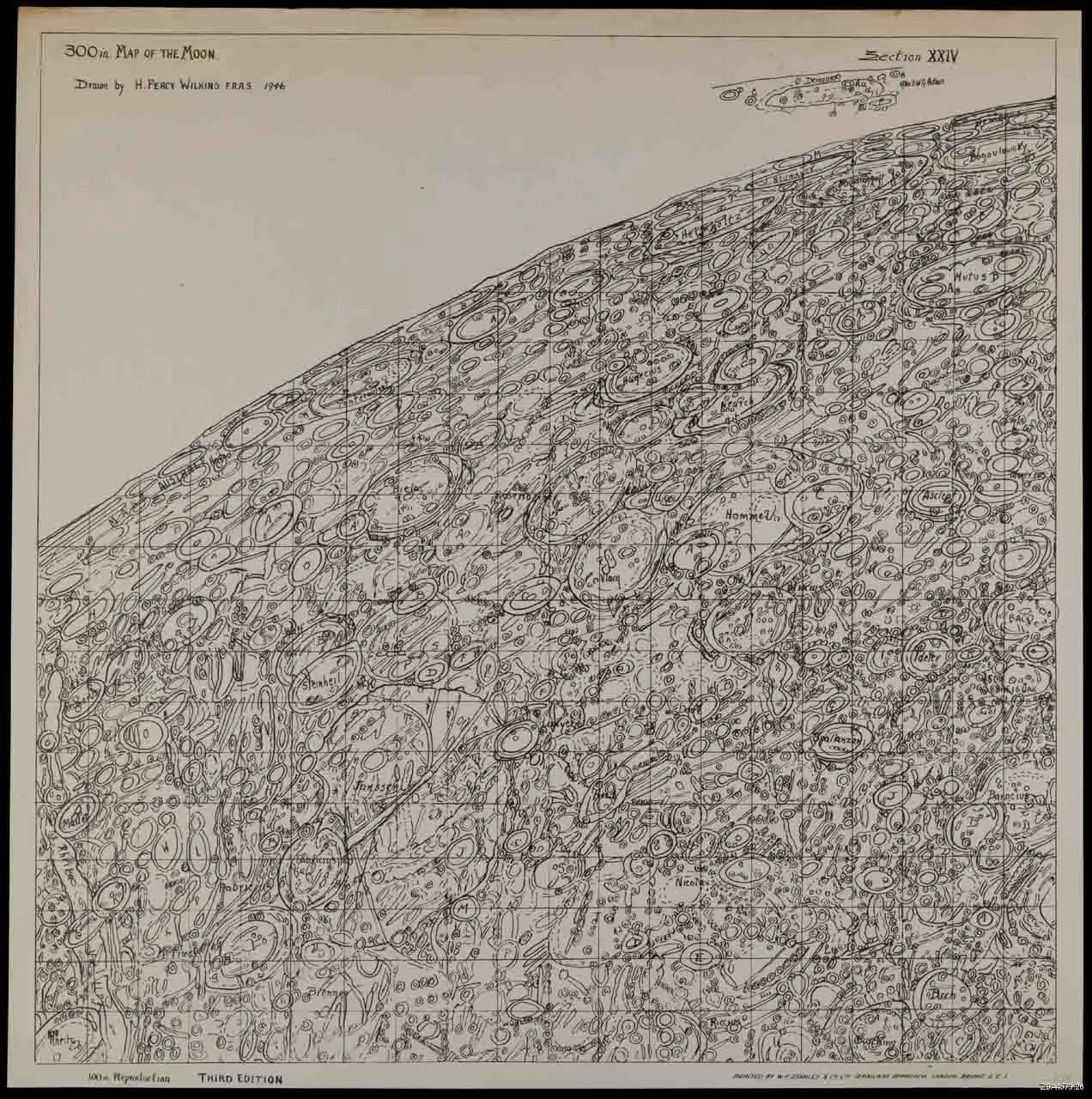
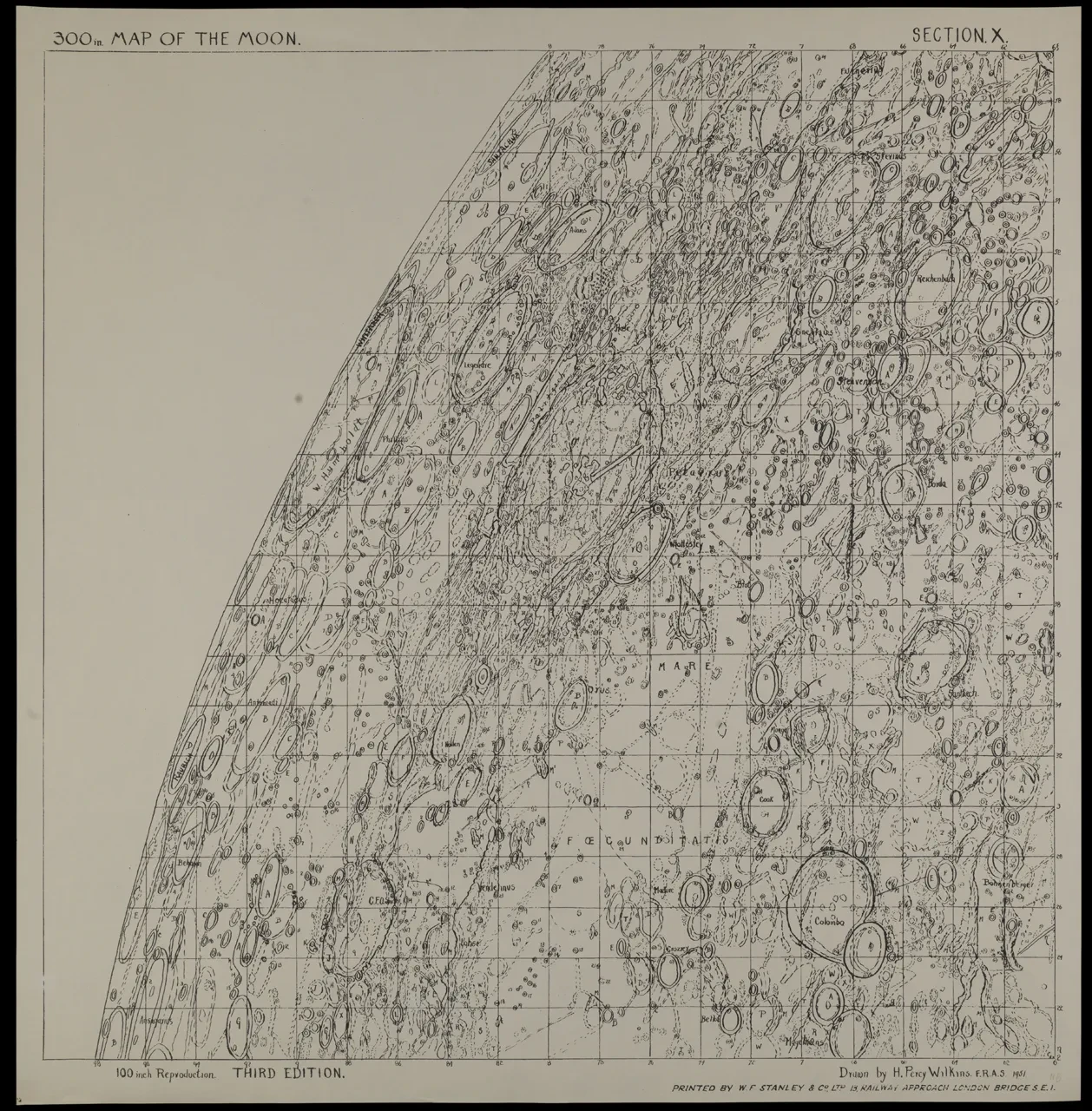
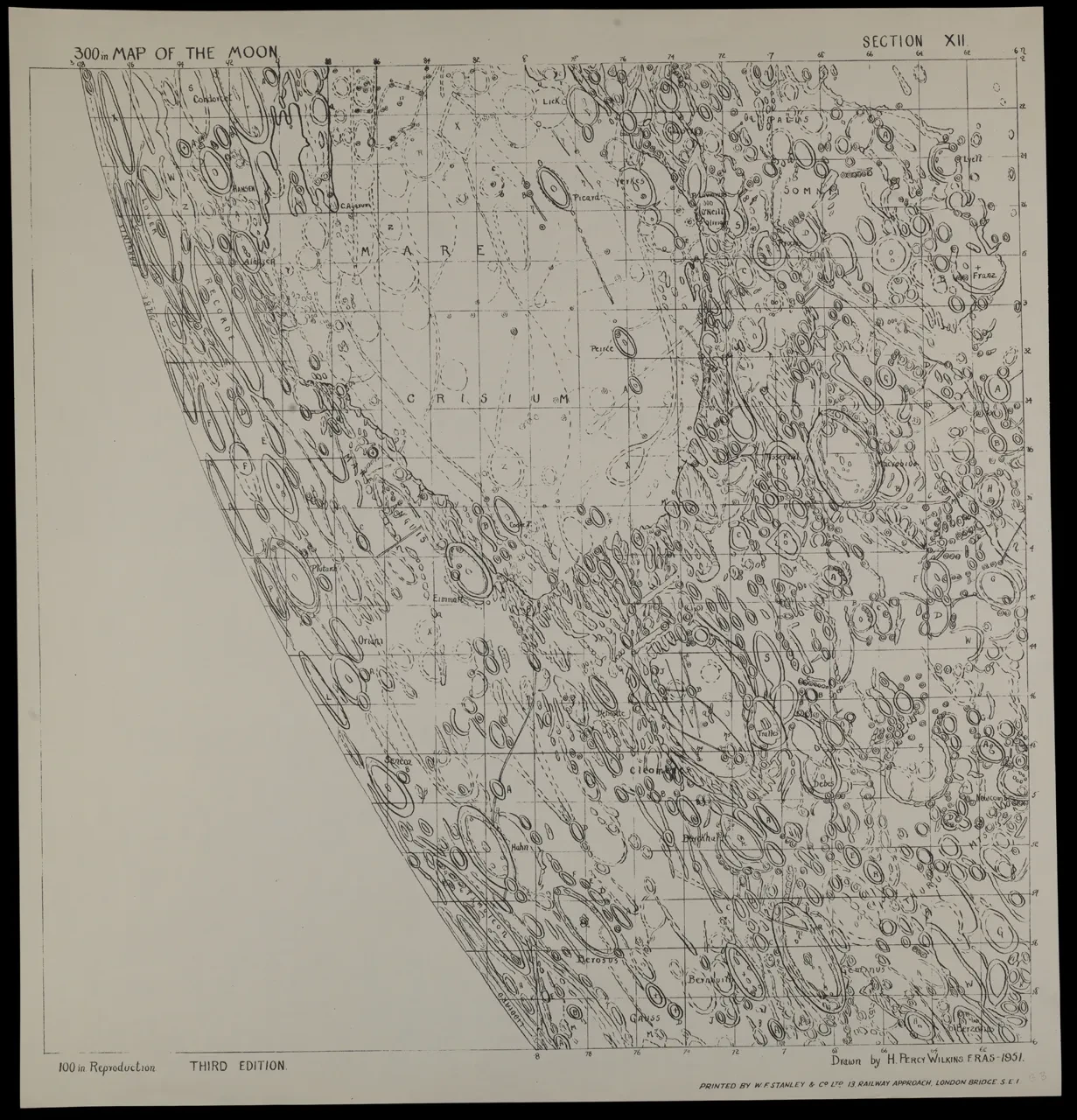
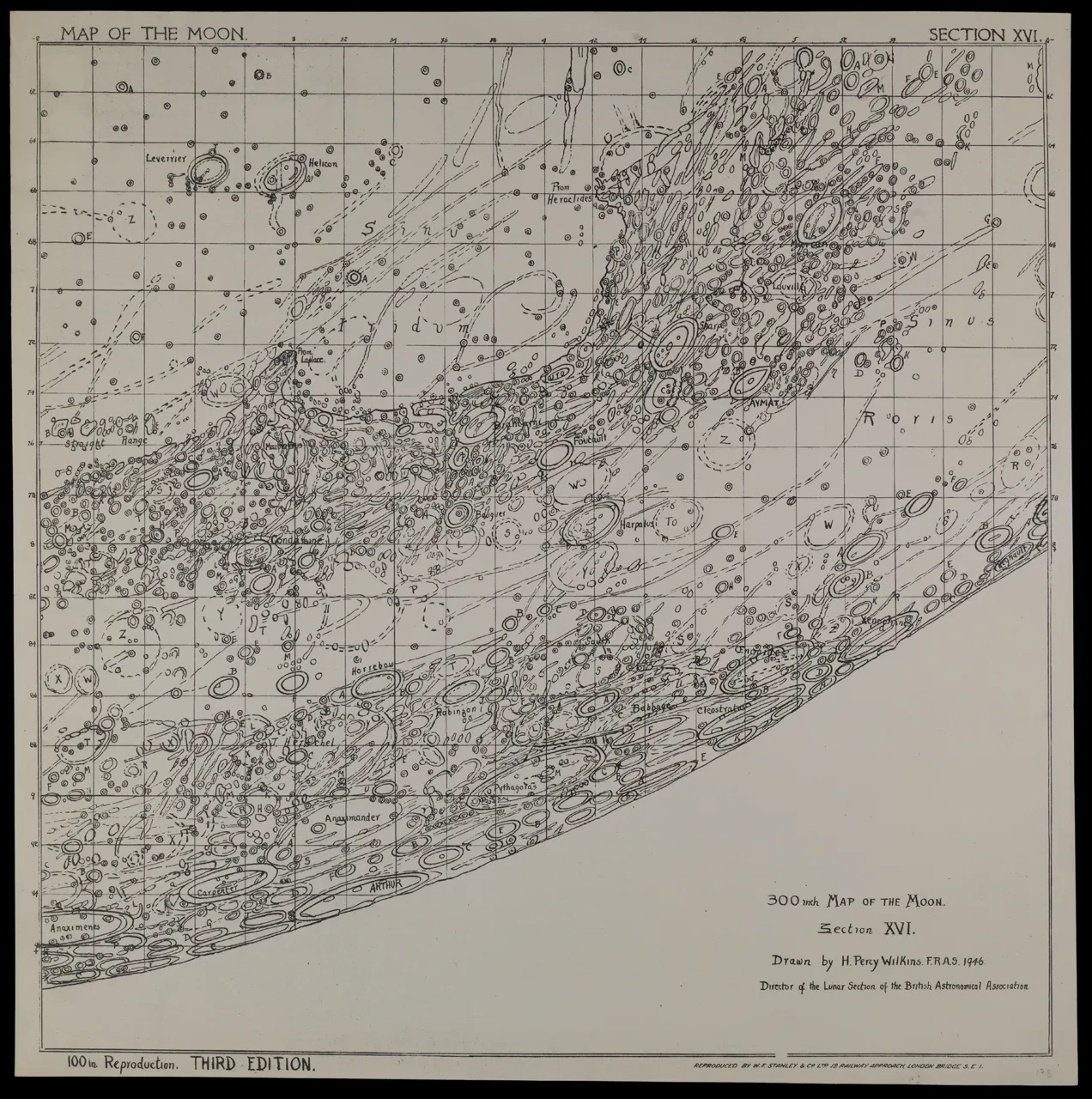
Created with ink and paper by hand from his home in Bexleyheath, south London, Wilkins’ map was the result of a lifetime’s meticulous work. 'When it was published, it was the most detailed map of the Moon that had ever been made,' says Dr Megan Barford, former Curator of Cartography at Royal Museums Greenwich.
- Find out more about Hugh Wilkins’ Moon Map here
1 / 5
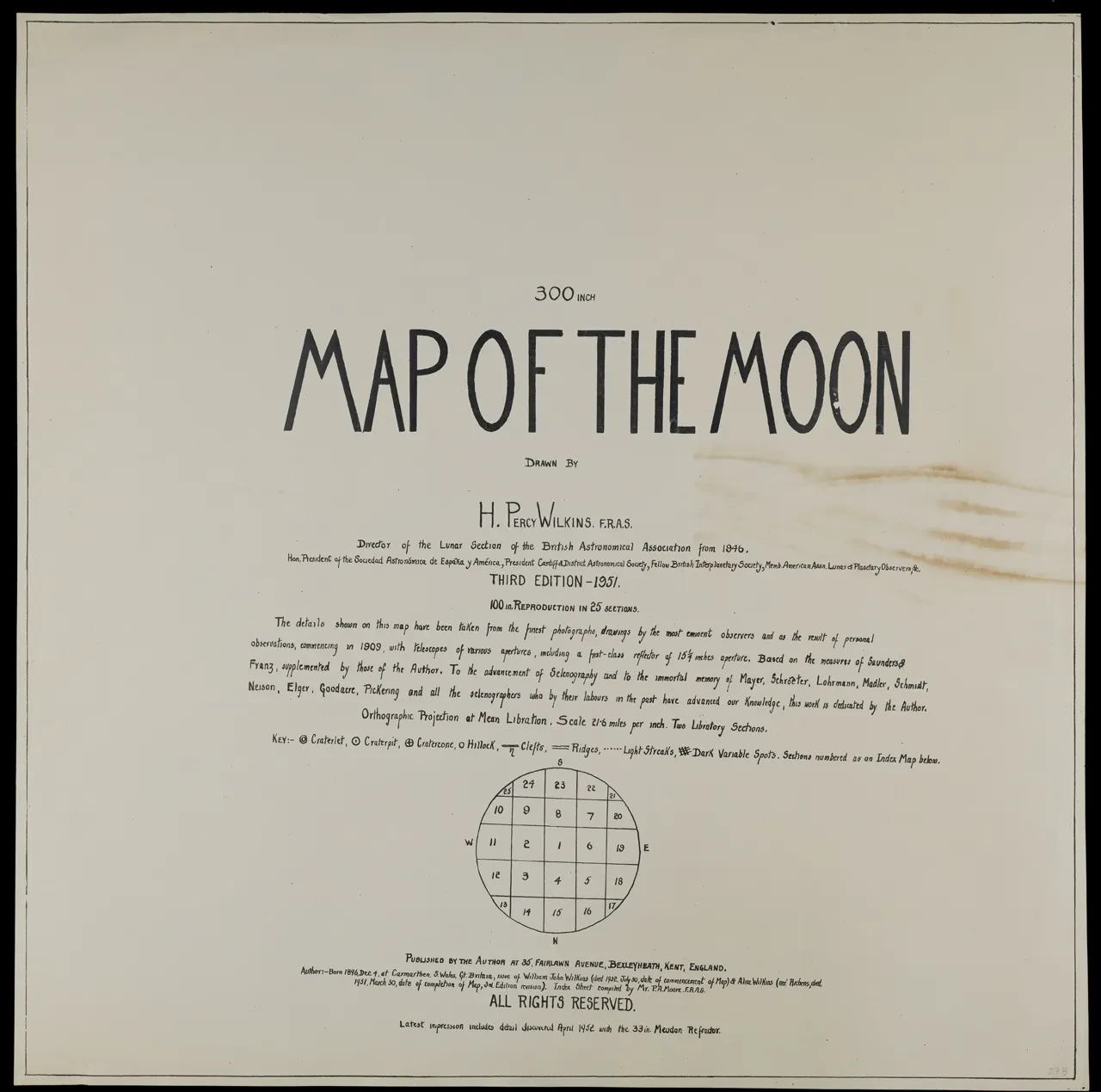
The title page of Wilkins' Map of the Moon
Wilkins dedicated the map to 'the advancement of Selenography, and to the immortal memory of Mayer, Schröeter, Lohrmann, Madler, Schmidt, Neison, Elger, Goodacre, Pickering and all the selenographers who by their labours in the past have advanced our knowledge'
2 / 5
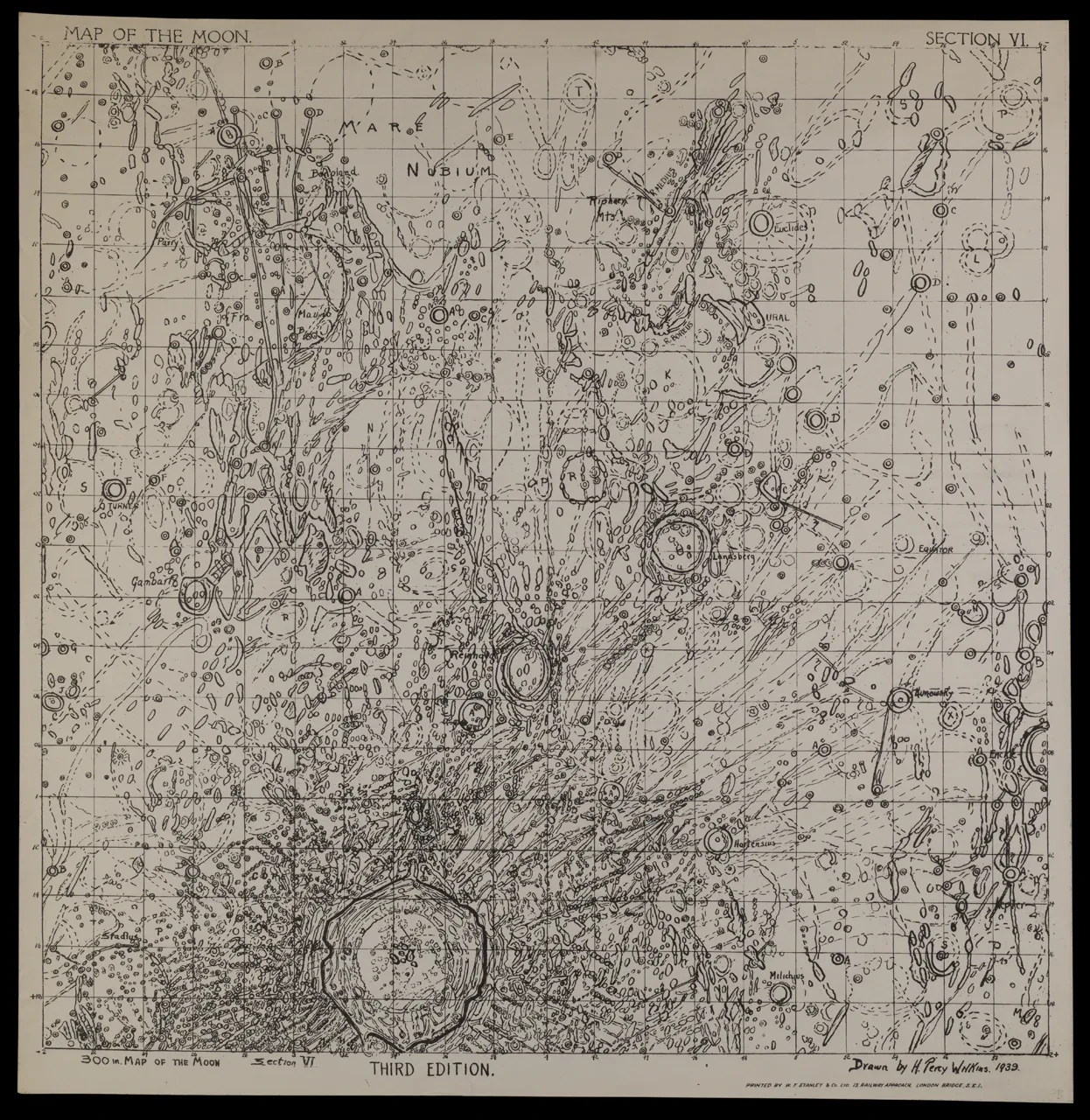
Section VI
With 'Mare Nubium', a large, ancient, basalt-flooded lunar mare on the Moon's near side.
3 / 5
Section X
Section X shows Humboldt a large lunar impact crater near the eastern limb of the Moon. Due to foreshortening, this formation has an extremely oblong appearance on Wilkins' map. The actual shape of the crater is an irregular circle.
4 / 5
Section XII
With Mare Crisium (Latin for 'Sea of Crises'), a distinct, dark lunar mare located in the Moon's northeastern quadrant.
5 / 5
Section XVI
With Sinus Roris (Latin for 'Bay of Dew'), a dark, basaltic plain on the near side of the Moon. Early concepts of a Moon landing envisaged the establishment of a permanent lunar base in the Sinus Roris region. These ideas lead, in much modified form, to Project Apollo.
6. Lunar table globe, 1961
Just 67 years ago, we finally found out what's on the far side of the Moon. And so, in 1961, this desk-lamp-sized lunar table globe was created using the Lunik 3 spacecraft's photos of the far side of the Moon. Today, we can spin around the Moon anytime we like on our phones, but this globe represents a real turning point in human history: before 1959 no-one had seen this 'dark side' of our natural satellite.
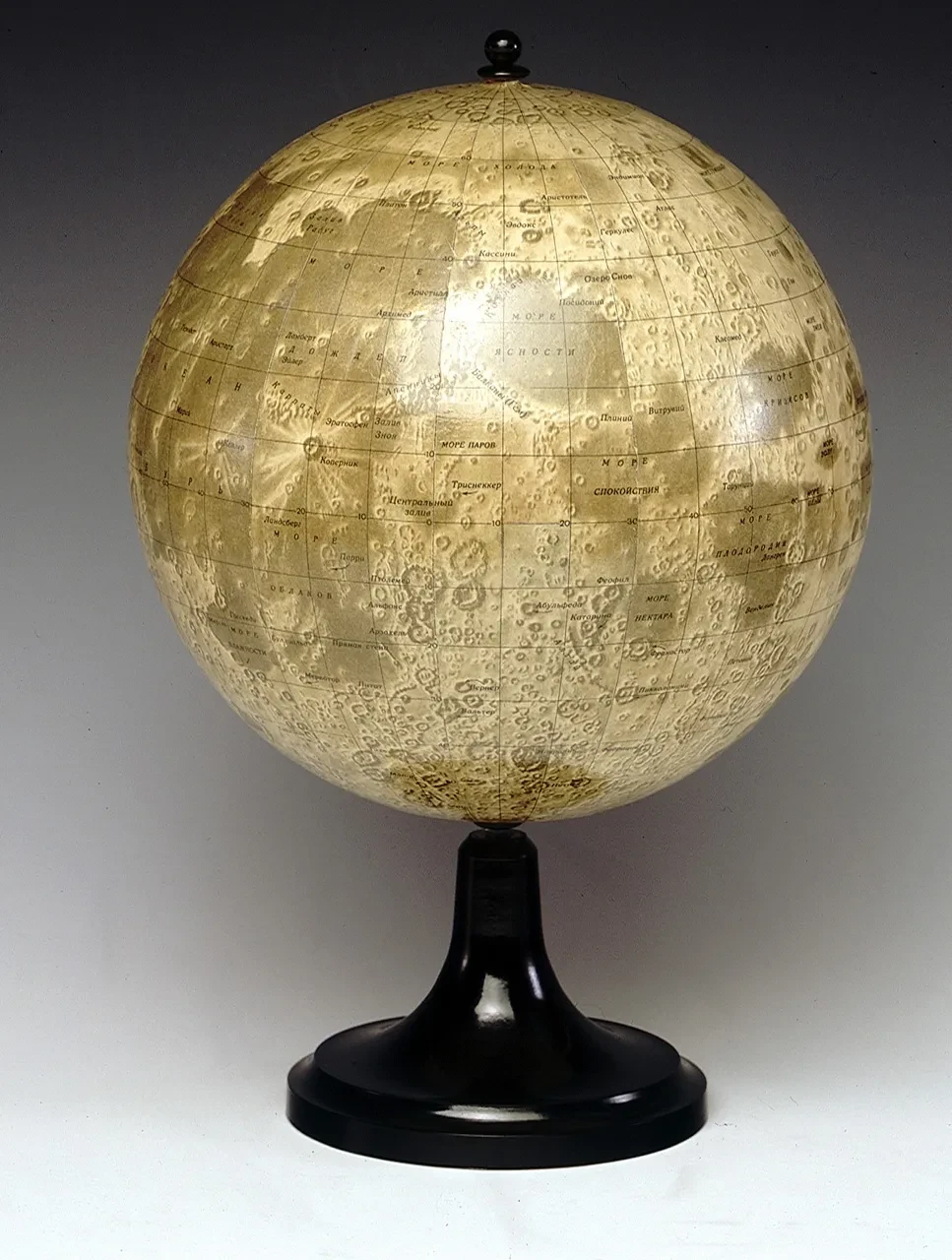
Details on the sphere show the landing position of the 1959 Soviet space probe and the 'Moonshot'. The most important craters are labelled in Russian; some names in red are barely legible. In 1961, space exploration was really speeding up. By the time this globe was created, it was out of date; better data about the far side of the Moon had already become available.
7. The Wightman Lunaglobe, 1971
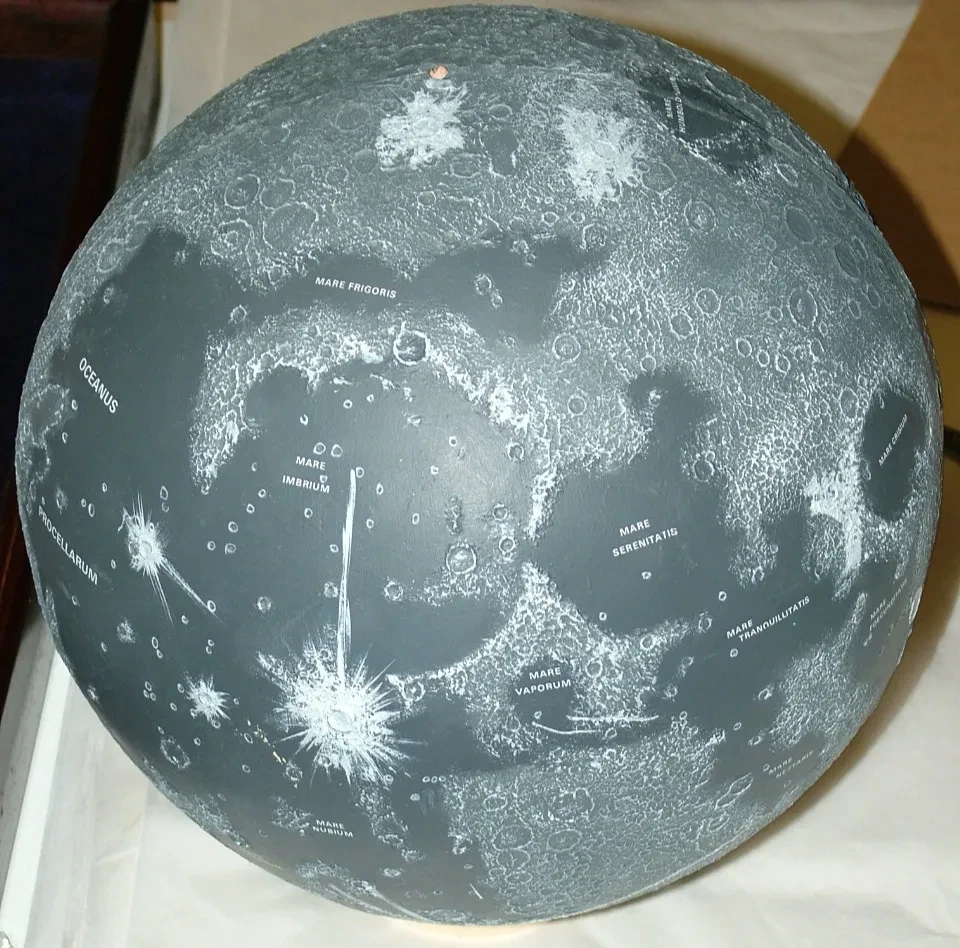
Fifty-five years ago, you may have celebrated the excitement of the 1969 Moon landings with the purchase of this plastic beauty. Hand-made by Arthur Wightman in his workshop in Penzance, Cornwall, the Lunaglobe is based on thousands of photographs supplied by NASA. It was carefully cast to show craters and other features of the lunar surface, then brushed with white paint to show debris fields. At the height of its popularity, Wightman was making 10 Lunaglobes a week.
1 / 3
A 12in Wightman Lunaglobe
The 12-inch grey plastic Lunaglobe came with a two-part stand.
2 / 3
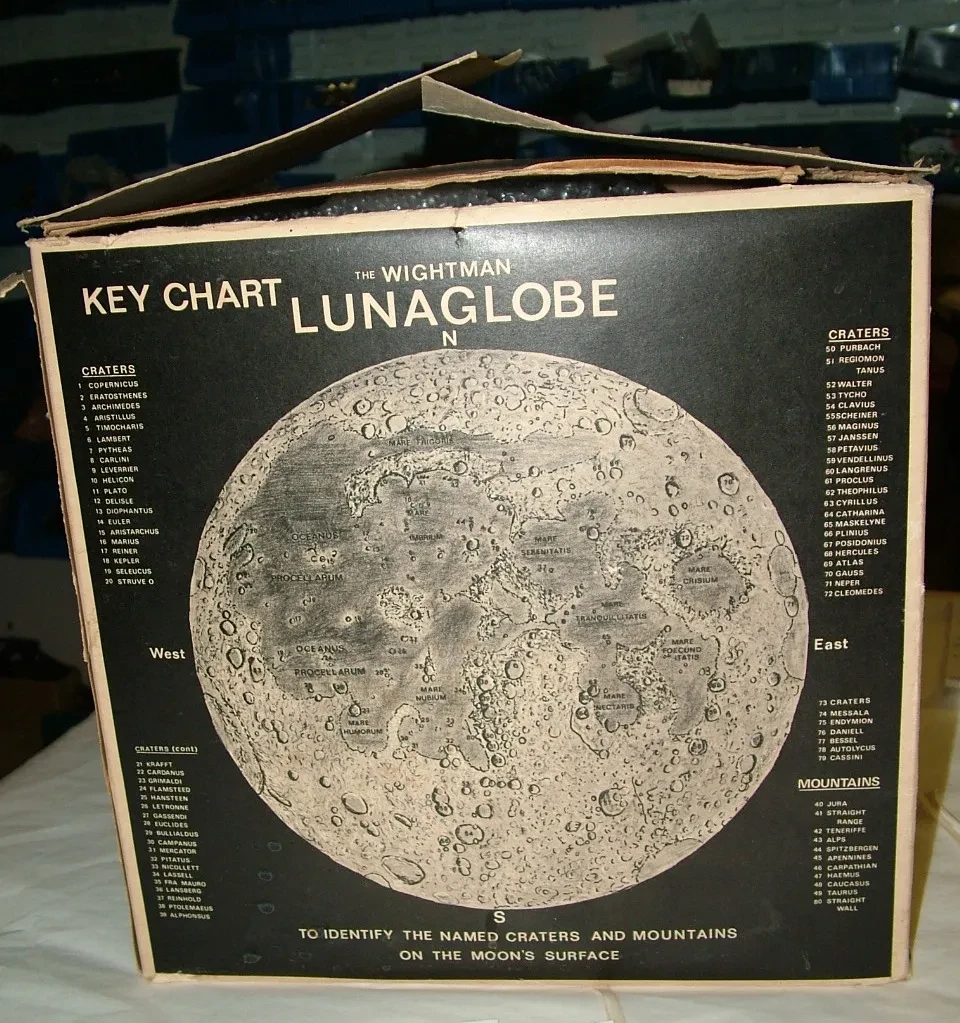
The Lunaglobe's box
'Be up to date with the APOLLO adventures', boasts the Wightman Lunaglobe's box. The container also includes a key indicating the names of the mountains and craters, and where the various labels should be placed.
3 / 3
The Lunaglobe instruction manual
With 'general colouring and finishing guidance', the plain Lunaglobe was supplied with colouring instructions and transfers for the names of the Moon's key features.
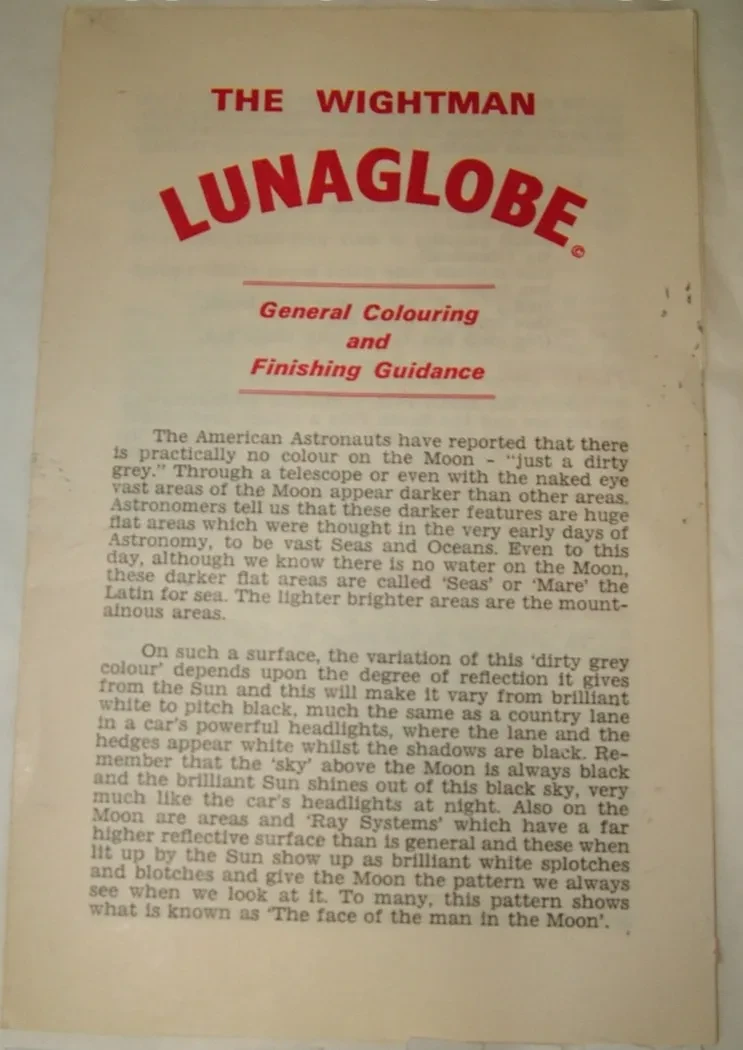
Once you’d bought your Lunaglobe souvenir, you could take on the task of labelling the different features; the globe came with Letraset transfers and colouring instructions on the side of the box. The American unmanned 'Surveyor' and 'Ranger' landing sites could be marked with yellow triangles; the Russian unmanned 'Lunar' sites in red; the manned 'Apollo' missions (11 and 12, both 1969) in blue.
Wightman sold three sizes of his Lunaglobes: 8inch, 12inch and 24inch. His customers included NASA itself as well as Frank Borman, captain of Apollo 8.
You can spot a 24inch version of the Wightman Lunaglobe adorning Blofeld's futuristic lair in the 1971 James Bond film, Diamonds are Forever.
8. George Tarsoudis' Best of the Craters, 2013
Today, camera technology means everyone can create their own likenesses of the moon, even with just a smartphone. This eighth object in our list shows what the amateur selenophile can create 360 years after Johannes Hevelius’ Tabula Selenographia.
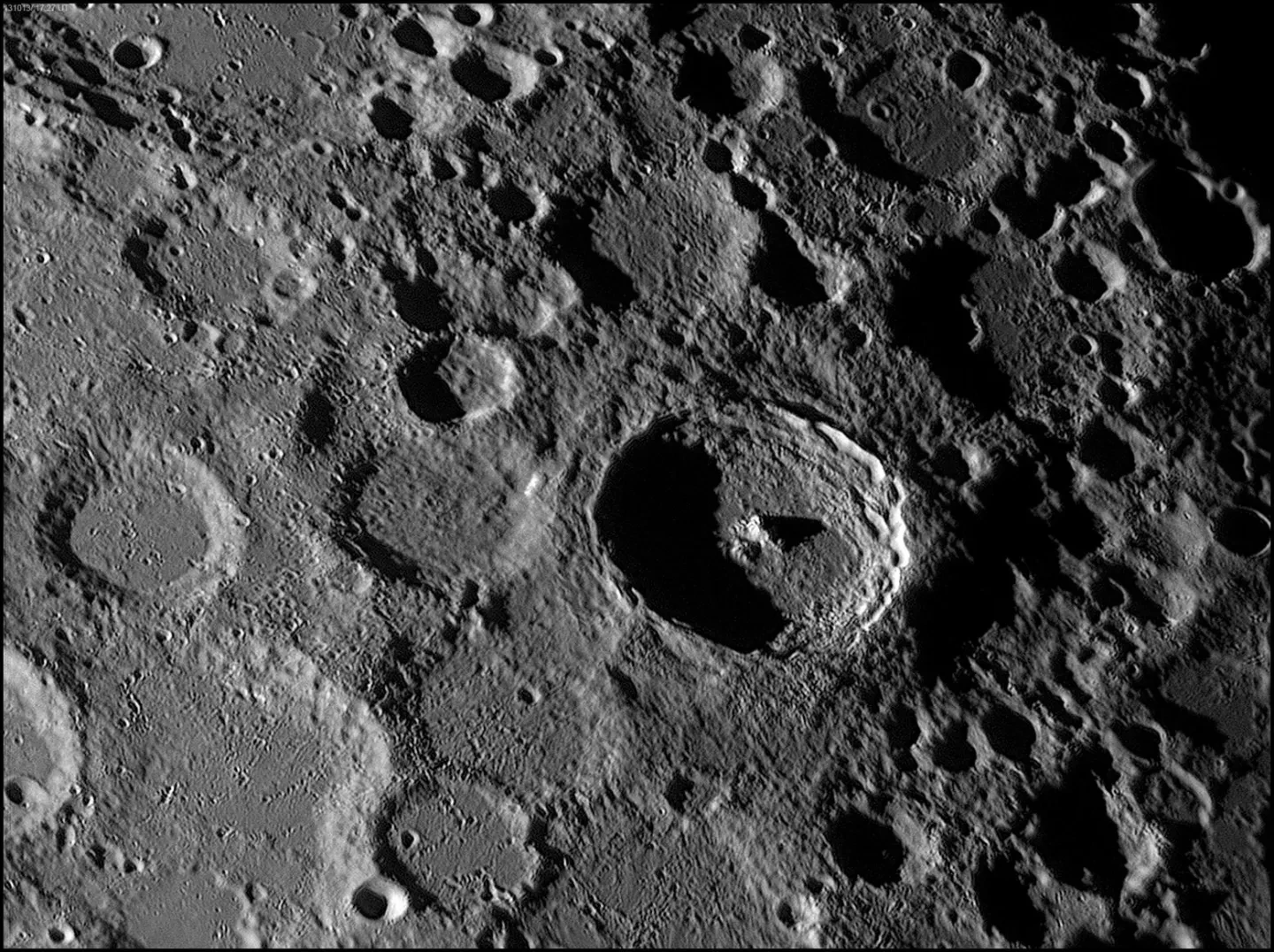
George Tarsoudis took this photograph of the Tycho crater from Greece in October 2013, with a Sky-Watcher BK DOB 14-inch Collapsible 355mm f/4.5 telescope and a Unibrain Fire-1 785 camera. The picture was a runner up in the Our Solar System category of Astronomy Photographer of the Year in 2014.
- Want to create your own brilliant photos of the Moon? We’ve got expert tips to help you.

Mirror Moon
'I hope Mirror Moon will inspire generations of visitors to have an interest in contemporary science, art and the wonder of the night's sky,' – Luke Jerram
More about Mirror Moon
Shop our lunar collection


